Within Spielberg
Why Spielberg Listened to UFO Witnesses
Spielberg's interviews with pilots, controllers and witnesses helped make the film feel grounded without becoming documentary.
On this page
- Pilots, controllers and ordinary observers
- Filtering belief from unreliable claims
- How testimony shaped the film's texture
Page outline Jump by section
Introduction
Steven Spielberg listened to UFO witnesses because Close Encounters of the Third Kind needed to feel as if it had grown out of real reports, not just out of movie spectacle. His research did not turn the film into a documentary, and it did not ask viewers to accept every UFO claim as true. Instead, Spielberg treated testimony as dramatic raw material: pilots, air traffic controllers, housewives and ordinary observers gave him the language of hesitation, embarrassment, awe and obsession that became the film’s emotional centre. The result was a UFO film that feels grounded because it understands the human problem behind sightings: people see something they cannot explain, then have to decide whether to speak, doubt themselves, or risk being dismissed.[AFI Catalog]catalog.afi.comCatalog AFI|CatalogAFI CatalogAFI|Catalog…
Pilots, controllers and ordinary observers gave the film its credibility
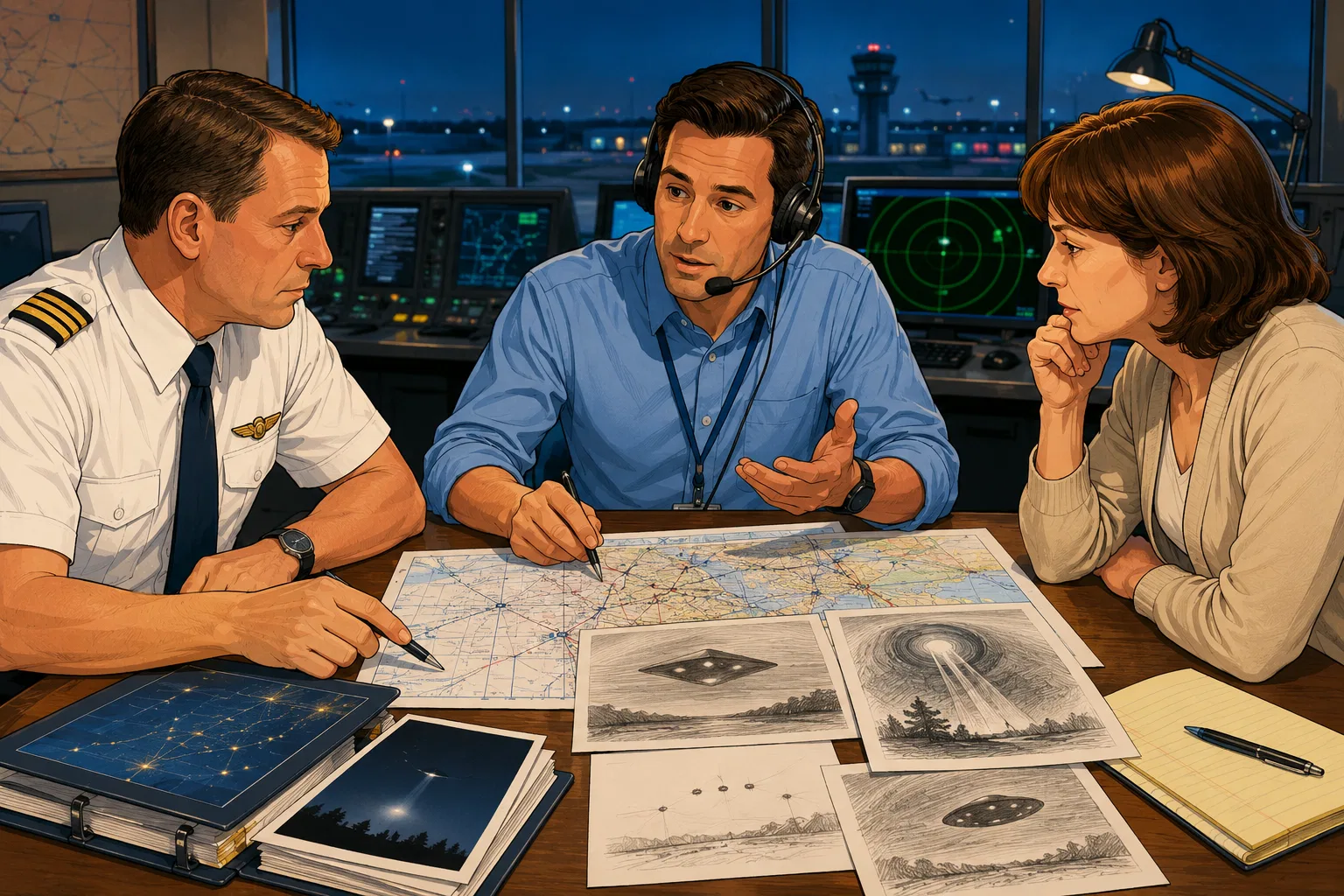
The most useful evidence for Spielberg’s witness research comes from contemporary production accounts. The American Film Institute’s production history records that a 13 November 1977 Los Angeles Times article said Spielberg interviewed “airline pilots, air traffic controllers, and housewives” while avoiding people he called “loonies”. The same AFI account notes that Spielberg relied heavily on J. Allen Hynek, the Northwestern University astronomer and UFO researcher who served as technical adviser on the film.[AFI Catalog]catalog.afi.comCatalog AFI|CatalogAFI CatalogAFI|Catalog…
That combination matters. Spielberg was not simply collecting strange anecdotes. He was listening across several kinds of witness: trained aviation professionals, people working inside reporting systems, and ordinary observers whose experiences were socially vulnerable because they lacked institutional authority. In Close Encounters, this becomes a layered witness world. The film moves from an air traffic control near-miss to Roy Neary’s roadside encounter, Jillian Guiler’s domestic terror, scattered international reports and the scientific-government response at Devils Tower.
In a 1977 Sight and Sound interview, Spielberg described the film as a “compendium of research” rather than a story based on one incident. He said he had read widely, including clippings and wire-service reports, and had tried unsuccessfully to access Project Blue Book archives before they were declassified. More importantly for this subtopic, he said direct contact with people who had reported experiences was what made him interested in making the movie.[BFI]bfi.org.ukBFIA close encounter with Steven Spielberg | Sight and SoundBFIA close encounter with Steven Spielberg | Sight and Sound
That explains why the film’s witness scenes often feel observational before they become spectacular. The air traffic controllers do not announce a cosmic revelation; they talk in professional fragments, asking what has been seen, whether a report should be filed, and how to handle an event that does not fit routine categories. Roy does not become a heroic truth-teller immediately; he becomes confused, burned, compulsive and socially isolated. Spielberg’s testimony-based research gave the film a behavioural realism: the drama lies not only in what appears in the sky, but in how people try to describe it without sounding foolish.
Spielberg filtered belief rather than accepting every claim
Spielberg’s witness research was unusually important because UFO culture depends heavily on testimony, but testimony is uneven evidence. A sighting may be sincere and still be mistaken. A witness may be trained and still lack enough data. A story may be emotionally compelling and still fail as proof. Spielberg seems to have understood that distinction early: he listened to people who claimed experiences, but he also drew a line around unreliable testimony. AFI’s account of his interviews explicitly says he avoided people he considered “loonies”, a blunt phrase that signals a selective process rather than indiscriminate belief.[AFI Catalog]catalog.afi.comCatalog AFI|CatalogAFI CatalogAFI|Catalog…
His Sight and Sound comments show the same filter in more nuanced terms. Spielberg said many night sightings were easy to explain because people rarely looked at the sky and were only “discovering” it. At the same time, he argued that some reports resisted conventional description. This is the central balance of Close Encounters: scepticism is present, but it does not erase wonder; belief is present, but it is not treated as a licence to accept every story.[BFI]bfi.org.ukBFIA close encounter with Steven Spielberg | Sight and SoundBFIA close encounter with Steven Spielberg | Sight and Sound
Hynek’s role sharpened that balance. AFI notes that Columbia bought rights connected to Hynek’s The UFO Experience and hired him as technical adviser after the film’s title drew from his classification system. Hynek’s “close encounter” language gave Spielberg a vocabulary that sounded investigative rather than purely fantastical. It also placed witness accounts into categories, which is exactly what the film does dramatically: lights in the sky, physical traces, encounters, and finally contact.[AFI Catalog]catalog.afi.comCatalog AFI|CatalogAFI CatalogAFI|Catalog…
The broader history of Project Blue Book helps explain why this mattered. The U.S. Air Force and related investigative offices treated UFO reports partly as airspace and Cold War security questions, not simply as alien stories. The Office of Special Investigations notes that Air Force agents documented and investigated UFO sightings from 1948 into the late 1960s, while National Archives material preserves the official record and later government handling of Blue Book-related files.[Office of Strategic Intelligence]osi.af.milProject Blue Book Part 1 (UFO Reports) > Office of Special Investigations > Display… Spielberg borrowed the aura of that world — reports, secrecy, expert review, classified information — but he turned it into an emotional story about the witness’s burden.
The air traffic control scene shows testimony under pressure
The air traffic control sequence is the clearest example of witness testimony shaping the film’s texture. Its power comes from restraint. Pilots and controllers perceive something dangerous and abnormal, but the scene is built around hesitation: what exactly did they see, can it be reported, and what will happen if they do report it?
Aviation-safety commentator Todd Curtis, revisiting the sequence for Flight Safety Detectives, argues that the scene captures real-world reporting pressures faced by pilots and controllers in the 1970s. His analysis stresses that the pilots and controllers in the scene hesitate even after a close call, and that the drama comes from professionals trying to stay composed while confronting something extraordinary.[Flight Safety Detectives]flightsafetydetectives.comFlight Safety DetectivesWhat Did Steven Spielberg Get Right About UFO Encounters in the Cockpit? - Episode 317 - Flight Safety Detectives…
That is precisely where Spielberg’s research pays off. A less grounded UFO film might cut quickly from sighting to panic, military response or alien reveal. Close Encounters lingers on procedure. It lets the audience hear uncertainty in real time. The witnesses are not fools; they are competent people trying to preserve professional language when their experience has outrun their categories.
Modern UAP reporting debates make this scene feel less dated than it might otherwise seem. NASA’s UAP study page defines UAP as observations that cannot be identified as aircraft or known natural phenomena and frames the question around better data collection and scientific analysis. AARO, the U.S. government’s All-domain Anomaly Resolution Office, has likewise emphasised improved reporting, reduced stigma and scientific triage, while also stating that it has found no verifiable evidence of extraterrestrial beings, activity or technology.[NASA Science]science.nasa.govScience UAPNASA ScienceUAP - NASA Science… That modern context reinforces what Spielberg intuited dramatically: witness testimony is valuable as a starting point, but it becomes most useful when systems can capture it without ridicule and test it against better data.
Ordinary witnesses made the film emotionally persuasive
The film’s ordinary witnesses are just as important as its aviation professionals. Roy Neary is not a pilot, soldier or scientist. Jillian Guiler is not a government insider. Their credibility comes from the ordinariness of their lives, which makes the sighting disruptive rather than glamorous. Spielberg’s interest in “housewives” and everyday observers matters because it shifts UFO testimony from a specialist subculture into domestic life.[AFI Catalog]catalog.afi.comCatalog AFI|CatalogAFI CatalogAFI|Catalog…
That choice gives Close Encounters its emotional seriousness. Roy’s testimony is not presented as a neat statement of facts. It is a psychological event that he cannot integrate into ordinary family language. His sunburn, drawings, compulsive model-making and repeated attempts to describe what he has seen show testimony before it becomes coherent. He does not simply report a UFO; he tries to translate an experience that has changed his sense of reality.
Spielberg’s 1977 interview makes clear that he was interested in why people look to the skies and want to believe, not only in whether a given report proves anything. He described himself as agnostic between science fact and science fiction, calling the film “science speculation”. That stance allowed him to dramatise testimony without pretending that witness accounts alone settle the UFO question.[BFI]bfi.org.ukBFIA close encounter with Steven Spielberg | Sight and SoundBFIA close encounter with Steven Spielberg | Sight and Sound
This is why the film does not feel like a lecture by believers. It feels like a study of people pushed beyond ordinary explanation. The witnesses are frightened, embarrassed, obsessed, sometimes mistaken, but not disposable. Their accounts are treated as human evidence: incomplete, emotionally charged, sometimes unreliable, but still worthy of attention.
Testimony shaped texture, not documentary proof
The crucial distinction is that Spielberg used testimony to make fiction feel grounded, not to make a legal or scientific case for extraterrestrial visitation. Close Encounters borrows research habits from UFO investigation — interviewing witnesses, consulting Hynek, invoking Blue Book, staging officials and instruments — but it remains a cinematic work. Its final act resolves ambiguity through awe, music and visual revelation, which real-world UFO investigation almost never provides.
That difference matters because the film’s testimony-based realism can be easy to misread. The presence of pilots, controllers and Hynek-style classification does not mean the film is a documentary argument. It means Spielberg wanted the audience to recognise the social world of UFO reporting: official secrecy, witness embarrassment, partial data, expert scepticism and the stubborn feeling that some experiences remain unresolved.
Ray Morton, author of a making-of book on the film, has argued that Close Encounters was revolutionary partly because it presented first contact as potentially peaceful and uplifting rather than as invasion or horror.[Cinema Retro]cinemaretro.comCinema RetroREMEMBERING "CLOSE ENCOUNTERS": AN INTERVIEW WITH "MAKING OF" AUTHOR RAY MORTON - Cinema Retro… Witness testimony helped make that tonal shift possible. The film begins not with conquest, but with people trying to tell others what they have seen. By taking those people seriously without making every claim equally credible, Spielberg found a middle path between debunking and credulity.
That is the lasting value of the witness research behind Close Encounters. It gave the film its pauses, its stammers, its procedural chatter, its suburban anxiety and its sense that wonder often begins as a difficult report. Spielberg listened to witnesses because the UFO phenomenon, as culture and as drama, is not only about objects in the sky. It is about the fragile moment when someone says, “I saw something,” and waits to learn whether anyone will believe them.

Amazon book picks
Further Reading
Books and field guides related to Why Spielberg Listened to UFO Witnesses. Use these as the next step if you want deeper reading beyond the article.
UFO
"The full story of our national obsession with UFOs--and the covert, decades-long search by scientists, the United States military, and t...
Close Encounters of the Third Kind
Covers the film's production context and its grounding in UFO witness culture.
The Close Encounters Man
Explores Hynek, witness accounts and the cultural handling of UFO testimony.
The UFO Experience
Directly concerns how witness reports can be sorted, assessed and described.
eBay marketplace picks
Marketplace Samples
Example marketplace items related to this page. Use the search link to explore similar finds on eBay.

Endnotes
1.
Source: catalog.afi.com
Title: Catalog AFI|Catalog
Link:https://catalog.afi.com/Film/67160-CLOSE-ENCOUNTERS-OF-THE-THIRD-KIND
Source snippet
AFI CatalogAFI|Catalog...
2.
Source: osi.af.mil
Title: Office of Strategic Intelligence
Link:https://www.osi.af.mil/News/Features/Display/Article/2302429/project-blue-book-part-1-ufo-reports/
Source snippet
Project Blue Book Part 1 (UFO Reports) > Office of Special Investigations > Display...
3.
Source: archives.gov
Title: National Archives Project BLUE BOOK
Link:https://www.archives.gov/research/military/air-force/ufos
Source snippet
National ArchivesProject BLUE BOOK - Unidentified Flying Objects | National Archives...
4.
Source: science.nasa.gov
Title: Science UAP
Link:https://science.nasa.gov/uap/
Source snippet
NASA ScienceUAP - NASA Science...
5.
Source: war.gov
Title: U.S. Department of War
Link:https://www.war.gov/News/Transcripts/Transcript/Article/3965734/dr-jon-kosloski-director-aaro-media-roundtable-on-the-fy24-consolidated-annual/
Source snippet
Dr. Jon Kosloski, Director, AARO, Media Roundtable on the FY24 Consolidated Annual Report on UAP > U.S. Department of War > Transcript |...
6.
Source: science.nasa.gov
Title: uap independent study team final report
Link:https://science.nasa.gov/wp-content/uploads/2023/09/uap-independent-study-team-final-report.pdf
7.
Source: war.gov
Link:https://www.war.gov/medialink/ufo/061226/release_03/documents/CIA-UAP-015-Project_Blue_Book_Special_Report_No_14.pdf
8.
Source: aaro.mil
Title: AARO Historical Record Report Vol 1 2024
Link:https://www.aaro.mil/Portals/136/PDFs/AARO_Historical_Record_Report_Vol_1_2024.pdf
9.
Source: aaro.mil
Title: Congressional Press Products
Link:https://www.aaro.mil/Congressional-Press-Products/
10.
Source: aaro.mil
Link:https://www.aaro.mil/UAP-Cases/Official-UAP-Imagery/
11.
Source: flightsafetydetectives.com
Link:https://flightsafetydetectives.com/what-did-steven-spielberg-get-right-about-ufo-encounters-in-the-cockpit-episode-317/
Source snippet
Flight Safety DetectivesWhat Did Steven Spielberg Get Right About UFO Encounters in the Cockpit? - Episode 317 - Flight Safety Detectives...
12.
Source: cinemaretro.com
Link:https://cinemaretro.com/index.php?%2Farchives%2F10383-REMEMBERING-CLOSE-ENCOUNTERS-AN-INTERVIEW-WITH-MAKING-OF-AUTHOR-RAY-MORTON.html=
Source snippet
Cinema RetroREMEMBERING "CLOSE ENCOUNTERS": AN INTERVIEW WITH "MAKING OF" AUTHOR RAY MORTON - Cinema Retro...
13.
Source: Wikipedia
Title: J. Allen Hynek
Link:https://en.wikipedia.org/wiki/J._Allen_Hynek
14.
Source: Wikipedia
Title: Close Encounters of the Third Kind
Link:https://en.wikipedia.org/wiki/Close_Encounters_of_the_Third_Kind
15.
Source: Wikipedia
Title: Project Blue Book
Link:https://en.wikipedia.org/wiki/Project_Blue_Book
16.
Source: Wikipedia
Title: Close encounter
Link:https://en.wikipedia.org/wiki/Close_encounter
17.
Source: jhwikicollection-20.fandom.com
Title: Close Encounters of the Third Kind
Link:https://jhwikicollection-20.fandom.com/wiki/Close_Encounters_of_the_Third_Kind
18.
Source: the-jh-movie-collection-official.fandom.com
Title: Close Encounters of the Third Kind
Link:https://the-jh-movie-collection-official.fandom.com/wiki/Close_Encounters_of_the_Third_Kind
19.
Source: britannica.com
Title: Project Blue Book
Link:https://www.britannica.com/topic/Project-Blue-Book
Additional References
20.
Source: youtube.com
Title: This Man Sparked Spielberg’s Interest in UFOs
Link:https://www.youtube.com/watch?v=lIGQii6wA04
Source snippet
Steven Spielberg talks "[Disclosure Day]({{ 'disclosure-day/' | relative_url }})" and says aliens "have been here and they are here"...
21.
Source: cia.gov
Link:https://www.cia.gov/readingroom/document/cia-rdp81r00560r000100010001-0
22.
Source: youtube.com
Link:https://www.youtube.com/watch?v=z6rSwFk-Mk4
Source snippet
This Man Sparked Spielberg's Interest in UFOs...
23.
Source: facebook.com
Link:https://www.facebook.com/groups/12117541695/posts/10161972934591696/
24.
Source: aiaa.org
Link:https://aiaa.org/wp-content/uploads/2025/08/AIAA-UAPIOC-Opinion-Paper-UAP-Occupational-Safety-Reporting_ForPublication_kb.pdf
25.
Source: sfcrowsnest.info
Link:https://sfcrowsnest.info/steven-spielberg-close-encounters-ufo-documentary-explained/
26.
Source: ebsco.com
Link:https://www.ebsco.com/research-starters/film/close-encounters-third-kind-film
27.
Source: amazon.com
Link:https://www.amazon.com/-/zh_TW/Ray-Morton/dp/B013IL7E6A
28.
Source: archive.org
Link:https://archive.org/stream/TheHynekUFOReport/The_Hynek_UFO_Report_djvu.txt
29.
Source: amazon.sa
Link:https://www.amazon.sa/-/en/Close-Encounters-Man-World-Believe/dp/0062484176
Topic Tree