Within Sound Light
Mothership Sound Des 42 A8 F2
One reason the alien mothership in Close Encounters of the Third Kind feels convincing is that it does not sound like a machine in the ordinary sense. Its voice is immense, mechanical and industrial, yet it also seems to breathe, shift and respond.
Page outline Jump by section
Introduction
One reason the alien mothership in Close Encounters of the Third Kind feels convincing is that it does not sound like a machine in the ordinary sense. Its voice is immense, mechanical and industrial, yet it also seems to breathe, shift and respond. Sound editor Frank Warner achieved this effect by building the mothership’s audio identity from heavily altered real-world noises and then stripping away the clues that would reveal their origins. The result was a sonic presence that felt less like a vehicle and more like a gigantic living organism made of machinery. That balance between mass, intelligence and gentleness became one of the defining achievements of Spielberg’s vision of alien contact. Warner’s work was so central to the film that he received a Special Achievement Academy Award for sound effects editing. [-]
Why the Mothership Needed a Nonhuman Voice
The final encounter in Close Encounters depends on a delicate emotional shift. The audience must see a colossal UFO descend from the sky, yet not experience it as a straightforward invasion. A conventional science-fiction approach might have relied on aggressive engine noises, explosions or military-style power. Spielberg’s encounter required something stranger.
The mothership had to communicate several contradictory ideas at once:
- It was unimaginably large.
- It was technologically advanced.
- It possessed intelligence and purpose.
- It was not inherently hostile.
Warner therefore avoided creating a single recognisable machine sound. Instead, he assembled layers of transformed noises that suggested movement, weight and internal activity without identifying a familiar source. The ship sounds as though thousands of systems are operating simultaneously, but none can be clearly named. That ambiguity encourages the audience to perceive a presence rather than a piece of hardware. [-]
The approach matched Spielberg’s broader treatment of UFOs. Visually, the mothership resembles a glowing city or ecosystem more than a conventional spacecraft. Sound helped complete that impression by making the vessel feel active from within rather than merely propelled from outside.[BFI]bfi.org.ukBFIDouglas Trumbull on creating sci-fi classicsFebruary 10, 2022 — 10 Feb 2022 — But you are the virtual creator of technological wonders – the Stargate of 2001, the Mothership of Clos…
How Altered Everyday Sounds Become Alien Presence
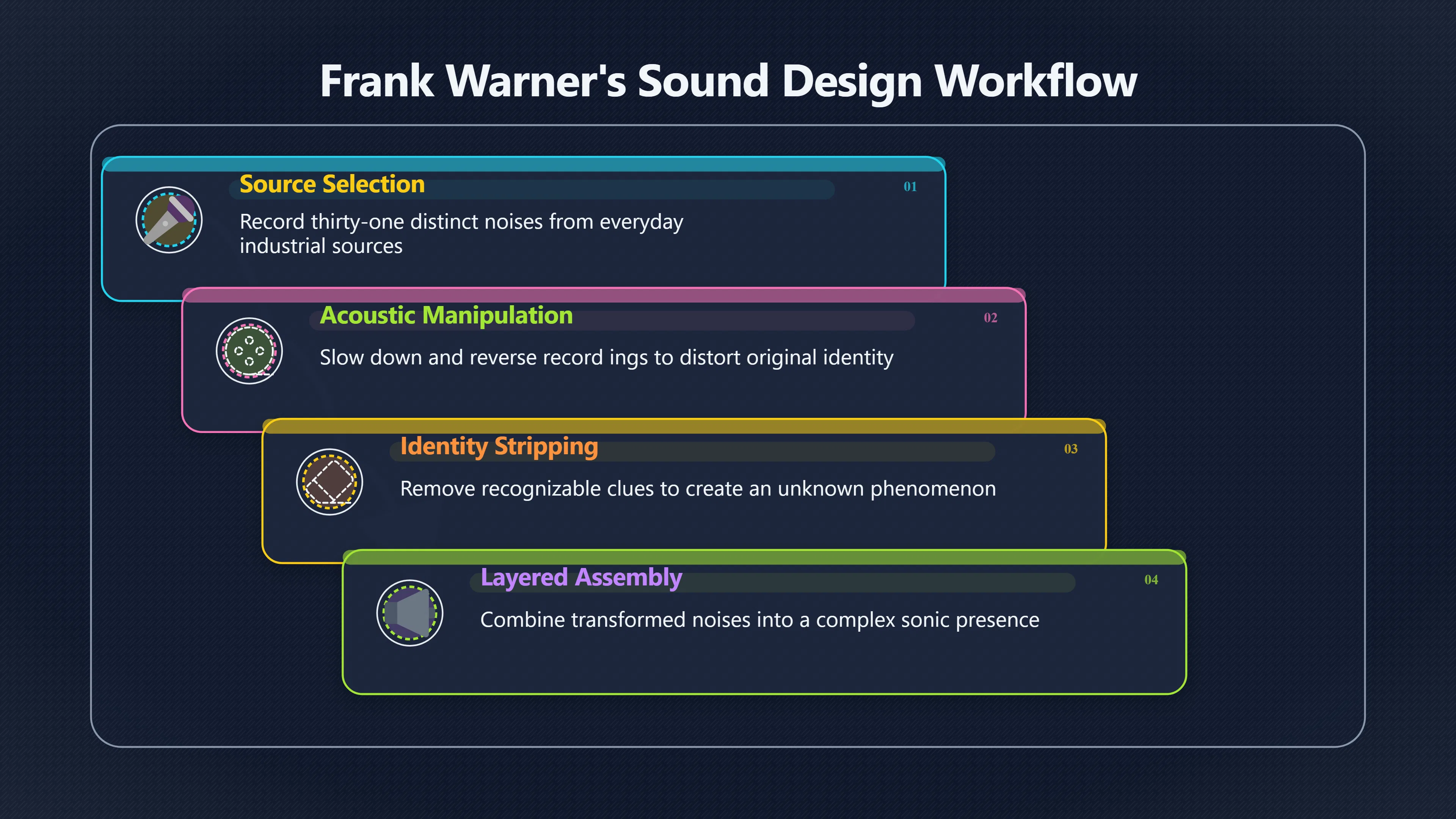
Warner later explained exactly how he built the mothership’s voice. He created thirty-one separate sounds drawn from ordinary sources, including hay balers, trucks, trains, mosquitoes, twisting metal, twisting wood and formations of aircraft. These recordings were then manipulated through slowing, reversing and other treatments designed to remove any obvious connection to their origins. [-]
What makes this method so effective is the combination of familiar physical properties and unfamiliar acoustic behaviour.
Industrial Weight Without Identifiable Engines
Hay balers, trains and trucks naturally produce deep mechanical rhythms. When slowed down and transformed, they retain a sense of mass and momentum. The audience subconsciously recognises the acoustic signature of heavy machinery, even if the exact source cannot be identified. [-]
This gives the mothership extraordinary physical presence. It sounds heavy enough to fill the sky.
Biological Motion Inside the Machine
The inclusion of insects and other small-scale sounds introduces a very different texture. Mosquito recordings, once altered, create buzzing and fluttering elements that feel organic rather than mechanical. These details suggest internal activity, as though the craft possesses circulation, respiration or nervous-system functions. [-]
The listener hears something operating beneath the surface but cannot categorise it.

Removal of Acoustic Identity
Warner described treating the sounds specifically to “remove their source”. This step is crucial. A train that still sounds like a train becomes a special effect. A train transformed beyond recognition becomes an unknown phenomenon. The audience experiences the sound directly rather than translating it back into something familiar. [-]
The mothership therefore occupies an unusual territory between machine and creature. It feels engineered, yet alive.
Why the Sound Feels Like Living Machinery
Many science-fiction films separate machines from organisms. Spaceships sound mechanical; creatures sound biological. Warner deliberately blurred that distinction.
The mothership’s audio design works because different layers imply different forms of behaviour:
- Deep rumbles imply structural weight.
- Metallic groans suggest moving components.
- Swarms of higher frequencies imply internal activity.
- Shifting tonal textures suggest responsiveness rather than automation.
Together these layers create the impression of a vast system constantly adjusting itself. The craft seems to possess metabolism rather than merely propulsion.
This concept aligns closely with the film’s visual design. The mothership is covered with lights, protrusions and moving details that resemble an illuminated industrial complex. Spielberg and the effects team avoided the sleek metallic aesthetic that dominated much science-fiction design. The ship instead resembles a densely populated mechanical ecosystem. Warner’s sound design reinforces that interpretation by giving the structure a sonic equivalent of life.[Wikipedia]WikipediaClose Encounters of the Third KindClose Encounters of the Third Kind
The audience is therefore encouraged to ask not “What engine powers this craft?” but “What kind of being is this?”
Why Harmlessness Matters to the Final Encounter
Perhaps the most remarkable aspect of Warner’s description is his emphasis on harmlessness. He explained that all of the processed sounds were intended to create the image of “a big, heavy, living but harmless mass.” That final phrase reveals the emotional goal behind the entire design. [-]
A gigantic unknown object descending from the sky naturally invites fear. If the sound had been harsher, more militaristic or more overtly threatening, the climax would have shifted toward conflict. Instead, the mothership often sounds curious, resonant and almost playful despite its overwhelming scale.
This emotional quality supports the film’s central idea that contact with the unknown can lead to wonder rather than destruction. The ship’s sounds announce power, but they do not announce aggression. They communicate presence before they communicate intent.
That distinction becomes especially important during the landing sequence. Human observers are confronted with something larger than any machine they have ever seen, yet the soundscape gradually reassures them that the encounter is not an attack. The mothership remains mysterious, but it no longer feels monstrous. [-]
The Lasting Significance of Warner’s Approach
Frank Warner often preferred what he called “dirty sounds” over purely electronic synthesis, believing that real-world recordings carried complex harmonics that were difficult to invent artificially. The mothership demonstrates the strength of that philosophy. Rather than generating an entirely synthetic alien voice, he transformed familiar noises until they occupied a new category between technology and biology. [-]
The achievement is not merely technical. It serves Spielberg’s larger UFO theme that communication begins before language. Long before the famous musical exchange reaches its climax, the mothership is already speaking through its presence. Its sounds tell the audience that this object is vast, intelligent and alive in some unfamiliar way.
By making a machine feel like a benign organism, Warner helped create one of cinema’s most memorable representations of alien contact: a UFO that arrives not as a weapon, but as a living mystery. [-]

Amazon book picks
Further Reading
Books and field guides related to Frank Warner's mothership sound as living machinery. Use these as the next step if you want deeper reading beyond the article.
Passport to Magonia
Over two decades ago, eminent scientist Vallee wrote a provocative book about alleged UFO landings, folklore, and certain unexplained phe...
eBay marketplace picks
Marketplace Samples
Example marketplace items related to this page. Use the search link to explore similar finds on eBay.



Endnotes
1.
Source: Wikipedia
Title: Close Encounters of the Third Kind
Link:https://en.wikipedia.org/wiki/Close_Encounters_of_the_Third_Kind
2.
Source: bfi.org.uk
Title: BFIDouglas Trumbull on creating sci-fi classics
Link:https://www.bfi.org.uk/sight-and-sound/interviews/douglas-trumbull-creating-sci-fi-classics
Source snippet
February 10, 2022 — 10 Feb 2022 — But you are the virtual creator of technological wonders – the Stargate of 2001, the Mothership of Clos...
Published: February 10, 2022
3.
Source: Wikipedia
Title: Frank Warner (sound editor)
Link:https://en.wikipedia.org/wiki/Frank_Warner_%28sound_editor%29
Source snippet
Frank Warner (sound editor)Frank Warner (March 27, 1926 – August 31, 2011) was an American sound editor. He received the Special Achie...
Published: March 27, 1926
4.
Source: youtube.com
Title: The Close Encounters Mothership
Link:https://www.youtube.com/watch?v=YYrwu8KvZA0
Source snippet
Close Encounters of the Third Kind - Five Tones...
5.
Source: youtube.com
Title: Close Encounters of the Third Kind
Link:https://www.youtube.com/watch?v=3Z0JUPXq8vc
Source snippet
5 tones theme...
6.
Source: youtube.com
Title: Close Encounters of the Third Kind
Link:https://www.youtube.com/watch?v=-JpIjv6XSLM
7.
Source: cinemontage.org
Title: Frank Warner
Link:https://cinemontage.org/frank-warner/
Source snippet
November 1, 2011 — Regarding his Academy Award for the sound effects on Close Encounters, he had said, “For the mother ship sound, I made...
Published: November 1, 2011
Additional References
8.
Source: bookerhorror.com
Title: close encounters of the third kind 1977 director steven spielberg
Link:https://bookerhorror.com/close-encounters-of-the-third-kind-1977-director-steven-spielberg/
Source snippet
CLOSE ENCOUNTERS OF THE THIRD KIND (1977...However, of these awards the film won only for the cinematography of Vilmos Zsigmond, though...
9.
Source: movies.fandom.com
Title: Mothership Photography: Dennis Muren; Project Coordinator: Mona Thal
Link:https://movies.fandom.com/wiki/Close_Encounters_of_the_Third_Kind/Credits
Source snippet
Encounters of the Third Kind/Credits - Moviepedia WikiSupervising Sound Effects Editor: Frank Warner; Sound Effects Editorial Staff...
10.
Source: youtube.com
Link:https://www.youtube.com/watch?v=W4v4esKcApE
Source snippet
Close Encounters of the Third Kind (1977) | Communicating with Aliens | Richard Dreyfuss, Teri Garr...
11.
Source: youtube.com
Link:https://www.youtube.com/watch?v=I2bTXPKTc7A
Source snippet
The Close Encounters Mothership...
12.
Source: facebook.com
Link:https://www.facebook.com/groups/12117541695/posts/10160351869806696/
Topic Tree