Within Vulnerable Alien
Et Farewell Ethics 1 Efd 93
The ending of E.T. the Extra-Terrestrial is not simply a tearful goodbye between a boy and an alien. It is the film’s final moral argument. After spending the story protecting E.T., Elliott and the other children face a harder challenge: proving that care does not mean possession.
Page outline Jump by section
Why E.T. Has to Go Home
For most of the film, success appears to mean keeping E.T. safe. Elliott hides him from adults, feeds him, teaches him about human life and risks punishment to protect him. Yet the ending reveals that rescue and possession are not the same thing.
 E.T. is not a pet, a trophy or a permanent solution to Elliott’s loneliness. He is a stranded visitor whose deepest need is reunion with his own people. The story repeatedly frames “home” as the goal. Elliott’s mission is therefore temporary from the beginning, even if neither he nor the audience wants to accept it. The plot ultimately centres on helping E.T. return rather than integrating him into human society.[Wikipedia]WikipediaE.T. the Extra-TerrestrialE.T. the Extra-Terrestrial
This distinction carries ethical weight. The children demonstrate their humanity not by claiming ownership over the alien but by recognising his independence. Their protection has value precisely because it does not become control. In governance terms, the film suggests that vulnerable outsiders deserve guardianship without domination. The moral obligation is stewardship, not possession.
The emotional power of the farewell comes from the fact that the characters have every personal reason to keep E.T. with them. Elliott gains companionship, purpose and affection through the friendship. Letting E.T. leave therefore requires sacrificing his own immediate happiness for E.T.’s well-being. The ending turns empathy into action.

Why Rescue Is Different From Possession
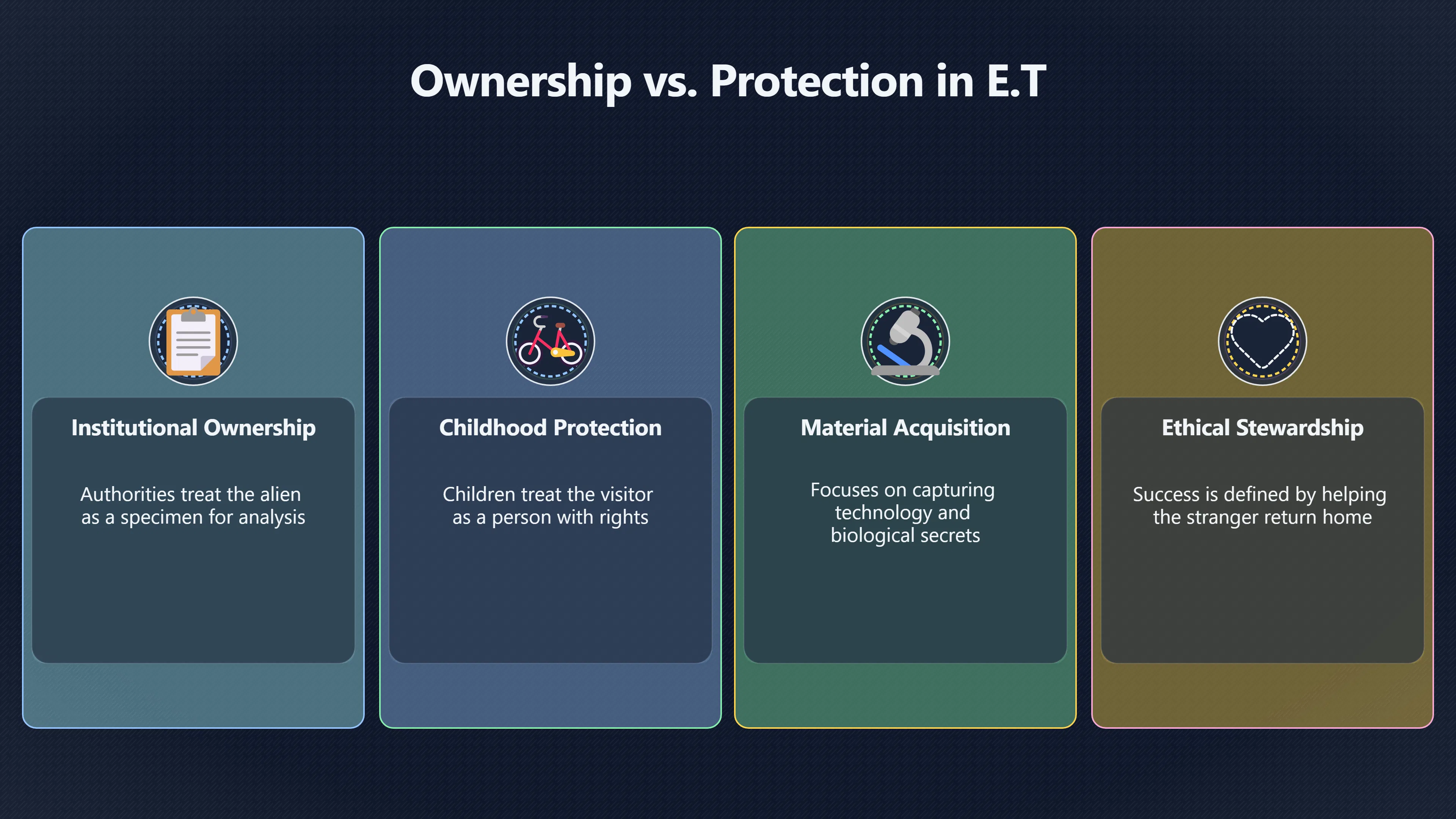
Many alien-contact stories focus on acquisition: capturing extraterrestrial technology, studying alien biology or claiming knowledge as a form of power. E.T. moves in the opposite direction.
Government authorities enter the story with the language of examination, containment and management. Even when some adults are sympathetic, the institutional response treats the alien as something to be secured and analysed. The children, by contrast, treat E.T. as a person with desires and rights of his own. Their final objective is not access to alien secrets but the restoration of alien freedom.[Wikipedia]WikipediaE.T. the Extra-TerrestrialE.T. the Extra-Terrestrial
The farewell scene therefore resolves a conflict between two ways of encountering the unknown:
- Ownership: the unknown becomes valuable because humans can use, study or keep it.
- Protection: the unknown remains valuable even when it cannot be possessed.
The film clearly favours the second model. E.T. leaves Earth carrying no grand scientific revelations and offering no technological reward. The achievement is ethical rather than material. Humanity succeeds because a group of children helps a vulnerable stranger get home.
This idea helps explain why the ending remains unusually moving. The audience is asked to celebrate a departure rather than a victory in the conventional sense. Success looks like loss because the characters choose another being’s needs over their own.
How Farewell Completes Elliott’s Emotional Growth
Elliott begins the story as a lonely child struggling with absence. Spielberg has often connected the film to feelings surrounding his parents’ divorce and to childhood experiences of isolation, themes that shape Elliott’s emotional world.[Wikipedia]WikipediaE.T. the Extra-TerrestrialE.T. the Extra-Terrestrial
Meeting E.T. initially fills a gap. The alien becomes friend, confidant and emotional companion. Their psychic connection creates one of cinema’s most intimate friendships, making separation seem almost impossible.
The farewell scene changes the meaning of that bond. Elliott learns that emotional connection is not validated by permanence. The relationship matters even though it ends.
When E.T. tells Elliott that he will remain “right here,” pointing to Elliott’s heart, the film rejects the idea that departure erases attachment. The friendship survives as memory, influence and emotional growth.[Scribd]scribd.comTrabajo sobre E TEmotional Farewell Scene Analysis | PDFThe film explores themes of friendship and connection, culminating in the emotional farewell scene…
This is the moment Elliott becomes more mature. Earlier in the film he needs E.T. because he feels incomplete. By the end, he is capable of loving someone enough to release them. The farewell is therefore not a failure of friendship but its highest expression.
Spielberg reinforced the emotional authenticity of this transformation during production by filming much of the movie in chronological order. As the young actors bonded with the character of E.T., the final goodbye carried genuine feelings of separation, strengthening the scene’s emotional impact.[Wikipedia]WikipediaE.T. the Extra-TerrestrialE.T. the Extra-Terrestrial

What the Ending Says About Spielberg’s UFO Hope
Within Spielberg’s broader UFO storytelling, E.T. occupies a distinctive place. Close Encounters of the Third Kind presents extraterrestrial contact as awe-inspiring and transformative. E.T. narrows the scale from cosmic spectacle to personal responsibility. Together, they express a remarkably optimistic view of human–alien relations.[GamesRadar]gamesradar.comBased on a story by Spielberg and written by David Koepp, "Disclosure Day" coincides with growing public interest in UFOs and UAPs, follo…
The farewell is central to that optimism.
Many UFO narratives assume that encounters between species will be defined by fear, conquest or exploitation. Spielberg imagines another possibility. Humans and aliens can meet, form genuine bonds and still respect each other’s separate destinies.
The ending does not erase difference. E.T. remains fundamentally alien. He does not become human, and humanity does not fully understand him. Yet mutual care becomes possible despite that gap. The film’s hope lies not in assimilation but in coexistence founded on respect.
This is why the final image of departure feels uplifting rather than tragic. The spaceship’s arrival does not represent escape from humanity. It represents the successful completion of a moral responsibility. The children have protected the unknown without claiming ownership of it.
In Spielberg’s vision of UFO contact, that may be the most important test of all. The measure of humanity is not whether it can reach the stars, but whether it can meet something from the stars and allow it the freedom to return home.
Amazon book picks
Further Reading
Books and field guides related to E.T.'s farewell and the ethics of letting go. Use these as the next step if you want deeper reading beyond the article.

E.T., the Extra-Terrestrial
Directly contains the farewell, return-home story and ethics of letting E.T. go.
Close Encounters of the Third Kind
Contrasts E.T.'s private farewell with Close Encounters' public departure into the unknown.

Steven Spielberg
Links E.T.'s farewell to Spielberg's recurring themes of loss, family and maturity.

The Giving Tree
Commercially strong emotional-adjacent pick for readers interested in care, sacrifice and release.
eBay marketplace picks
Marketplace Samples
Example marketplace items related to this page. Use the search link to explore similar finds on eBay.




Endnotes
1.
Source: Wikipedia
Title: E.T. the Extra-Terrestrial
Link:https://en.wikipedia.org/wiki/E.T._the_Extra-Terrestrial
2.
Source: scribd.com
Title: Trabajo sobre [E T]({{ ‘e-t/’ | relative_url }})
Link:https://www.scribd.com/document/822662366/Trabajo-sobre-E-T
Source snippet
Emotional Farewell Scene Analysis | PDFThe film explores themes of friendship and connection, culminating in the emotional farewell scene...
3.
Source: gamesradar.com
Link:https://www.gamesradar.com/entertainment/sci-fi-movies/[disclosure-day
Source snippet
Based on a story by Spielberg and written by David Koepp, "Disclosure Day" coincides with growing public interest in UFOs and UAPs, follo...
Additional References
4.
Source: facebook.com
Link:https://www.facebook.com/groups/577478936403574/posts/2243078389843612/
Source snippet
E.T. fans celebrate 44th anniversary of the iconic filmSpielberg captures childhood through Elliott's eyes: the fear, magic, confusion, a...
5.
Source: ew.com
Link:https://ew.com/movies/e-t-extra-terrestrial-harrison-ford-help/
Source snippet
Spielberg shot the film in continuity to help the child actors perform more naturally. This approach, along with Matheson's insightful wr...
6.
Source: reddit.com
Link:https://www.reddit.com/r/movies/comments/18k6a76/did_we_hallucinate_ets_ending/
7.
Source: facebook.com
Link:https://www.facebook.com/groups/577478936403574/posts/1868760750608713/
8.
Source: instagram.com
Link:https://www.instagram.com/reel/DVfZ49hDFqC/?hl=en
Source snippet
WAIT… This might be the E.T. sequel we never knew we...No sequel. Just a boy. A bicycle. And an alien who needed to go home. Steven Spie...
9.
Source: reddit.com
Link:https://www.reddit.com/r/UFOs/comments/1pp2624/remember_spielberg_was_sent_a_20_page_letter_from/
Source snippet
fos and aliens.... [SPOILERS] First look at alien and UFO...Read more...
10.
Source: instagram.com
Link:https://www.instagram.com/reel/DY45Dz-xZRj/
Source snippet
epeatedly throughout his career. Semi weak at the knees, the...
11.
Source: facebook.com
Link:https://www.facebook.com/comicsbeerscifi/posts/with-disclosureday-spielberg-has-another-scifi-classic-centered-around-alien-enc/1626459639483280/
Source snippet
n encounters! No other filmmaker has done it better or more...
12.
Source: instagram.com
Title: The goodbye scene at the end of E.T
Link:https://www.instagram.com/p/DYA2spkoBnK/?hl=en
Source snippet
hits so hard because...He shot E.T. in chronological order, top to bottom, so that by the time Elliott said goodbye to his alien friend...
13.
Source: facebook.com
Link:https://www.facebook.com/empiremagazine/videos/the-kids-really-felt-like-they-were-saying-goodbye-to-et-forever-as-he-revisits-/2022398071824201/
Source snippet
he revisits his favourite sci-fi shots and sequences...
Topic Tree