Within Cold War
Fifties UFO Failed C Ef 04 B3
One of the defining features of 1950s UFO cinema was not invasion itself but the repeated failure of communication. Again and again, films presented extraterrestrial contact as an event that humans could neither interpret nor manage.
Page outline Jump by section
Warnings in the Sky Before Dialogue
The UFO films of the 1950s rarely began with conversation. They began with signs.
 Flying saucers, radar anomalies, unexplained electromagnetic disturbances and mysterious visitors appeared long before anyone understood their purpose. The gap between observation and interpretation created the central tension. Audiences watched scientists, military officers and civilians struggle to answer a basic question: what do these visitors want?
This pattern was reinforced by the real-world context of the flying-saucer era. Reports of UFO sightings proliferated in newspapers after 1947, and the film industry rapidly incorporated these anxieties into science-fiction narratives. As film historian J. P. Telotte notes in his survey of 1950s science-fiction cinema, the decade witnessed a major cycle of alien-invasion and flying-saucer films closely linked to contemporary fascination with unidentified aerial phenomena.[cambridge]resolve.cambridge.orgUniversity Press & Assessment2SCIENCE FICTION FILMS IN THE 1950sThe film industry embraced the 'flying saucer' and, in parallel to the contin- ued reports of UFO sight… University Press & Assessment
The communication problem is especially visible in The Day the Earth Stood Still (1951). Klaatu arrives with a message intended for humanity, but the message cannot be delivered because human institutions are incapable of receiving it. He emerges from his spacecraft declaring peaceful intentions, only to be shot almost immediately by a nervous soldier. The event establishes the film’s central irony: the visitor comes to communicate, yet the first response is violence.[Wikipedia]WikipediaThe Day the Earth Stood StillThe Day the Earth Stood Still
Scholars have repeatedly identified communication as the film’s central concern. A Massachusetts Institute of Technology teaching resource on the film notes that it is unusually preoccupied with “the problems which block effective communication between those who come from different perspectives.” Rather than depicting aliens as invaders, the film examines the social and institutional obstacles that prevent understanding.[Massachusetts Institute of Technology]mit.eduday the earth stood stillMassachusetts Institute of TechnologyTHE DAY THE EARTH STOOD STILL3) Of all the 1950s science fiction films, DAY THE EARTH STOOD STILL se…
Klaatu’s mission repeatedly encounters barriers. Governments refuse to cooperate. Political leaders cannot meet collectively. Military authorities prioritise control over dialogue. By the time communication becomes possible, the film has already demonstrated how difficult meaningful contact is under Cold War conditions. A scholarly analysis from the University of Nebraska Omaha similarly argues that Klaatu’s efforts fail because governments are unwilling to communicate with one another amid prevailing political tensions.[digitalcommons.unomaha.edu]digitalcommons.unomaha.eduThe Day the Earth Stood Still”: 1950's Sci-Fi, Religion and…by M Etherden · 2016 · Cited by 22 — This proves futile as the various gov…
The result is a recurring 1950s theme: the warning arrives before the language needed to understand it.
Militarised Interpretation and the Assumption of Hostility
If UFO films repeatedly failed at communication, one reason was that contact was almost always interpreted through military frameworks.
The unidentified object in the sky was not primarily treated as a diplomatic challenge. It was treated as a security problem.
Cold War politics encouraged this interpretation. American audiences lived in a world shaped by nuclear deterrence, strategic surprise and fears of Soviet attack. In that environment, uncertainty itself became threatening. When a spacecraft appeared on radar screens, authorities assumed hostile intent because the consequences of being wrong seemed catastrophic.[Encyclopedia.com]encyclopedia.comscience fiction films and cold war anxietyAlien Invasion and Infiltration. Invasion films were common27 in the 1950s featuring a variety of aliens portrayed as superior to earthli…
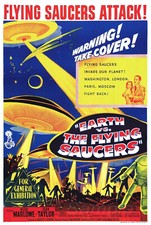
Earth vs. the Flying Saucers (1956) demonstrates this pattern clearly. Although communication between humans and extraterrestrials occurs, it does not produce mutual understanding. Instead, exchanges function largely as warnings and ultimatums that accelerate military confrontation. Dialogue becomes another stage in the march toward conflict. The possibility of negotiation narrows rapidly as each side interprets the other through assumptions of aggression.[Encyclopedia.com]encyclopedia.comscience fiction films and cold war anxietyAlien Invasion and Infiltration. Invasion films were common27 in the 1950s featuring a variety of aliens portrayed as superior to earthli…
The same dynamic appears in The War of the Worlds (1953). Human beings observe the Martian arrival, gather evidence and attempt explanation, but no meaningful communication occurs. The encounter quickly becomes a struggle between military forces and an incomprehensible enemy. Scientific investigation serves primarily tactical purposes rather than diplomatic ones. Contact is reduced to survival.[BFI]bfi.org.uk10 great american sci fi films 1950sBFI10 great American sci-fi films of the 1950s30 Oct 2014 — In the 1950s, Cold War paranoia and the fear of imminent destruction gave ris…
What matters is not simply that communication fails. It is that institutions repeatedly choose military interpretation before alternative interpretations can emerge. UFO cinema of the period assumes that unidentified visitors will be analysed through the logic of conflict. This assumption transforms uncertainty into hostility long before anyone understands the facts.
Secrecy, Fragmented Knowledge and Institutional Failure
Another recurring obstacle to communication was secrecy.
Many 1950s UFO films depict information moving through military channels, intelligence systems and government bureaucracies. No single group possesses the full picture. Scientists know one part of the story, military officers another, politicians a third. The result is fragmentation rather than understanding.
This narrative structure reflected broader Cold War realities. The era was characterised by classified research programmes, nuclear secrecy and intelligence competition. Public trust in institutions was often accompanied by suspicion regarding what those institutions might be concealing. UFO films translated those tensions into stories where knowledge exists but cannot be shared effectively.[Encyclopedia.com]encyclopedia.comscience fiction films and cold war anxietyAlien Invasion and Infiltration. Invasion films were common27 in the 1950s featuring a variety of aliens portrayed as superior to earthli…
In these films, communication often fails before humans even reach the aliens. Scientists struggle to convince military authorities. Officials withhold information from civilians. Political leaders act without complete knowledge. By the time extraterrestrial intentions become clearer, fear and misunderstanding have already escalated.
The irony is striking. These stories frequently celebrate scientific expertise while simultaneously portraying institutions incapable of using that expertise effectively. Humanity can build rockets, radar systems and atomic weapons, yet cannot coordinate enough information to understand a visitor from another world.
This tension became a hallmark of 1950s science fiction. Technology expands rapidly while social communication remains fragile. The films repeatedly suggest that the greatest obstacle to contact is not extraterrestrial difference but human organisational failure.[cambridge]resolve.cambridge.orgUniversity Press & Assessment2SCIENCE FICTION FILMS IN THE 1950sThe film industry embraced the 'flying saucer' and, in parallel to the contin- ued reports of UFO sight… University Press & Assessment

When Communication Itself Becomes Untrustworthy
Some of the decade’s most influential films pushed the communication problem even further.
In Invasion of the Body Snatchers (1956), the issue is not translation or diplomacy. The issue is trust. People can still speak, but language no longer guarantees understanding because identities themselves become uncertain.
The film’s alien threat operates through replacement rather than invasion. Friends, neighbours and family members look the same but are no longer the same people. Ordinary conversation loses its reliability because appearance and reality have become disconnected. Critics have long connected this premise to Cold War anxieties surrounding conformity, infiltration and hidden enemies.[enculturation.net]enculturation.netInvasion of the Body Snatchers and Invaders from MarsCold War paranoia, while specifically alluding to Invasion of the Body Snatchers:… alien threat in the film must correspond to an exte…
The communication failure here is deeper than in invasion narratives. Invasion stories assume that humans and aliens cannot understand one another. Invasion of the Body Snatchers suggests that humans may no longer understand each other.
This development broadened the emotional meaning of UFO and alien cinema. The threat was not merely an external visitor from space. The threat was the collapse of trust itself. Once communication becomes unreliable, every social relationship becomes vulnerable. The films transformed Cold War fears into communication crises, where uncertainty spreads through everyday interactions.
A similar pattern can be found in Invaders from Mars (1953), where a child witnesses an extraterrestrial threat that adults refuse or are unable to recognise. Here communication fails across generations. The protagonist possesses crucial knowledge but cannot persuade authority figures to believe him. The story turns misunderstanding into a source of paranoia and isolation.[enculturation.net]enculturation.netInvasion of the Body Snatchers and Invaders from MarsCold War paranoia, while specifically alluding to Invasion of the Body Snatchers:… alien threat in the film must correspond to an exte…
The Mechanism Behind the Pattern
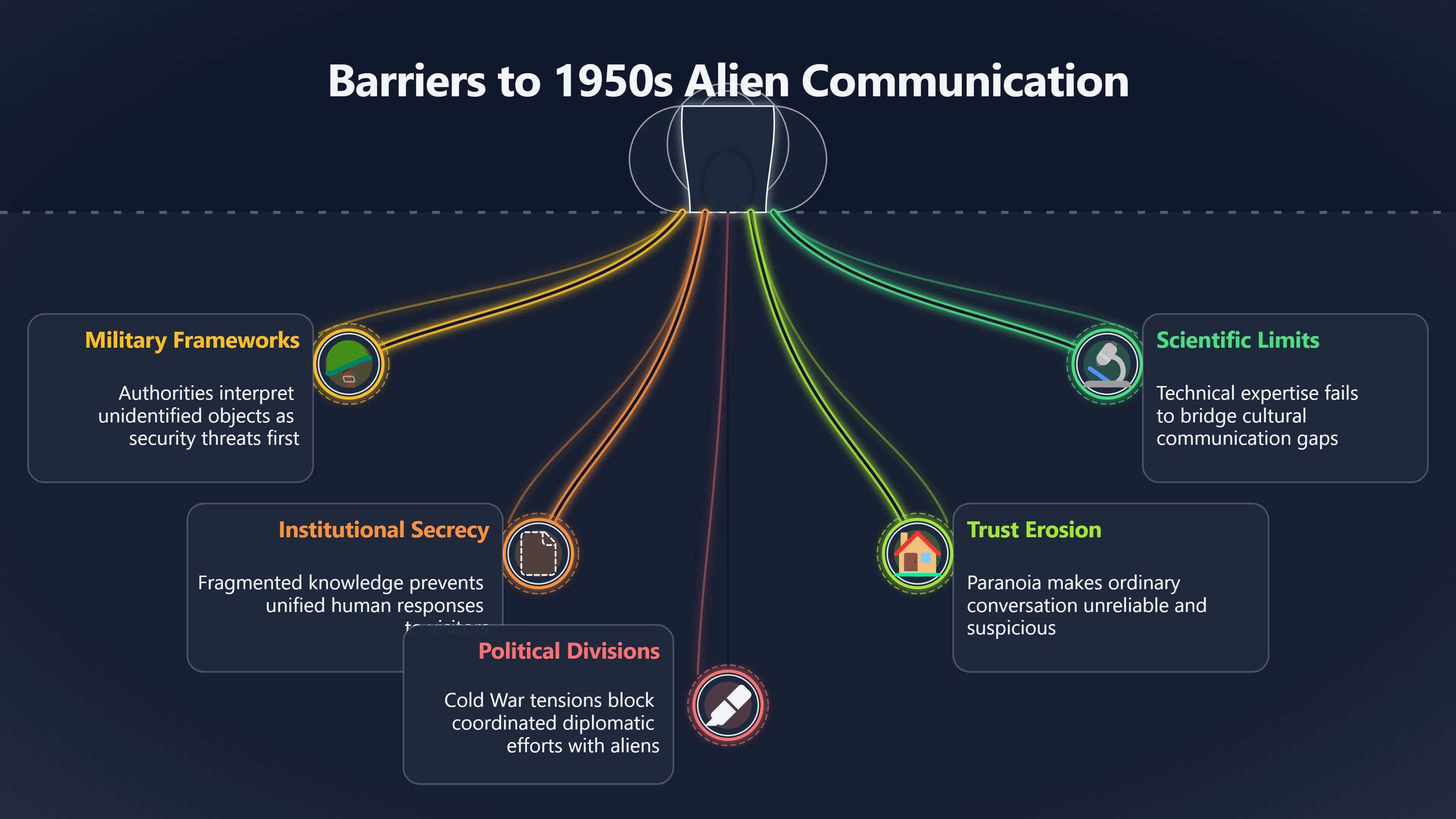
Across the decade, successful communication was consistently blocked by the same mechanisms:
- UFOs appeared without explanatory context.
- Authorities assumed danger before understanding.
- Political divisions prevented coordinated responses.
- Scientific knowledge proved incomplete.
- Secrecy fragmented information.
- Trust eroded under conditions of fear.
- Communication itself became suspect.
These mechanisms explain why so many UFO narratives of the period feel trapped. Contact narrows human options rather than expanding them. Every attempt at understanding seems to arrive too late. The audience watches opportunities for dialogue disappear as institutions fall back on familiar patterns of suspicion and control.[cambridge]resolve.cambridge.orgUniversity Press & Assessment2SCIENCE FICTION FILMS IN THE 1950sThe film industry embraced the 'flying saucer' and, in parallel to the contin- ued reports of UFO sight… University Press & Assessment
The cumulative effect was a genre in which extraterrestrial arrival exposed human weakness rather than alien mystery. The real question was often not whether the visitors could communicate. It was whether humanity could.
How Spielberg Reversed the Pattern
Seen against this history, Close Encounters of the Third Kind represents a remarkable inversion of 1950s UFO conventions.
Spielberg retained many familiar ingredients. Strange lights appear in the sky. Government agencies investigate unexplained phenomena. Ordinary citizens become obsessed with mysterious experiences. Scientific experts attempt to decode signals. On the surface, the film resembles the flying-saucer narratives that preceded it.[HISTORY]history.comUFOs and Alien Invasions in FilmUFOs and Alien Invasions in Film - Meaning, Hollywood, List9 Apr 2010 — The vision of aliens as friendly, even cuddly beings was f…
What changes is the outcome of communication.
In earlier UFO cinema, unexplained signals generally functioned as warnings. They announced invasion, infiltration or catastrophe. In Close Encounters, signals become clues. The recurring musical tones and visual patterns are not threats but components of a shared language. Mystery remains, but it becomes an invitation to interpret rather than a trigger for conflict.
This reversal directly addresses the central communication failure of the 1950s tradition. Spielberg imagines a world in which scientists, civilians and even government officials eventually cooperate in constructing meaning from the unknown. The famous musical exchange at Devils Tower transforms first contact into a communicative achievement. Rather than proving that humans and aliens cannot understand one another, the sequence demonstrates that understanding is possible if curiosity overcomes fear.
The shift was profound because it challenged a decades-old assumption. Earlier UFO films repeatedly portrayed contact as an event that revealed humanity’s inability to communicate across political, cultural or biological boundaries. Spielberg proposed a different possibility: that the unknown might not be an enemy waiting to be identified but a conversation waiting to begin.[HISTORY]history.comUFOs and Alien Invasions in FilmUFOs and Alien Invasions in Film - Meaning, Hollywood, List9 Apr 2010 — The vision of aliens as friendly, even cuddly beings was f…
Amazon book picks
Further Reading
Books and field guides related to 1950s UFO cinema and the failure of communication. Use these as the next step if you want deeper reading beyond the article.
The UFO Experience
Provides a framework for understanding communication and encounter narratives.
Close Encounters of the Third Kind
Represents the communication breakthrough contrasted with 1950s films.
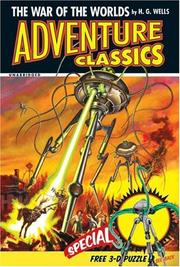
The War of the Worlds
Influential model for misunderstanding and conflict between species.

Passport to Magonia: from folklore to flying saucers
Examines interpretations of unusual encounters.
eBay marketplace picks
Marketplace Samples
Example marketplace items related to this page. Use the search link to explore similar finds on eBay.


Endnotes
1.
Source: resolve.cambridge.org
Title: University Press & Assessment2
Link:https://resolve.cambridge.org/core/services/aop-cambridge-core/content/view/4F77995811535B3CA2ACD5BD78ACDAEB/9780748628704c2_p29-74_CBO.pdf/science-fiction-films-in-the-1950s.pdf
Source snippet
SCIENCE FICTION FILMS IN THE 1950sThe film industry embraced the 'flying saucer' and, in parallel to the contin- ued reports of UFO sight...
2.
Source: Wikipedia
Title: The Day the Earth Stood Still
Link:https://en.wikipedia.org/wiki/The_Day_the_Earth_Stood_Still
3.
Source: digitalcommons.unomaha.edu
Link:https://digitalcommons.unomaha.edu/cgi/viewcontent.cgi?article=1642&context=jrf
Source snippet
The Day the Earth Stood Still”: 1950's Sci-Fi, Religion and...by M Etherden · 2016 · Cited by 22 — This proves futile as the various gov...
4.
Source: encyclopedia.com
Title: science fiction films and cold war anxiety
Link:https://www.encyclopedia.com/arts/culture-magazines/science-fiction-films-and-cold-war-anxiety
Source snippet
Alien Invasion and Infiltration. Invasion films were common27 in the 1950s featuring a variety of aliens portrayed as superior to earthli...
5.
Source: enculturation.net
Title: Invasion of the Body Snatchers and Invaders from Mars
Link:https://enculturation.net/1_1/hardin.html
Source snippet
Cold War paranoia, while specifically alluding to Invasion of the Body Snatchers:... alien threat in the film must correspond to an exte...
6.
Source: history.com
Title: UFOs and Alien Invasions in Film
Link:https://www.history.com/articles/ufos-and-alien-invasions-in-film
Source snippet
UFOs and Alien Invasions in Film - Meaning, Hollywood, List9 Apr 2010 — The vision of aliens as friendly, even cuddly beings was f...
7.
Source: Wikipedia
Link:https://en.wikipedia.org/wiki/1950s
Source snippet
1950sDuring the 1950s, the world population increased from 2.5 to 3.0 billion, with approximately 1 billion births and 500 million dea...
8.
Source: Wikipedia
Link:https://en.wikipedia.org/wiki/Earth
Source snippet
EarthEarth is the third planet from the Sun and the only astronomical object known to harbor life. This is made possible by Earth bein...
9.
Source: Wikipedia
Title: List of science fiction films of the 1950s
Link:https://en.wikipedia.org/wiki/List_of_science_fiction_films_of_the_1950s
Source snippet
List of science fiction films of the 1950sInvasion was a common theme, as were various threats to humanity. Four films from this decad...
10.
Source: mit.edu
Title: day the earth stood still
Link:https://www.mit.edu/~21l.434/day_the_earth_stood_still.htm
Source snippet
Massachusetts Institute of TechnologyTHE DAY THE EARTH STOOD STILL3) Of all the 1950s science fiction films, DAY THE EARTH STOOD STILL se...
11.
Source: themoviescreenscene.wordpress.com
Link:https://themoviescreenscene.wordpress.com/2019/04/13/the-day-the-earth-stood-still-1951/
Source snippet
Day the Earth Stood Still (1951) - The Movie Screen Scene13 Apr 2019 — We should note that the film has a message against the use of nucl...
12.
Source: science.nasa.gov
Link:https://science.nasa.gov/earth/facts/
Source snippet
About EarthEarth is the third planet from the Sun, and the fifth largest planet. It's the only place we know of inhabited by living things...
Additional References
13.
Source: dokumen.pub
Link:https://dokumen.pub/1950s-science-fiction-films-and-9-11-hostile-aliens-hollywood-and-todays-news-9780875864976-9780875864983-9780875864990.html
Source snippet
1950s science fiction films and 9/11: hostile aliens...The author draws parallels between the Cold War fears of the 1950s and 60s and th...
14.
Source: researchgate.net
Link:https://www.researchgate.net/publication/232958649_Cold_War_Fears_Cold_War_Passions_Conservatives_And_Liberals_Square_Off_in_1950s_Science_Fiction
Source snippet
Conservatives And Liberals Square Off in 1950s Science...This chapter interrogates the alien invasion film and argues that they are able...
15.
Source: esri.com
Link:https://www.esri.com/en-us/arcgis/products/arcgis-earth/overview
Source snippet
3D Earth Map | Earth App for Desktop & Mobile | ArcGIS...ArcGIS Earth is a free application designed for visualizing and exploring geosp...
16.
Source: instagram.com
Link:https://www.instagram.com/earth/?hl=en
17.
Source: trustory.fm
Title: 1950s science fiction atomic age anxiety with robert horton
Link:https://trustory.fm/cinemascope/1950s-science-fiction-atomic-age-anxiety-with-robert-horton/
Source snippet
1950s Science Fiction: Atomic Age Anxiety (with Robert...28 Jan 2026 — Across invasion stories, mutation nightmares, and post-apocalypse...
18.
Source: bookerhorror.com
Title: the day the earth stood still 1951 director robert wise
Link:https://bookerhorror.com/the-day-the-earth-stood-still-1951-director-robert-wise/
Source snippet
THE DAY THE EARTH STOOD STILL (1951, Director...The unspoken implication is that the knowledge of Klaatu's people might be of great bene...
19.
Source: coldwarstudies.com
Title: the scary cold war 1950s science fiction films
Link:https://coldwarstudies.com/2023/09/14/the-scary-cold-war-1950s-science-fiction-films/
Source snippet
The Scary Cold War: 1950s Science Fiction Films14 Sept 2023 — Invasion films were common in the 1950s featuring all sorts of aliens who w...
20.
Source: humanities.org
Link:https://www.humanities.org/spark/movie-critic-robert-horton-discusses-sci-fi-films-the-cold-war-and-today/
Source snippet
Movie Critic Robert Horton Discusses Sci-Fi Films, the Cold...What: Robert Horton's Alien Encounters: Sci-Fi Movies and the Cold War Cul...
21.
Source: basementofthebizarre.com
Title: invisible invaders 1959 sci fi classic
Link:https://basementofthebizarre.com/2024/11/16/invisible-invaders-1959-sci-fi-classic/
Source snippet
Unseen Aliens, Undead Threats, and 1950s Sci-Fi Charm16 Nov 2024 — Explore the 1959 sci-fi film Invisible Invaders, where unseen aliens a...
22.
Source: ahcwyo.org
Title: terror in the theater fifties fears 2
Link:https://ahcwyo.org/2017/11/13/terror-in-the-theater-fifties-fears-2/
Source snippet
Terror in the Theater – Fifties FearsNov 13, 2017 — One of the most well-known science fiction films of the Fifties is Invasion of the Bo...
Topic Tree