Within Spielberg
Why UFO Secrecy Matters in Spielberg Films
Spielberg uses secrecy to make alien contact feel both plausible and emotionally frustrating.
On this page
- Hidden knowledge and public confusion
- Authority figures as protectors and blockers
- Why secrecy raises the emotional stakes
Page outline Jump by section
Introduction
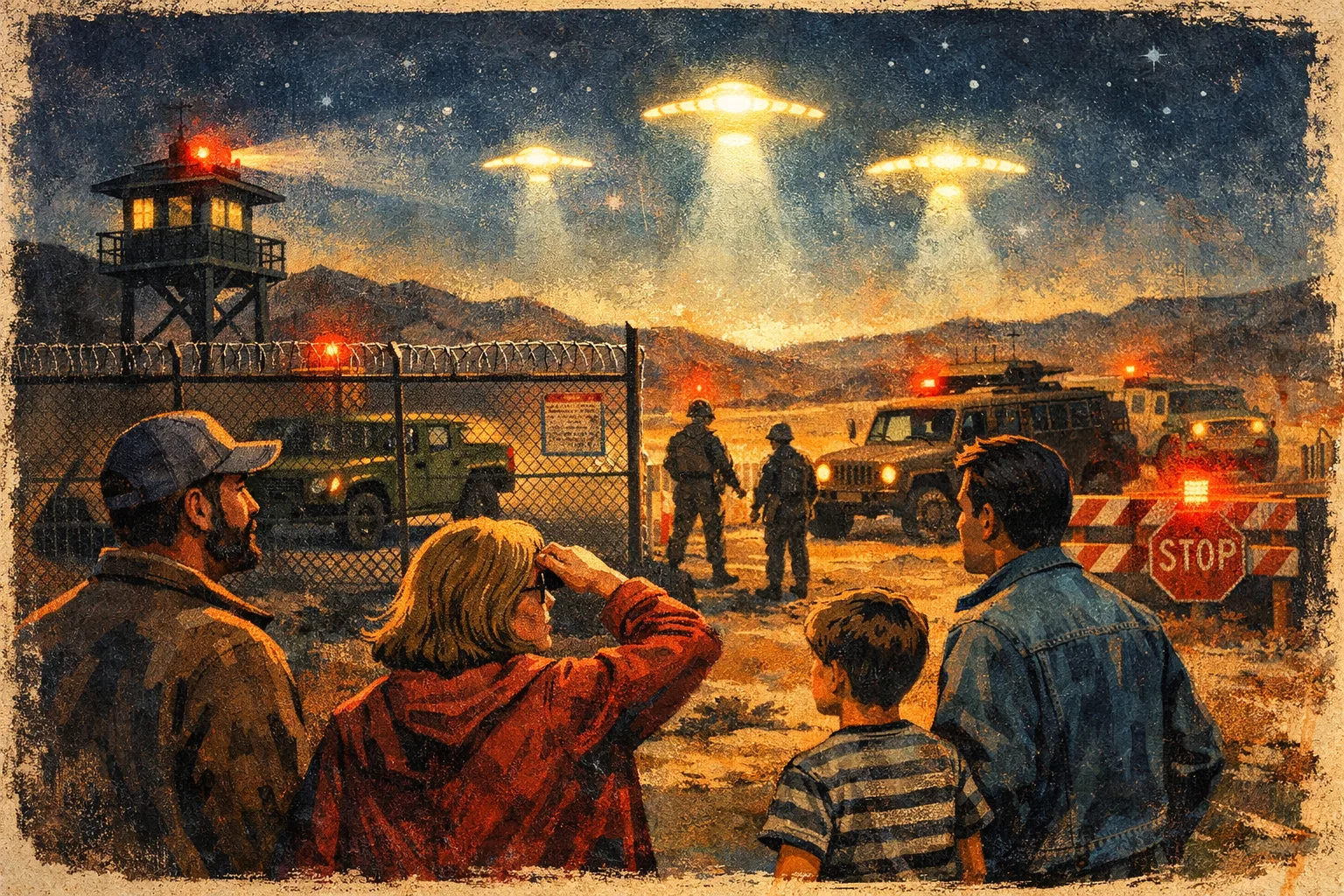
Government secrecy matters in Steven Spielberg’s UFO stories because it turns alien contact into a crisis of trust. In Close Encounters of the Third Kind, secrecy makes the UFO mystery feel institutionally plausible: witnesses see something real, but public explanation is withheld, redirected or staged. In E.T. the Extra-Terrestrial, secrecy becomes more intimate: faceless agents and quarantined scientists invade a family home, forcing children to protect an alien from the state. Across these stories, Spielberg rarely treats government authority as purely evil. It is protective, frightened, curious and controlling at once. That ambiguity is what gives the secrecy mechanism its power. The public is not simply denied information; ordinary people are made to doubt their own experience, while official experts decide who may approach the truth and on what terms.
Hidden knowledge and public confusion
The clearest secrecy machine in Spielberg’s UFO cinema is Close Encounters of the Third Kind. The film was not invented in isolation from UFO culture: its title came from astronomer J. Allen Hynek’s classification system, and Hynek served as a technical adviser on the production. The American Film Institute notes that Columbia bought rights connected to Hynek’s The UFO Experience, while AFI’s production history also records Spielberg’s interest in interviewing pilots, air traffic controllers and ordinary UFO witnesses while filtering out accounts he considered unreliable.[AFI Catalog]catalog.afi.com67160 CLOSE ENCOUNTERS OF THE THIRD KINDJ. Allen Hynek, who created the hierarchy of alien encounters. An item in…
That research background matters because Close Encounters builds secrecy out of recognisable public institutions: air traffic systems, military evacuation orders, scientific teams, official briefings and controlled media narratives. The most famous example is the Devil’s Tower operation. In the film, the authorities clear the area by spreading a false story that a train wreck has released toxic nerve gas, while the real purpose is to prepare a hidden landing site for alien contact. Even basic plot summaries preserve that crucial structure: public danger story on the surface, secret UFO rendezvous underneath.[Wikipedia]WikipediaClose Encounters of the Third KindDevils Tower near Moorcroft, Wyoming. The US Army evacuates the area around Devils Tower, planting false reports in the media that a trai…
This does two things at once. First, it makes the alien contact feel more credible within the story world. A landing by extraterrestrials would not happen in a civic square with a press conference already scheduled; it would be cordoned off, classified, managed and translated through state power. Secondly, it makes ordinary witnesses emotionally isolated. Roy Neary is not merely trying to “believe in UFOs”. He is trying to hold on to the truth of an experience while family, television, military personnel and everyday explanations push him back towards normality.
The result is a very Spielbergian kind of frustration. The audience is shown enough to know that Roy is not delusional, but Roy’s social world is not shown enough to trust him. Secrecy therefore becomes a storytelling engine: it widens the gap between what the viewer knows, what the witness knows and what the public is allowed to know.
Authority figures as protectors and blockers
Spielberg’s UFO secrecy is rarely a simple conspiracy fantasy in which officials are monsters and witnesses are saints. The authorities block, deceive and contain, but they also prepare, study and sometimes protect. That dual role is especially clear in Close Encounters, where the government-scientific team is not trying to destroy the aliens. It is trying to make contact under controlled conditions.
This is why the film’s secrecy feels more complex than a standard cover-up. Lacombe and the other scientists are closer to priests, translators or diplomats than villains. They gather evidence from around the world, decode musical communication and organise a monumental first-contact ritual. Yet their access to knowledge depends on excluding the public. Their competence is inseparable from their paternalism: they know more, so they decide more.
That pattern reflects the real-world UFO atmosphere that surrounded the film. The United States Air Force’s Project Blue Book had investigated UFO reports for decades before being terminated in 1969. The National Archives summarises the Air Force’s conclusions as finding no investigated UFO that indicated a threat to national security, no evidence of technology beyond modern scientific knowledge and no evidence that “unidentified” sightings were extraterrestrial vehicles.[National Archives]archives.govNational Archives Public Interest in UFOs Persists 50 Years After Project BlueNational ArchivesPublic Interest in UFOs Persists 50 Years After Project Blue…December 4, 2019 — 5 Dec 2019 — no UFO reported, investi… Spielberg’s film does not endorse those official conclusions. Instead, it dramatises the public suspicion left behind by such programmes: what if the official explanation is not the whole story?
That is the key governance tension. In real institutional language, UFO investigation is often framed around national security, data quality and public order. In Spielberg’s fiction, the same language becomes emotionally unstable. “Safety” can mean protecting civilians from panic, but it can also mean removing them from the truth. “Expertise” can mean careful preparation, but it can also mean deciding that witnesses are too unreliable, too inconvenient or too ordinary to be trusted with what they have seen.
The witness problem in Close Encounters
Roy Neary’s story shows why secrecy is not just a plot device but a pressure system. His UFO sighting gives him privileged knowledge, yet no recognised status. He is not a scientist, soldier, official witness or chosen public representative. He is an electrical lineman with a sunburn-like mark, an obsession and an image of Devil’s Tower he cannot explain.
That makes him the perfect figure for Spielberg’s secrecy theme. Roy is caught between private revelation and public invalidation. The official world knows enough to stage the Devil’s Tower contact, but it does not make room for him as a legitimate participant. He has to break through roadblocks, false explanations and medicalised containment to reach the site.
The emotional stakes come from that mismatch. The state has evidence, equipment and authority; Roy has experience, compulsion and longing. A less interesting version of the story would simply ask whether aliens exist. Spielberg’s version asks who gets to interpret contact once it happens. The government can build the landing strip, but it cannot own the meaning of the encounter.
Hynek’s presence intensifies that tension. Because he was associated with official UFO investigation and with the “close encounter” taxonomy, his involvement gives the film a bridge to real UFO discourse. Yet Close Encounters ultimately uses that scientific-administrative vocabulary for an emotional purpose: the classification system gets the audience to the threshold, but the final communication is light, music and awe rather than a government report.[AFI Catalog]catalog.afi.com67160 CLOSE ENCOUNTERS OF THE THIRD KINDJ. Allen Hynek, who created the hierarchy of alien encounters. An item in…

In E.T., secrecy enters the home
If Close Encounters is about public secrecy around a national event, E.T. the Extra-Terrestrial turns secrecy into a domestic invasion. The first half of the film belongs to children hiding a stranded alien from adults. The second half reveals that the state has also been watching, searching and closing in.
The government presence in E.T. is designed to feel frightening before it becomes fully personal. Agents are glimpsed through keys, legs, flashlights, equipment and pursuit rather than rounded identity. Plot summaries emphasise that E.T. is left behind when government agents arrive in the forest, that agents covertly search for him, and that the family home is eventually invaded and quarantined.[Wikipedia]WikipediaE.T. the Extra-TerrestrialE.T. the Extra-Terrestrial
The crucial twist is Keys, played by Peter Coyote. He is framed like a threat for much of the film, but he is not finally revealed as a sadist or brute. He tells Elliott that meeting aliens was his childhood dream and that he wants to save E.T. This makes him a classic Spielberg authority figure: a blocker who is also a believer, an agent of containment who still recognises wonder.[Wikipedia]WikipediaJ. Allen HynekJ. Allen Hynek
That ambiguity changes the politics of secrecy. The problem is not that every official lacks empathy. The problem is that institutions convert empathy into procedure. Once E.T. is discovered, the family home becomes a sealed medical site. Love, fear, childhood loyalty and interspecies friendship are forced into the language of quarantine, samples, machines and command. The alien is no longer a guest; he is an object of state-managed knowledge.
Why secrecy raises the emotional stakes
Spielberg uses secrecy to make UFO contact feel both bigger and more painful. Bigger, because secrecy implies that the event is too consequential for ordinary life to absorb. Painful, because the people closest to the encounter are often the least empowered to explain it.
In Close Encounters, secrecy separates Roy from his family and from public credibility. The cover story at Devil’s Tower is not merely a logistical trick; it is the final proof that the world he lives in is being managed by people who know more than they admit. His emotional crisis is therefore inseparable from a governance crisis. He cannot return to normal civic trust because normality itself has become part of the cover.
In E.T., secrecy raises the stakes by turning protection into disobedience. Elliott and his siblings must hide E.T. not because they understand geopolitics, but because they understand vulnerability. The children recognise personhood before the authorities do. Spielberg’s emotional logic is simple but powerful: the state asks, “What is it?”; the child asks, “Is he scared?” That difference drives the whole film.
The same mechanism also explains why Spielberg’s UFO stories rarely need complicated exposition about classified files. Secrecy is felt before it is explained. It appears as roadblocks, false broadcasts, masks, plastic tunnels, locked rooms, medical suits and adults refusing to say plainly what they know. These images make governance visible as atmosphere.
Secrecy, stigma and the real UFO debate
Spielberg’s fiction has endured partly because real UFO discussion has long revolved around the same problems: official knowledge, public trust, witness credibility and the stigma attached to reporting strange aerial events. NASA’s 2023 independent study on unidentified anomalous phenomena, or UAP, explicitly identified stigma as a problem because it can reduce reporting and weaken the quality of available data.[NASA Science]science.nasa.govScience Independent Study Team ReportScience Independent Study Team Report
Recent official UAP work still stops far short of Spielberg’s cosmic optimism. The All-domain Anomaly Resolution Office says the Department of Defense has found no evidence of extraterrestrial technology, and its historical review similarly reports no confirmed evidence of extraterrestrial origin for UFO or UAP cases it examined.[AARO]aaro.milOpen source on aaro.mil. That contrast is useful. Spielberg’s films are not good evidence that alien contact is real; they are powerful stories about why secrecy makes people suspect that evidence is being withheld.
The distinction matters because Spielberg’s secrecy theme works even for sceptical viewers. A viewer does not need to believe in extraterrestrial visitors to understand the drama of being disbelieved, managed or excluded by institutions. The films turn UFO secrecy into a broader emotional question: what happens when public authority controls the boundary between reality and fantasy?
Why Spielberg’s secrecy is not just paranoia
The most distinctive feature of Spielberg’s UFO secrecy is that it preserves wonder. Many alien-cover-up stories become cynical: the hidden truth proves that every institution is corrupt. Spielberg’s approach is more conflicted. His officials lie, frighten and contain, but they also recognise the magnitude of contact. His witnesses suffer, but their longing is not treated as foolish. His aliens are vulnerable, communicative or mysterious rather than merely threatening.
That balance is why government secrecy in Spielberg’s UFO stories feels plausible without becoming only grim. Secrecy gives the films their structure: sightings become mysteries, witnesses become outsiders, experts become gatekeepers and contact becomes a test of who is allowed to know. But secrecy also gives the films their emotional release. When the truth finally breaks through — the mothership descending at Devil’s Tower, E.T.’s ship returning in the forest — the moment feels larger because it has passed through disbelief, concealment and institutional control.
Spielberg’s UFO stories therefore use secrecy as a governance mechanism and an emotional amplifier. The hidden knowledge makes the world feel organised by powers beyond the individual. The public confusion makes the witness’s loneliness believable. The conflicted authority figures keep the story from flattening into anti-government caricature. And the eventual encounter offers the fantasy that truth, once revealed, might not only expose power but heal the people damaged by its silence.
Amazon book picks
Further Reading
Books and field guides related to Why UFO Secrecy Matters in Spielberg Films. Use these as the next step if you want deeper reading beyond the article.
UFO
"The full story of our national obsession with UFOs--and the covert, decades-long search by scientists, the United States military, and t...
Close Encounters of the Third Kind
Examines the secrecy mechanisms and institutional structures used in Spielberg's landmark UFO film.
The UFO Experience
Provides the investigative framework that influenced Spielberg's treatment of UFO evidence and secrecy.
The Close Encounters Man
Shows how scientific inquiry, witnesses and institutional responses shaped UFO culture.
eBay marketplace picks
Marketplace Samples
Example marketplace items related to this page. Use the search link to explore similar finds on eBay.




Endnotes
1.
Source: catalog.afi.com
Title: 67160 CLOSE ENCOUNTERS OF THE THIRD KIND
Link:https://catalog.afi.com/Film/67160-CLOSE-ENCOUNTERS-OF-THE-THIRD-KIND
Source snippet
J. Allen Hynek, who created the hierarchy of alien encounters. An item in...
2.
Source: Wikipedia
Title: Close Encounters of the Third Kind
Link:https://en.wikipedia.org/wiki/Close_Encounters_of_the_Third_Kind
Source snippet
[Devils Tower]({{ 'devils-tower/' | relative_url }}) near Moorcroft, Wyoming. The US Army evacuates the area around Devils Tower, planting false reports in the media that a trai...
3.
Source: archives.gov
Title: National Archives Public Interest in UFOs Persists 50 Years After Project Blue
Link:https://www.archives.gov/news/articles/project-blue-book-50th-anniversary
Source snippet
National ArchivesPublic Interest in UFOs Persists 50 Years After Project Blue...December 4, 2019 — 5 Dec 2019 — no UFO reported, investi...
Published: December 4, 2019
4.
Source: Wikipedia
Title: E.T. the Extra-Terrestrial
Link:https://en.wikipedia.org/wiki/E.T._the_Extra-Terrestrial
5.
Source: science.nasa.gov
Title: Science Independent Study Team Report
Link:https://science.nasa.gov/wp-content/uploads/2023/09/uap-independent-study-team-final-report.pdf
6.
Source: science.nasa.gov
Link:https://science.nasa.gov/uap/
7.
Source: aaro.mil
Link:https://www.aaro.mil/
8.
Source: media.defense.gov
Title: DOPSR 2024 0263 AARO HISTORICAL RECORD REPORT VOLUME 1 2024
Link:https://media.defense.gov/2024/Mar/08/2003409233/-1/-1/0/DOPSR-2024-0263-AARO-HISTORICAL-RECORD-REPORT-VOLUME-1-2024.PDF
9.
Source: archives.gov
Title: Project BLUE BOOK
Link:https://www.archives.gov/research/military/air-force/ufos
10.
Source: archives.gov
Title: nr20 19
Link:https://www.archives.gov/press/press-releases/2020/nr20-19
11.
Source: prologue.blogs.archives.gov
Link:https://prologue.blogs.archives.gov/wp-content/uploads/sites/9/2018/03/report.pdf
12.
Source: archives.gov
Title: presidential libraries
Link:https://www.archives.gov/research/topics/uaps/presidential-libraries
13.
Source: prologue.blogs.archives.gov
Title: ufos natural explanations
Link:https://prologue.blogs.archives.gov/2018/04/16/ufos-natural-explanations/
14.
Source: media.defense.gov
Title: FY24 CONSOLIDATED ANNUAL REPORT ON UAP 508
Link:https://media.defense.gov/2024/Nov/14/2003583603/-1/-1/0/FY24-CONSOLIDATED-ANNUAL-REPORT-ON-UAP-508.PDF
15.
Source: afi.com
Title: [e t]({{ ‘e-t/’ | relative_url }}) the extra terrestrial afi movie club
Link:https://www.afi.com/news/e-t-the-extra-terrestrial-afi-movie-club/
16.
Source: science.nasa.gov
Link:https://science.nasa.gov/uap/faqs/
17.
Source: Wikipedia
Title: J. Allen Hynek
Link:https://en.wikipedia.org/wiki/J._Allen_Hynek
18.
Source: Wikipedia
Title: Project Blue Book
Link:https://en.wikipedia.org/wiki/Project_Blue_Book
19.
Source: aaro.mil
Link:https://www.aaro.mil/UAP-Cases/Official-UAP-Imagery/
20.
Source: aaro.mil
Title: UAP Records
Link:https://www.aaro.mil/UAP-Records/
21.
Source: youtube.com
Title: Unknown Skies: Special Episode | [Disclosure Day]({{ ‘disclosure-day/’ | relative_url }}) Review
Link:https://www.youtube.com/watch?v=fzvcS7XWwt4
Source snippet
Close Encounters Of The Third Kind - Watch the Skies...
22.
Source: youtube.com
Title: Close Encounters Of The Third Kind
Link:https://www.youtube.com/watch?v=LnujThAyxpM
Source snippet
The Real UFO Story Behind Disclosure Day - Spielberg Says Film Is 'More TRUTH Than Fiction'...
23.
Source: jhwikicollection-20.fandom.com
Title: Close Encounters of the Third Kind
Link:https://jhwikicollection-20.fandom.com/wiki/Close_Encounters_of_the_Third_Kind
24.
Source: film-te.fandom.com
Title: Close Encounters of the Third Kind
Link:https://film-te.fandom.com/wiki/Close_Encounters_of_the_Third_Kind
25.
Source: ettheextraterrestrial.fandom.com
Link:https://ettheextraterrestrial.fandom.com/wiki/Keys
26.
Source: kinofenster.de
Title: project blue book
Link:https://www.kinofenster.de/48566/project-blue-book
27.
Source: gayinthecle.com
Title: close encounter
Link:https://gayinthecle.com/2023/12/29/close-encounter/
28.
Source: stevenspielbergchroniken.de
Title: close encounters of the third kind
Link:https://stevenspielbergchroniken.de/tag/close-encounters-of-the-third-kind/
Additional References
29.
Source: tcm.com
Link:https://www.tcm.com/articles/18629/close-encounters-of-the-third-kind-close-encounters-of-the-third-kind
Source snippet
Turner Classic MoviesClose Encounters Of The Third KindAs for the film, it was inspired by The UFO Experience by Dr. J. Allen Hynek who s...
30.
Source: af.mil
Title: unidentified flying objects and air force project blue book
Link:https://www.af.mil/About-Us/Fact-Sheets/Display/Article/104590/unidentified-flying-objects-and-air-force-project-blue-book/
Source snippet
Air ForceUnidentified Flying Objects and Air Force Project Blue BookNo UFO reported, investigated and... There was no evidence indicatin...
31.
Source: themerica.org
Title: close encounters of the themed kind
Link:https://www.themerica.org/blog/2018/01/14/close-encounters-of-the-themed-kind
Source snippet
Close Encounters of the Themed Kind.Jan 14, 2018 — Devils Tower, northeastern... The government has chased everyone away with a...
32.
Source: youtube.com
Title: The Real UFO Story Behind Disclosure Day
Link:https://www.youtube.com/watch?v=21sAuD_2hOU
Source snippet
CLOSE ENCOUNTERS OF THE THIRD KIND (1977 Theatrical Trailer)...
33.
Source: loc.gov
Link:https://www.loc.gov/static/programs/national-film-preservation-board/documents/close_encounters.pdf
34.
Source: nsa.gov
Link:https://www.nsa.gov/portals/75/documents/news-features/declassified-documents/ufo/usaf_fact_sheet_95_03.pdf
35.
Source: loc.gov
Link:https://www.loc.gov/static/programs/national-film-preservation-board/documents/ET.pdf
36.
Source: youtube.com
Link:https://www.youtube.com/watch?v=z6rSwFk-Mk4
Source snippet
Unknown Skies: Special Episode | Disclosure Day Review...
37.
Source: imdb.com
Link:https://www.imdb.com/title/tt0075860/fullcredits/
Source snippet
J. Allen Hynek · J. Allen Hynek. technical advisor (as Dr. J. Allen Hynek). Dan Perri · Dan Perri. title designer. Peter J. Silbermann ·...
38.
Source: cinephiliabeyond.org
Link:https://cinephiliabeyond.org/close-encounters-of-the-third-kind-steven-spielbergs-gamble-that-paid-off-generously/
Topic Tree