Within Roy Neary
Roy Credibility Cris 14 Bd 7 E
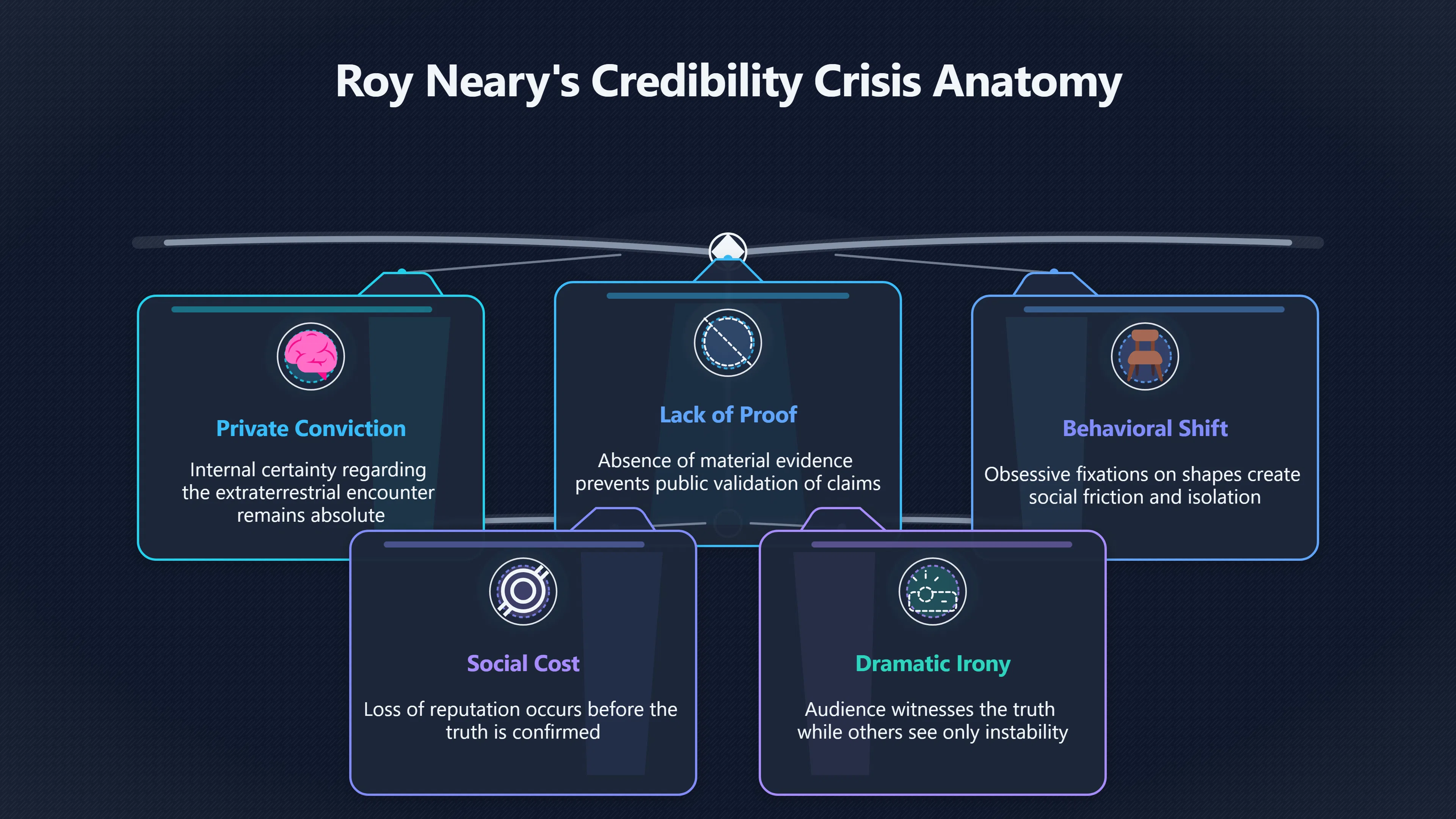
Roy Neary’s credibility crisis is the central human problem of Close Encounters of the Third Kind. After witnessing something extraordinary, Roy becomes less believable precisely because he is telling the truth. Steven Spielberg structures the film around a paradox familiar to many UFO witness narratives: certainty without proof.
Page outline Jump by section
Introduction
Roy Neary’s credibility crisis is the central human problem of Close Encounters of the Third Kind. After witnessing something extraordinary, Roy becomes less believable precisely because he is telling the truth. Steven Spielberg structures the film around a paradox familiar to many UFO witness narratives: certainty without proof. Roy knows what happened to him, but he cannot convert that knowledge into evidence that family members, neighbours or authorities can easily verify. The result is not immediate validation but social isolation, embarrassment and suspicion. By making a genuine witness appear increasingly unstable, Spielberg turns the UFO encounter into a study of how credibility can collapse when personal experience outruns publicly acceptable evidence. The film’s connection to real UFO-reporting culture was reinforced by the involvement of astronomer and UFO researcher J. Allen Hynek, whose encounter classification system inspired the title and who served as technical adviser.[AFI Catalog]catalog.afi.com67160 CLOSE ENCOUNTERS OF THE THIRD KINDJ. Allen Hynek, who created the hierarchy of alien encounters. An item in…

Why Roy Sounds Unstable When He Is Right
Spielberg deliberately presents Roy as an ordinary working man before the sighting. He is not a scientist, military insider or dedicated UFO enthusiast. He is an electrical worker whose encounter arrives unexpectedly and disrupts an otherwise recognisable suburban life. That ordinariness gives his testimony initial plausibility, but it also leaves him without any special authority when he tries to explain what happened.[Wikipedia]WikipediaClose Encounters of the Third KindClose Encounters of the Third Kind
The credibility crisis begins because Roy possesses conviction rather than proof. He can describe the lights, the experience and the overwhelming sense that something meaningful occurred. What he cannot provide is shareable evidence capable of persuading sceptics. The gap between private certainty and public verification becomes the film’s driving tension. In practical terms, Roy has the weakest form of evidence available in a modern society: sincere personal testimony unsupported by material proof.
This tension mirrors a recurring pattern in UFO witness stories. Witnesses often insist that the experience itself feels undeniable, yet outsiders must judge the claim without access to that experience. Spielberg transforms that abstract problem into a character drama. Roy is not struggling to remember what happened; he is struggling to make others believe that what he remembers is real.
Certainty Without Shareable Proof
The most damaging aspect of Roy’s situation is that the encounter changes his behaviour before it produces evidence that others can examine. He becomes fixated on images and sensations that make perfect sense to him but appear irrational to everyone else.
The recurring vision of the mountain, later revealed as Devils Tower, is a crucial example. Roy compulsively recreates a shape he cannot identify. From his perspective, he is responding to a genuine mental imprint left by the encounter. From the perspective of observers, he appears obsessed, distracted and increasingly detached from reality. The film repeatedly forces the audience to occupy both viewpoints at once. We know Roy has experienced something real, but we also see why other people interpret his conduct as evidence of psychological instability.[Wikipedia]WikipediaClose Encounters of the Third KindClose Encounters of the Third Kind
This distinction matters because credibility is often judged through behaviour rather than factual accuracy. Roy is factually correct about the existence of the phenomenon, yet his actions become progressively harder to defend. The more certain he becomes, the less credible he appears.
His situation demonstrates an uncomfortable truth about witness testimony: being right does not automatically make someone persuasive. In some circumstances, certainty can even undermine credibility if it is accompanied by conduct that looks obsessive, compulsive or socially disruptive.
Domestic Disbelief and Public Embarrassment
The film places the credibility crisis inside the home rather than primarily in laboratories or government offices. Roy’s wife Ronnie does not reject him because she possesses contrary evidence. She rejects the increasingly alarming behaviour that follows the sighting.
From her perspective, the problem is practical and immediate. Her husband becomes distracted, emotionally unavailable and consumed by an inexplicable fixation. Spielberg emphasises that Ronnie wants a return to ordinary life, while Roy becomes increasingly incapable of participating in it. The conflict is not simply belief versus disbelief; it is a clash between lived family responsibilities and an experience that refuses to fit into normal routines.[Wikipedia]WikipediaClose Encounters of the Third KindClose Encounters of the Third Kind
The famous scenes involving the recreation of Devils Tower are especially painful because they transform a private mystery into a public spectacle. Roy’s attempts to express what he knows make him look ridiculous. His family witnesses behaviour that appears irrational and embarrassing. The encounter therefore creates a secondary social reality: even if the UFOs are real, the witness now has to live with the consequences of appearing not to be.
This dynamic gives the film unusual emotional credibility. Many science-fiction stories focus on proving the phenomenon. Spielberg spends equal time showing the interpersonal damage caused by the inability to prove it.

The Social Cost of Knowing
Roy’s crisis extends beyond family disagreement. The film repeatedly suggests that possessing unverified knowledge can become socially destructive.
One reason is that modern credibility depends heavily on collective validation. People generally trust experiences that can be documented, repeated or independently confirmed. Roy possesses none of these advantages. He has memory, conviction and an increasingly urgent sense of purpose. Those qualities may be meaningful to him, but they carry little weight in everyday social interactions.
As a result, Roy occupies an uncomfortable position between two worlds. He can no longer fully participate in ordinary life because the encounter has changed him. Yet he cannot easily enter the world of accepted knowledge because he lacks recognised evidence. He becomes trapped between certainty and legitimacy.
This is what makes him an enduring UFO witness archetype. The core tragedy is not that nobody believes him immediately. The tragedy is that the experience restructures his identity before society has any reason to trust his account.
Why Spielberg Makes the Audience Feel the Problem
The film’s most effective narrative choice is that it eventually confirms Roy’s experience. The UFO phenomenon is real within the story world. The audience ultimately learns that Roy was correct all along. Yet Spielberg refuses to erase the consequences of the earlier disbelief.
Because viewers know Roy is right, they experience his credibility crisis from the inside. Every dismissal, awkward conversation and family conflict acquires a layer of dramatic irony. The audience sees the truth of Roy’s claims while simultaneously understanding why others reject them.
This balance reflects Spielberg’s broader interest in UFOs as a human rather than purely technological subject. The mystery is not only what is in the sky. The mystery is how people respond when extraordinary experiences arrive without the evidence required for social acceptance. Roy’s journey demonstrates that truth and credibility are not the same thing. A witness can possess one while losing the other.[Wikipedia]WikipediaClose Encounters of the Third KindClose Encounters of the Third Kind
Credibility as the Heart of the UFO Witness Archetype
Roy Neary remains a powerful UFO witness figure because his story is built around a problem that extends beyond science fiction. He embodies the painful gap between personal knowledge and public proof. The encounter gives him certainty, but certainty alone cannot protect his reputation, preserve his family life or persuade sceptics.
By the time the film reaches its validation of the phenomenon, the audience has already witnessed the social price of being unable to demonstrate what one knows. That cost is what makes Roy memorable. He is not simply the man who saw a UFO. He is the man whose credibility collapsed because the truth arrived before the evidence.
Amazon book picks
Further Reading
Books and field guides related to Roy's credibility crisis after the sighting. Use these as the next step if you want deeper reading beyond the article.
UFOs: Generals, Pilots, and Government Officials Go on the Re...
Best nonfiction match for the problem of witnesses being believed.
Close Encounters of the Third Kind: The Making of Steven Spie...
Directly connects Roy's credibility crisis with the making of the film.
The UFO Experience: A Scientific Inquiry
Supplies the real investigative vocabulary behind Roy's fictional crisis.

Steven Spielberg: A Biography
Explores Spielberg's recurring outsiders, family strain, and wonder themes.
eBay marketplace picks
Marketplace Samples
Example marketplace items related to this page. Use the search link to explore similar finds on eBay.



Endnotes
1.
Source: catalog.afi.com
Title: 67160 CLOSE ENCOUNTERS OF THE THIRD KIND
Link:https://catalog.afi.com/Film/67160-CLOSE-ENCOUNTERS-OF-THE-THIRD-KIND
Source snippet
J. Allen Hynek, who created the hierarchy of alien encounters. An item in...
2.
Source: Wikipedia
Title: Close Encounters of the Third Kind
Link:https://en.wikipedia.org/wiki/Close_Encounters_of_the_Third_Kind
3.
Source: jhwikicollection-20.fandom.com
Title: Close Encounters of the Third Kind
Link:https://jhwikicollection-20.fandom.com/wiki/Close_Encounters_of_the_Third_Kind
Source snippet
Encounters of the Third Kind | JH Wiki Collection 2.0 WikiThough Spielberg received sole credit for the script, he was assisted by Paul S...
4.
Source: stevenspielbergchroniken.de
Title: close encounters of the third kind
Link:https://stevenspielbergchroniken.de/tag/close-encounters-of-the-third-kind/
Source snippet
Während des Interviews vermutet. Weiterlesen...
Additional References
5.
Source: x.com
Link:https://x.com/vashikoo/status/2062629510273781981
Source snippet
CETK deep dive ⬇️This documentary covers the early life and career of Steven Spielberg leading up to his first major UFO film Close Encou...
6.
Source: tcm.com
Link:https://www.tcm.com/articles/18629/close-encounters-of-the-third-kind-close-encounters-of-the-third-kind
Source snippet
Turner Classic MoviesClose Encounters Of The Third KindSteven Spielberg's. Spielberg wanted Jack Nicholson for the role of Roy Neary it w...
7.
Source: syfy.com
Link:https://www.syfy.com/syfy-wire/steven-spielberg-would-make-one-change-to-close-encounters-if-making-the-film-today
Source snippet
Steven Spielberg Would Make This One Change to Close...14 May 2026 — The idea of Roy Neary (Richard Dreyfuss) leaving his family behind...
Published: May 2026
8.
Source: facebook.com
Title: this is important this means somethingroy neary close encounters of the third ki
Link:https://www.facebook.com/JoshHorowitzMTV/posts/this-is-important-this-means-somethingroy-neary-close-encounters-of-the-third-ki/1565700058731285/
Source snippet
Roy Neary, Close Encounters of the Third Kind*Close Encounters of the Third Kind* (1977), directed by Steven Spielberg, is a groundbreaki...
9.
Source: youtube.com
Link:https://www.youtube.com/watch?v=ESMA0sXmpVM
Source snippet
This sequence of clips highlights Roy's mounting domestic friction and isolation as his family struggles to find his extraordinary claims...
10.
Source: itcamefromblog.com
Title: the incredible alternate possibilities of spielbergs close encounters
Link:https://itcamefromblog.com/2017/11/16/the-incredible-alternate-possibilities-of-spielbergs-close-encounters/
Source snippet
The Incredible Alternate Possibilities of Spielberg's 'Close...16 Nov 2017 — A new book on Steven Spielberg's CLOSE ENCOUNTERS details i...
11.
Source: mygeekblasphemy.com
Title: i guess youve noticed something a little strange with dad
Link:https://mygeekblasphemy.com/2011/03/03/i-guess-youve-noticed-something-a-little-strange-with-dad/
Source snippet
I Guess You've Noticed Something A Little Strange With Dad.3 Mar 2011 — Roy Neary (Dreyfuss) becomes obsessed with his close encounter an...
12.
Source: themindreels.com
Title: close encounters of the third kind 1977 steven spielberg
Link:https://themindreels.com/2013/02/22/close-encounters-of-the-third-kind-1977-steven-spielberg/
Source snippet
Close Encounters of the Third Kind (1977) – Steven Spielberg22 Feb 2013 — The film follows an everyman, Roy Neary (Richard Dreyfuss) as h...
13.
Source: chud.com
Title: tugging on the beard close encounters of the third kind
Link:https://chud.com/174/tugging-on-the-beard-close-encounters-of-the-third-kind/
Source snippet
CLOSE ENCOUNTERS OF THE THIRD KIND18 Feb 2008 — On the way to a job after a power outage, Roy Neary basically has a Saul to Paul conversi...
14.
Source: reactormag.com
Title: the birth of spielbergian close encounters of the third kind at 40
Link:https://reactormag.com/the-birth-of-spielbergian-close-encounters-of-the-third-kind-at-40/
Source snippet
We begin with a nuclear family: Roy Neary, his wife Ronnie, and their three kids in a cluttered, noisy house.Read more...
Topic Tree