Within Spielberg
How Five Notes Made Contact Feel Possible
The five-note exchange made contact feel like a shared language rather than a military confrontation.
On this page
- The role of John Williams's motif
- Music instead of weapons or words
- Why the scene still defines hopeful contact
Page outline Jump by section
Introduction
In Close Encounters of the Third Kind, Steven Spielberg turns first contact into a musical problem before it becomes a visual spectacle. The famous five-note exchange matters because it gives humans and aliens a shared structure: not English, not telepathy, not military command, but a repeatable pattern that can be heard, answered and varied. That is why the landing sequence feels less like a confrontation than a lesson in mutual recognition.
John Williams’s motif is short enough to feel like a signal and memorable enough to feel like language. Spielberg reportedly insisted that the alien-contact phrase should be five notes, and Williams later recalled writing “all manner” of possibilities before the final version was chosen. The result became one of the rare film themes that is not merely attached to a story but actively performs the story’s central act: communication.[PBS]pbs.orgJohn Williams' Great Performances Theme Song and…… Close Encounters and how you got to where you ended up? John Williams… And…
Why the Five Notes Work as a Contact Mechanism
The five-note phrase succeeds because it sits between noise and melody. If it were only a single tone, it would be too thin to imply intelligence. If it were a full tune, it might sound too human, too culturally specific, too much like a song already carrying earthly associations. Five notes give Spielberg and Williams a compact middle ground: enough sequence to suggest pattern recognition, not enough to close down mystery.
That balance is not accidental. Williams has said that the script required a five-note motif, and in one interview he described composing hundreds of variants before he and Spielberg settled on the one used in the film. A separate music-theory explanation gives the familiar solfège shape as “Re, Mi, Do, Do, So”, with the second “Do” an octave lower, and notes that the phrase was chosen from a huge field of possible five-note combinations in the chromatic scale.[Douban]m.douban.com1997 John Williams Interview - Total Film Magazine3 Feb 2006 — John Williams: It's hard to say that, but I always answer Close Enco…
The motif is also powerful because it is unfinished. It does not land like a completed anthem; it hangs in the air as a prompt. That makes it ideal for the film’s dramatic purpose. The phrase asks for a response, and the mothership’s reply converts the scene from display into dialogue. In ordinary science-fiction terms, the aliens are technologically superior; in Spielberg’s scene, superiority is softened by turn-taking. They listen, answer, elaborate and play.
This is where the five notes become more than a musical logo. The Los Angeles Philharmonic’s programme note for Williams’s concert excerpts describes music in Close Encounters as “the key to communication between humans and benign aliens”, with the five-note motif acting as the non-verbal link that appears across both plot and score.[LA Phil]laphil.comLA Phil Excerpts from Close Encounters of the Third Kind *, John WilliamsLA Phil Excerpts from Close Encounters of the Third Kind *, John Williams
John Williams’s Motif: Simple Enough to Share, Strange Enough to Matter
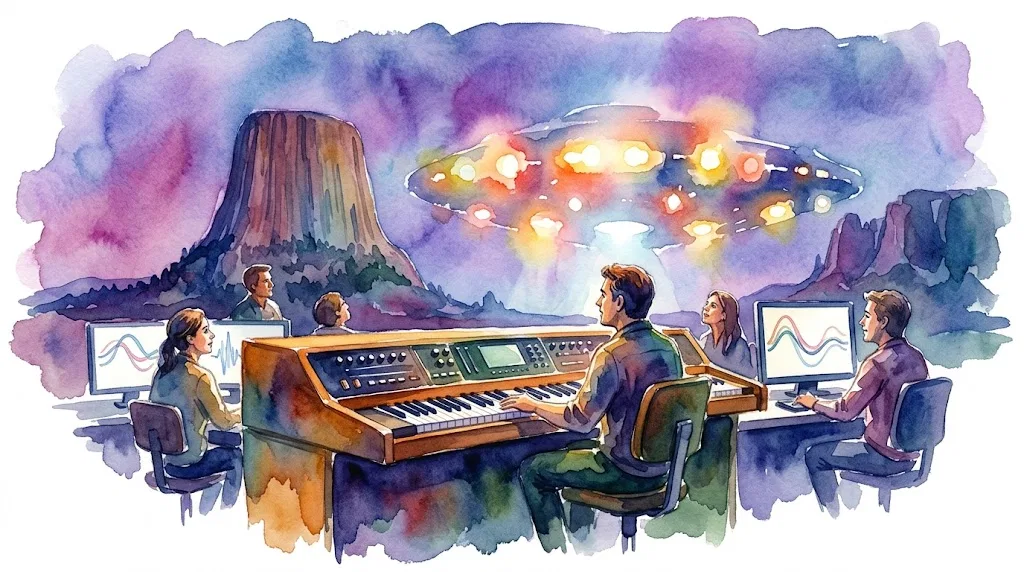
The brilliance of the motif is that it is instantly graspable without feeling ordinary. Its shape can be sung, whistled, played on a synthesiser, translated into lights and matched with hand signs. That adaptability makes it feel less like a private musical theme and more like a protocol: a compact unit of information that can move across instruments, bodies and machines.
Williams’s broader score prepares the audience for that shift. The music does not begin in a world of easy reassurance. Scholarly analysis of the score has noted how Close Encounters sets threatening, cluster-like modernist sonorities against more tonal, resolving music, mirroring the film’s movement from fear and uncertainty towards wonder.[Academia]academia.eduAcademia(PDF) Sweet Fulfillment: Allusion and Teleological Genesis in John Williams’s Close Encounters of the Third Kind… The five-note phrase emerges inside that larger emotional design: it is not simply “nice music”, but a way of moving from dread to intelligibility.
That matters because Spielberg’s UFO cinema is often less interested in defeating the unknown than in learning how to face it. In the early scenes, the visitors are frightening because they exceed ordinary categories. Lights appear where they should not; machines fail; witnesses cannot explain what has happened to them. By the finale, the same otherness is still present, but the film has found a form in which humans can respond.
The phrase is also diegetic, meaning it exists inside the world of the film rather than only on the soundtrack for the audience. The scientists play it. The aliens hear it. The mothership answers. Music scholar Tom Schneller specifically identifies the five-note motive as the primary means of communication between aliens and humans, and notes that because it plays a role in the plot, it belongs to the tradition of diegetic film music rather than ordinary background scoring.[Academia]academia.eduAcademia(PDF) Sweet Fulfillment: Allusion and Teleological Genesis in John Williams’s Close Encounters of the Third Kind…
Music Instead of Weapons or Words
The final contact scene is staged like a military operation, but it is resolved like a rehearsal. There are floodlights, technicians, coded procedures and a government landing site near Devil’s Tower, yet the crucial interface is not a gun turret, missile battery or interrogation chamber. It is a musical console.
That choice changes the ethics of the scene. A military response assumes the unknown must be contained or repelled. A purely linguistic response assumes the unknown can be folded into human categories quickly enough to be understood. Spielberg’s musical response does something subtler: it admits that humans do not yet know what the visitors mean, while still insisting that pattern, rhythm and reply can create a first bridge.
The film also makes communication multi-sensory. The exchange is not only heard; it is seen through lights and colours, and embodied through hand signs. Accounts of the sequence connect Lacombe’s gestures to Curwen hand signs used in music education and associated with the Kodály method, turning classroom solfège into a speculative language of interspecies contact.[Science Fiction & Fantasy Stack Exchange]scifi.stackexchange.comLacombe, the UFO expert, is shown in a conferenceScience Fiction & Fantasy Stack ExchangeWhat is the point of the hand signals in "Close Encounters"?15 Jul 2012 — In "Close Encounters of…
That detail is easy to miss, but it is central to the scene’s emotional force. The hand signs make the humans look less like conquerors and more like students. They are not imposing a finished language on the aliens; they are trying to match sound, colour and gesture into a grammar simple enough to begin with. One useful reading of the scene is that humanity is being placed in a classroom. The famous line “the first day of school” fits because the film turns contact into pedagogy rather than conquest.

The Mothership as Conversation Partner
The great dramatic turn in the landing sequence comes when the mothership does not merely receive the phrase but responds musically. At first, the humans present a greeting. Then the ship answers with deeper, more massive tones. The exchange becomes faster, stranger and more complex until the human operators can no longer keep up manually and must let the computer take over.
This escalation is important. The five notes are not treated as a full alien language. They are the handshake, the opening password, the shared starting point. Once contact has been established, the dialogue moves beyond human performance into a scale of speed and complexity that suggests alien intelligence without reducing it to subtitles.
That is one reason the scene still feels hopeful rather than naïve. Spielberg does not pretend that humans and aliens instantly understand one another. The first exchange is partial, asymmetrical and technically mediated. But it is enough to prove that contact is not impossible. A signal is sent. A reply comes back. Meaning begins in repetition before it becomes explanation.
The hardware reinforces that idea. The visible musical technology gives the scene a tactile, practical quality: people at consoles trying to translate awe into procedure. Sources discussing the sequence identify the synthesiser associated with the final communication as an ARP 2500, and the National Music Centre’s collection entry for an ARP 2500 directly notes the cultural memory of the film’s five electronic-sounding notes as a means of communication with aliens.[nmc.emuseum.com]nmc.emuseum.comarp 2500arp 2500
Why the Scene Feels Hopeful Without Becoming Simple
The five-note exchange defines hopeful contact because it does not erase fear; it reorganises it. Much of Close Encounters is unsettling. People vanish. Families fracture. Official secrecy surrounds the landing site. Roy Neary’s experience is not cosy wonder but obsession and social dislocation. The finale feels so luminous partly because the film has earned its release from confusion.
Williams’s score supports that movement. The LA Phil notes that the music uses more threatening, modernist sonorities for mysterious or alarming aspects of the visitors, while the five-note motif serves as the film’s non-verbal bridge.[LA Phil]laphil.comLA Phil Excerpts from Close Encounters of the Third Kind *, John WilliamsLA Phil Excerpts from Close Encounters of the Third Kind *, John Williams Schneller’s analysis similarly describes the score’s movement between terror and wonder, with atonality linked to the visitors’ initially threatening mystery and more tonal resolution arriving as their benign nature becomes clear.[Academia]academia.eduAcademia(PDF) Sweet Fulfillment: Allusion and Teleological Genesis in John Williams’s Close Encounters of the Third Kind…
The result is not blind optimism. It is structured optimism. Spielberg’s scene says that contact becomes possible when humans stop treating the unknown only as a target, threat or puzzle to be solved privately. They must make themselves legible too. The five notes are not just a message to the aliens; they are a public act of vulnerability.
That is why the sequence has lasted in popular memory. Many science-fiction films imagine communication as translation: aliens speak, computers decode, humans understand. Close Encounters imagines communication as call and response. It is closer to music-making than messaging. Each side has to leave space for the other.

The Five Notes in Spielberg’s UFO Imagination
Within Spielberg’s wider UFO storytelling, the five notes are the cleanest expression of his most generous idea about alien contact: the unknown may be frightening because it is vast, but it need not be hostile. Close Encounters is full of government machinery and Cold War-era anxiety, yet its final image of communication is collaborative rather than coercive.
That distinction is what separates the five-note exchange from a standard spectacle ending. The mothership is visually overwhelming, but the emotional climax is not its size. It is the moment when the sound coming from Earth is answered. Spielberg makes the audience feel that humanity has passed a threshold not by winning a battle, but by learning how to say hello.
The motif’s simplicity also lets the film travel beyond its own plot. Viewers can remember it after hearing it once. Musicians can quote it. Audiences can imitate it. It becomes a cultural shorthand for first contact because it performs the same function outside the film that it performs inside the film: it invites recognition.
That is the deeper mechanism behind its durability. The five notes do not explain the aliens. They make room for them. In a story about UFOs, secrecy, obsession and awe, Spielberg and Williams found a way to make the first shared language feel almost childlike without making it trivial. Contact begins not with conquest, disclosure or proof, but with a phrase simple enough for both sides to answer.
Amazon book picks
Further Reading
Books and field guides related to How Five Notes Made Contact Feel Possible. Use these as the next step if you want deeper reading beyond the article.
Close Encounters of the Third Kind
Directly covers the film, production choices and creative context behind its musical communication scene.
The Close Encounters Man
Adds background on the UFO culture that made musical contact in Close Encounters feel plausible.

John Williams's film music
Supports the page's focus on how Williams uses music as narrative communication.

The sounds of commerce
Helps frame how memorable film motifs become marketable cultural signals.
eBay marketplace picks
Marketplace Samples
Example marketplace items related to this page. Use the search link to explore similar finds on eBay.



Endnotes
1.
Source: pbs.org
Link:https://www.pbs.org/wnet/gperf/john-williams-great-performances-theme-song-and-interview/4075/
Source snippet
John Williams' Great Performances Theme Song and...... Close Encounters and how you got to where you ended up? John Williams... And...
2.
Source: m.douban.com
Link:https://m.douban.com/group/topic/1029416/
Source snippet
1997 John Williams Interview - Total Film Magazine3 Feb 2006 — John Williams: It's hard to say that, but I always answer Close Enco...
3.
Source: academia.edu
Link:https://www.academia.edu/6928980/Sweet_Fulfillment_Allusion_and_Teleological_Genesis_in_John_Williams_s_Close_Encounters_of_the_Third_Kind
Source snippet
Academia(PDF) Sweet Fulfillment: Allusion and Teleological Genesis in John Williams’s Close Encounters of the Third Kind...
4.
Source: nmc.emuseum.com
Title: arp 2500
Link:https://nmc.emuseum.com/objects/203/arp-2500
5.
Source: youtube.com
Title: Close Encounters of the Third Kind (6/8) Movie CLIP
Link:http://www.youtube.com/watch?v=S4PYI6TzqYk
Source snippet
Steven Spielberg - Close Encounters of the Third Kind, 1977 - Play The Five Tones...
6.
Source: youtube.com
Title: Steven Spielberg
Link:http://www.youtube.com/watch?v=wZj7gUIO-2k
Source snippet
Close Encounters of the Third Kind: Communicating with music...
7.
Source: youtube.com
Title: Dario Marianelli explains John Williams’ impact on ‘Close Encounters’
Link:http://www.youtube.com/watch?v=Z9xh2gFzLUM
Source snippet
Close Encounters - Communication with the Mothership (Final Scene) (HD) (Best Quality)...
8.
Source: youtube.com
Title: Close Encounters
Link:http://www.youtube.com/watch?v=OEloAotHhKM
Source snippet
"Close Encounters of the Third Kind" Communicating with the Mothership Close Encounters of the Third Kind (6/8) Movie CLIP - Communicatin...
9.
Source: youtu.be
Title: Binge Society
Link:https://youtu.be/YZ-mu160OCc
Source snippet
Close Encounters - Communication with the Mothership (Final Scene) (HD) (Best Quality) Jay Kwon...
10.
Source: laphil.com
Title: LA Phil Excerpts from Close Encounters of the Third Kind *, John Williams
Link:https://www.laphil.com/musicdb/pieces/1314/excerpts-from-close-encounters-of-the-third-kind
11.
Source: scifi.stackexchange.com
Title: Lacombe, the UFO expert, is shown in a conference
Link:https://scifi.stackexchange.com/questions/20564/what-is-the-point-of-the-hand-signals-in-close-encounters
Source snippet
Science Fiction & Fantasy Stack ExchangeWhat is the point of the hand signals in "Close Encounters"?15 Jul 2012 — In "Close Encounters of...
12.
Source: Wikipedia
Title: Close Encounters of the Third Kind
Link:https://en.wikipedia.org/wiki/Close_Encounters_of_the_Third_Kind
13.
Source: youtube.com
Link:https://www.youtube.com/watch?v=gwU6VC1JxMQ
15.
Source: johnwilliams.org
Link:https://www.johnwilliams.org/reference/biography
16.
Source: researchgate.net
Title: Sweet Fulfillment
Link:https://www.researchgate.net/publication/274149978_Sweet_Fulfillment_Allusion_and_Teleological_Genesis_in_John_Williams%27s_Close_Encounters_of_the_Third_Kind
17.
Source: johnloomis.org
Title: Close Encounters of the Third Kind
Link:https://johnloomis.org/ece303L/notes/music/Close_Encounters.html
18.
Source: sbiff.org
Title: close encounters of the third kind
Link:https://sbiff.org/close-encounters-of-the-third-kind/
Additional References
19.
Source: ars-nova.com
Title: The second Do is an octave below the first. The five tones were chosen
Link:https://www.ars-nova.com/Theory%20Q%26A/Q35.html
Source snippet
Ars NovaWhere do the 5 tones with hand symbols in the movie "...The five musical tones in Close Encounters are, in solfege, Re, Mi, Do...
20.
Source: youtube.com
Title: Close Encounters of the Third Kind: Communicating with music
Link:http://www.youtube.com/watch?v=nkykqyMEarA
Source snippet
Dario Marianelli explains John Williams' impact on 'Close Encounters'...
21.
Source: kodaly.org.au
Link:https://kodaly.org.au/wp-content/uploads/2015/12/handsign.pdf
Source snippet
Kodály AustraliaCurwen Hand SignsPage 1. Curwen Hand Signs re do ti la so fa mi do. (c)2003 Kodaly Music Education Instiute of Australia...
22.
Source: afi.com
Link:https://www.afi.com/afis-100-years-100-movies-10th-anniversary-edition/
23.
Source: afi.com
Link:https://www.afi.com/afis-100-years-100-heroes-villians/
24.
Source: afi.com
Link:https://www.afi.com/afis-100-years-100-laughs/
25.
Source: afi.com
Link:https://www.afi.com/afis-100-years-100-movie-quotes/
26.
Source: filmtracks.com
Link:https://www.filmtracks.com/titles/close_encounters.html
27.
Source: facebook.com
Link:https://www.facebook.com/groups/12117541695/posts/10156298172246696/
28.
Source: facebook.com
Link:https://www.facebook.com/groups/12117541695/posts/10160236355136696/
Topic Tree