Within Spielberg
What Spielberg's Aliens Test in Humans
Spielberg's alien encounters reveal how humans respond to fear, vulnerability, secrecy and the unknown.
On this page
- Panic, control and compassion
- Children, families and officials
- Why contact becomes a human mirror
Page outline Jump by section
Introduction
Spielberg’s alien stories work because the visitor is rarely only a creature from elsewhere. In Close Encounters of the Third Kind, E.T. the Extra-Terrestrial and War of the Worlds, the alien encounter becomes a test of human character: whether people panic, conceal, exploit, protect, listen or care. The key question is not simply “what are the aliens?” but “what do humans become when the unknown arrives?”
That is why Spielberg’s UFO cinema sits so comfortably between wonder and critique. His aliens can be luminous, vulnerable or murderous, yet the moral pressure falls on human beings. Officials hide information. Families fracture or heal. Children recognise need before adults do. Crowds turn desperate. Parents discover responsibilities they previously avoided. The visitor from the sky becomes a mirror, exposing the human response to fear, vulnerability, secrecy and contact.
Panic, control and compassion
Spielberg’s alien encounters often begin with a failure of human categories. A UFO, a stranded creature or an invasion cannot be fitted neatly into ordinary life, so people reach for the tools they already know: surveillance, quarantine, denial, military force or family protection. The moral test starts in that gap between not understanding and choosing how to act.
In Close Encounters of the Third Kind, the unknown is frightening but not automatically hostile. The film’s UFO framework was not casual decoration: the American Film Institute records that the title came from astronomer J. Allen Hynek’s hierarchy of alien encounters, and that Columbia bought rights to Hynek’s The UFO Experience while hiring him as technical adviser. That connection to UFO classification gives the story an investigative surface, but Spielberg turns the material into an ethical drama about secrecy, obsession and trust. The authorities know more than the public, witnesses struggle to explain what they have seen, and contact becomes possible only when communication replaces containment.[AFI Catalog]catalog.afi.comCatalog AFI|CatalogAFI CatalogAFI|Catalog…
The film’s most famous moral tension is not between humans and aliens but between official control and human openness. The government response is secretive, strategic and paternalistic: keep civilians away, manage the site, hide the scale of what is happening. Yet the climactic encounter at Devil’s Tower imagines a different model of first contact, one based on music, pattern and patience rather than weaponry. The alien presence tests whether human intelligence can become receptive rather than possessive.
E.T. sharpens the same test by making the alien weak. The visitor is not a grand intelligence descending in splendour but a lost, frightened being who needs shelter. AFI’s plot summary stresses the contrast from the beginning: E.T. is left behind after humans arrive with trucks and flashlights, and later the family home is sealed off by scientists in protective quarantine barriers while medical tests are run on both E.T. and Elliott.[American Film Institute]afi.comAFI’S 100 YEARS…100 MOVIES — 10TH ANNIVERSARY EDITION | American Film Institute… The moral question is therefore immediate and simple: when the unknown is vulnerable, do humans protect it or possess it?
That question is why the government agents and scientists in E.T. are not straightforward villains. Their fear is understandable. Their procedures are rational. Their failure is moral proportion. They treat the alien primarily as a biological event, while Elliott recognises him as a being. Spielberg’s critique is not anti-science so much as anti-reduction: knowledge without compassion becomes another form of capture.
War of the Worlds reverses the emotional charge. Here the aliens are not misunderstood innocents; they are lethal invaders. But even in this darker film, Spielberg keeps the moral focus close to the humans under pressure. Slant’s 2005 review noted that the film keeps its point of view “squarely amid a family of survivors” and argued that its panic, handheld disorder and civilian perspective made the destruction feel like horror rather than spectacle.[Slant Magazine]slantmagazine.comSlant Magazine Review: War of the WorldsSlant MagazineReview: War of the Worlds - Slant Magazine… The aliens test humanity by removing the usual supports of law, infrastructure and social trust. Once those supports collapse, the danger comes from both the tripods and the frightened people around them.
Across the three films, the scale changes but the mechanism stays recognisable. Spielberg’s aliens expose the first human impulse and then judge it dramatically:
- Control tries to classify, isolate or suppress the encounter.
- Panic turns neighbours, refugees and crowds into threats to one another.
- Compassion appears most clearly when someone treats the alien, child or stranger as a person rather than a problem.
- Communication becomes the highest form of courage when fear would make silence, secrecy or violence easier.
Children, families and officials
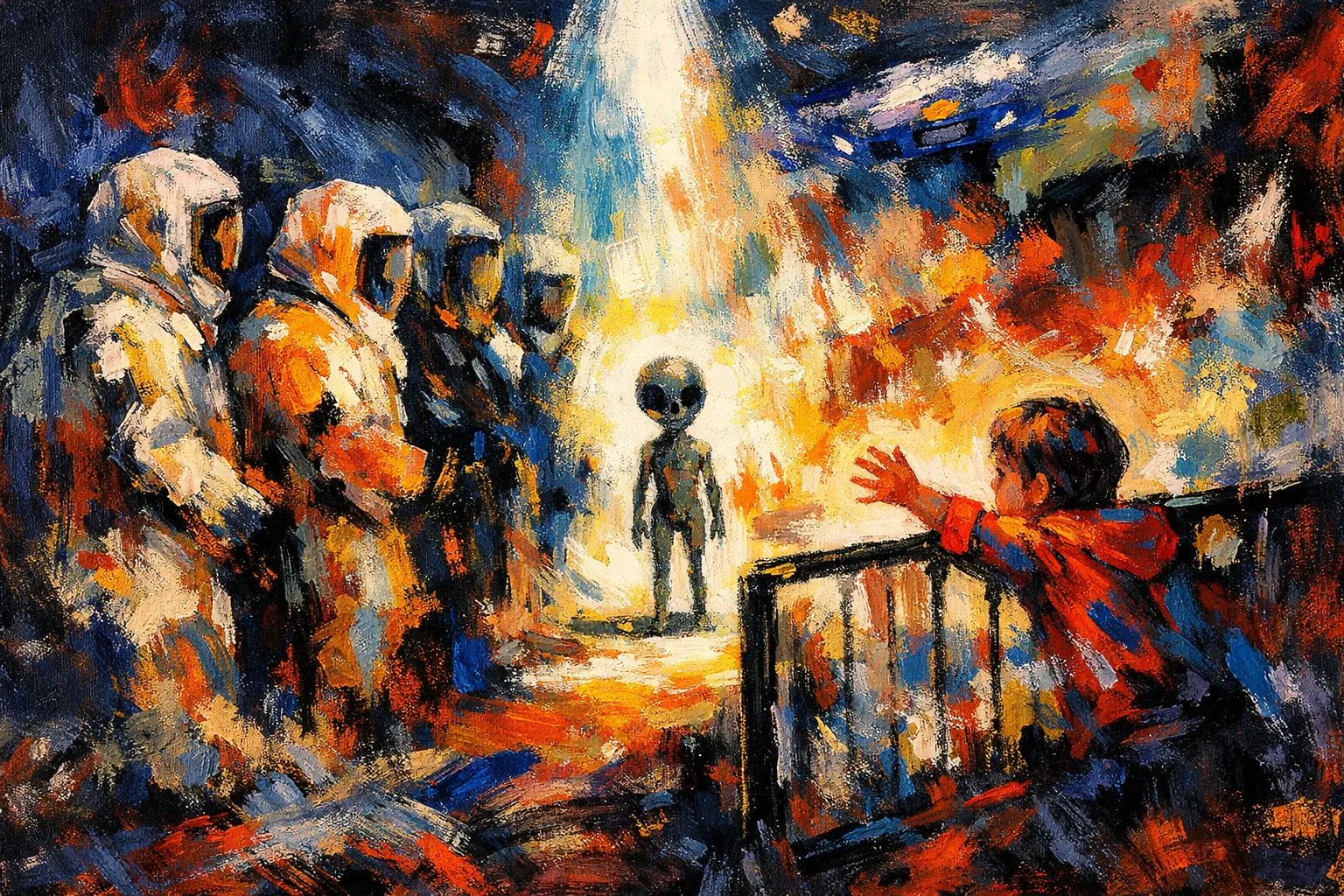
Spielberg repeatedly gives children a moral advantage in alien stories. They are not wiser because they know more. They are wiser because they respond before institutions have finished naming the threat. Elliott does not need a policy for E.T.; Barry in Close Encounters is drawn towards the strange light before adults can decide whether to fear it; Rachel in War of the Worlds forces Ray Ferrier’s survival instinct to become parental care rather than simple self-preservation.
This pattern is especially clear in E.T. Spielberg has linked the film directly to family rupture. Speaking at a 40th-anniversary event, he said the story grew from thinking about his parents’ divorce and asking what would happen if a child needed “to become responsible for a life form to fill the gap in his heart”. He also described divorce as creating responsibility among siblings: “we all take care of each other.”[The Independent]independent.co.ukSource details in endnotes. That background matters because E.T. is not just an alien friend. He is the test that asks whether a damaged family can become protective.
The children pass that test before the adults do. Elliott, Michael and Gertie learn secrecy, care and risk on behalf of someone defenceless. Their rescue mission is childish in method — sweets, bicycles, hiding places, improvised escape — but morally serious. The adult world arrives with torches, keys, suits, plastic barriers and medical language. The children’s world answers with recognition: he is scared, he is sick, he wants to go home.
Close Encounters is more troubling because Roy Neary’s test cuts against family duty. His UFO experience awakens wonder, but it also consumes him. The Library of Congress’s National Film Registry essay frames Spielberg as a director with an unusually sharp sense of how middle-class Americans “thought, felt, and dreamed”, and Close Encounters uses that gift to show awe as both revelation and disruption.[The Library of Congress]blogs.loc.govSource details in endnotes. Roy’s obsession makes contact possible, but it damages his domestic life. The alien summons is morally ambiguous because transcendence comes at a human cost.
That ambiguity has become one of the film’s most debated features. In later Spielberg, especially E.T. and War of the Worlds, the alien encounter more often pushes families together. In Close Encounters, it pulls Roy away. The film does not entirely condemn him, because his longing is presented as authentic and contact as wondrous. But the moral test is harsher than nostalgia sometimes admits: can wonder justify abandonment? Spielberg’s later family-centred alien films seem to answer by revising the question. The better encounter is not escape from family but responsibility within it.
Officials occupy a different moral position. They are usually competent, but their competence is incomplete. In Close Encounters, officials can organise, conceal and stage-manage contact, but they cannot own its meaning. In E.T., scientists can diagnose decline but cannot understand the bond that keeps E.T. and Elliott emotionally connected. In War of the Worlds, soldiers can fight, but military power cannot restore the moral order of a collapsing society. Spielberg’s institutions are not useless; they are limited. The human test is whether their authority can be tempered by humility.
When fear turns humans into the real danger
War of the Worlds is the starkest example of Spielberg using aliens to test human conduct under terror. The tripods are monstrous, but their presence strips away social confidence so quickly that people begin failing one another almost immediately. Ray’s journey is not a heroic campaign against aliens. It is a forced education in fear, fatherhood and triage.
The film’s opening family set-up is crucial. Ray is late, careless and emotionally underprepared. Slant describes his home as a mess of unwashed clothes, pizza boxes and a barren fridge, while his children already understand his unreliability.[Slant Magazine]slantmagazine.comSlant Magazine Review: War of the WorldsSlant MagazineReview: War of the Worlds - Slant Magazine… The alien invasion does not create his parental failure; it exposes it. Ray’s moral test is whether a man who has treated fatherhood casually can become responsible when responsibility is no longer optional.
Spielberg also refuses the clean comforts of the invasion genre. There is no command-room overview that makes the catastrophe manageable. The terror is seen from streets, ferries, basements and crowds. That perspective matters because it turns the alien attack into a pressure chamber for ordinary behaviour. People fight over vehicles. Refugees become competitors. Survival narrows the moral field until even decent instincts become hard to maintain.
The basement sequence with Harlan Ogilvy is the film’s most uncomfortable version of this test. Harlan wants resistance; Ray wants silence and escape for Rachel. Neither impulse is absurd. One is the desire to fight back, the other the desire to keep a child alive. The horror is that the situation makes them incompatible. When Ray kills Harlan to prevent him from attracting the aliens, the film reaches a moral place far darker than E.T. or Close Encounters: the alien threat has made a human being decide that another human being is now the immediate danger.
This is Spielberg’s critique of panic. Fear does not merely make people run. It changes what they are able to justify. The aliens in War of the Worlds are therefore not only enemies; they are catalysts. They reveal how quickly civilisation depends on fragile agreements: wait your turn, protect children, share shelter, believe strangers, do not kill unless there is no other way. When the tripods rise, those agreements start to fail.
Yet the film does not become wholly cynical. Ray’s arc still bends towards protection. Rachel survives because he learns to place her life above his pride, confusion and terror. The world is not saved by human virtue in the grand strategic sense; the invaders fall because Earth’s microbes defeat them. But Ray’s smaller victory matters more to Spielberg’s moral design. He cannot master the cosmic event. He can answer the human test placed immediately before him.
Why contact becomes a human mirror
Spielberg’s alien cinema is often remembered for spectacle: the mothership’s lights, the bicycle crossing the moon, the tripods tearing through streets. But the deeper continuity is moral reflection. The alien arrives as an unknown quantity, and the human response supplies the meaning.
That is clearest when the films are placed beside one another. Close Encounters asks whether human beings can move from secrecy and obsession towards communication. E.T. asks whether fear of contamination can be overcome by care for the vulnerable. War of the Worlds asks what remains of parental duty and social ethics when terror breaks the ordinary world. The aliens differ radically, but each one functions as a test.
The pattern also explains why Spielberg’s aliens are not always morally simple. E.T. is good, but the adults’ fear is not baseless. The Close Encounters visitors appear benevolent, but Roy’s response to them is ethically costly. The War of the Worlds invaders are murderous, but the film’s most painful choices are made by humans. Spielberg’s best alien scenes sit inside that tension: the unknown may be wondrous or terrible, but the first moral danger is often the human need to dominate the situation too quickly.
This is where the UFO dimension matters. UFO stories are rarely only about objects in the sky. They are about witnesses, credibility, secrecy, panic, longing and mistrust. Spielberg understood that dramatically. The UFO or alien body becomes a device for testing institutions and intimate relationships at the same time. A government cover-up and a family argument can belong to the same story because both ask who is trusted with the truth.
The recurring child’s-eye view gives the test its emotional standard. Children in Spielberg’s alien films are not innocent in a simplistic sense; they are frightened, lonely, jealous and impulsive. But they often respond to the alien as a relationship before they respond to it as a threat category. That does not make them practically right in every situation. It makes them morally revealing. They show what adults have trained themselves to suppress: curiosity without conquest, fear without cruelty, attachment without ownership.
The risk in Spielberg’s moral design
The strength of Spielberg’s alien-as-test mechanism is also its risk. It can make contact feel emotionally legible before it is intellectually examined. Audiences may leave Close Encounters remembering the beauty of communication more than the cost to Roy’s family. They may read E.T. as a simple defence of childlike trust, even though the adults’ quarantine response has a rational basis. They may experience War of the Worlds as a family survival story and miss how bleak its view of crowd behaviour becomes.
That risk is part of the critique. Spielberg’s films often ask viewers to want openness, compassion and wonder, then place those values under pressure. The point is not that humans should always trust the unknown. It is that fear quickly recruits the language of prudence, science, patriotism or protection, and can turn those tools into excuses for domination.
The most durable Spielbergian answer is not naive welcome. It is moral attention. Look closely at the frightened child, the stranded creature, the obsessed witness, the panicking crowd, the official behind the barrier, the parent who has failed before. The alien encounter matters because it forces a choice before certainty arrives. In Spielberg’s UFO imagination, humanity is tested not by whether it can explain the visitor, but by whether it can remain human while trying.

Amazon book picks
Further Reading
Books and field guides related to What Spielberg's Aliens Test in Humans. Use these as the next step if you want deeper reading beyond the article.
The Close Encounters Man
Connects UFO belief, investigation and the moral questions surrounding contact.
Close Encounters of the Third Kind
Shows how human responses to the unknown became central to Spielberg's UFO storytelling.
The UFO Experience
Introduced the encounter framework that influenced Close Encounters and its human-testing themes.

Steven Spielberg
Examines the moral and family themes that run through Spielberg's alien films.
eBay marketplace picks
Marketplace Samples
Example marketplace items related to this page. Use the search link to explore similar finds on eBay.

Endnotes
1.
Source: catalog.afi.com
Title: Catalog AFI|Catalog
Link:https://catalog.afi.com/Film/67160-CLOSE-ENCOUNTERS-OF-THE-THIRD-KIND
Source snippet
AFI CatalogAFI|Catalog...
2.
Source: afi.com
Title: American Film Institute
Link:https://www.afi.com/afis-100-years-100-movies-10th-anniversary-edition/
Source snippet
AFI’S 100 YEARS…100 MOVIES — 10TH ANNIVERSARY EDITION | American Film Institute...
3.
Source: catalog.afi.com
Link:https://catalog.afi.com/Search?searchField=Subjects&searchText=Aliens%2C+Extraterrestrial
4.
Source: catalog.afi.com
Title: 54476 MUNICH
Link:https://catalog.afi.com/Film/54476-MUNICH
5.
Source: afi.com
Title: s 100 years 100 movie quotes
Link:https://www.afi.com/afis-100-years-100-movie-quotes/
6.
Source: afi.com
Title: s 100 years of film scores
Link:https://www.afi.com/afis-100-years-of-film-scores/
7.
Source: afi.com
Title: s 100 years 100 thrills
Link:https://www.afi.com/afis-100-years-100-thrills/
8.
Source: afi.com
Title: s 100 years 100 movies
Link:https://www.afi.com/afis-100-years-100-movies/
9.
Source: afi.com
Title: s 100 years 100 cheers
Link:https://www.afi.com/afis-100-years-100-cheers/
10.
Source: afi.com
Link:https://www.afi.com/afis-100-years-100-heroes-villians/
11.
Source: catalog.afi.com
Title: 57571 BORN INEASTLA
Link:https://catalog.afi.com/Film/57571-BORN-INEASTLA?cp=1&pos=1&sid=39accdff-9b66-48d9-94f4-f9ae4e83e1bb&sr=0.040798705
12.
Source: afi.com
Title: afis 10 top 10
Link:https://www.afi.com/afis-10-top-10/
13.
Source: people.com
Title: steven spielberg james cameron et amc visionaries
Link:https://people.com/tv/steven-spielberg-james-cameron-et-amc-visionaries/
14.
Source: slantmagazine.com
Title: Slant Magazine Review: War of the Worlds
Link:https://www.slantmagazine.com/film/war-of-the-worlds/
Source snippet
Slant MagazineReview: War of the Worlds - Slant Magazine...
15.
Source: independent.co.uk
Link:https://www.independent.co.uk/arts-entertainment/films/news/steven-spielberg-et-divorce-parents-anniversary-b2063879.html
16.
Source: blogs.loc.gov
Link:https://blogs.loc.gov/now-see-hear/2018/12/reading-the-film-registry-close-encounters-of-the-third-kind-1977/
17.
Source: Wikipedia
Title: Close Encounters of the Third Kind
Link:https://en.wikipedia.org/wiki/Close_Encounters_of_the_Third_Kind
Source snippet
Close Encounters of the Third KindThe title is derived from astronomer and Ufologist J. Allen Hynek's classification of close encounte...
18.
Source: britannica.com
Link:https://www.britannica.com/topic/ET-The-Extra-Terrestrial
19.
Source: letterboxd.com
Title: war of the worlds
Link:https://letterboxd.com/hkfanatic/film/war-of-the-worlds/
20.
Source: bfidatadigipres.github.io
Title: close encounters of the third kind
Link:https://bfidatadigipres.github.io/member%20picks/2022/02/23/close-encounters-of-the-third-kind/
21.
Source: sbiff.org
Title: close encounters of the third kind
Link:https://sbiff.org/close-encounters-of-the-third-kind/
22.
Source: reverseshot.org
Title: war of the worlds
Link:https://reverseshot.org/archive/entry/725/war-of-the-worlds
23.
Source: moviemom.com
Title: war of the worlds
Link:https://moviemom.com/war-of-the-worlds/
24.
Source: deepfocusreview.com
Title: war of the worlds
Link:https://www.deepfocusreview.com/reviews/war-of-the-worlds/
Additional References
25.
Source: Wikipedia
Title: E.T. the Extra Terrestrial
Link:https://en.wikipedia.org/wiki/E.T._the_Extra-Terrestrial
Source snippet
E.T. the Extra-TerrestrialIt tells the story of Elliott, a boy who befriends an extraterrestrial that he names E.T. who has been stran...
26.
Source: youtube.com
Title: Spielberg Returns to Alien Sci-Fi with [DISCLOSURE DAY]({{ ‘disclosure-day/’ | relative_url }}) | Final Trailer
Link:https://www.youtube.com/watch?v=VFCFL0tdarM
Source snippet
The Spirit Guide: Spielberg's Disclosure Day: It's Time...
27.
Source: youtube.com
Title: Spielberg’s Disclosure Day Is Closer To Truth Than Fiction
Link:https://www.youtube.com/watch?v=j4vLWVdoHSY
Source snippet
Spielberg Returns to Alien Sci-Fi with DISCLOSURE DAY | Final Trailer...
28.
Source: loc.gov
Link:https://www.loc.gov/static/programs/national-film-preservation-board/documents/ET.pdf
29.
Source: Wikipedia
Title: Steven Universe
Link:https://en.wikipedia.org/wiki/Steven_Universe
Source snippet
Steven UniverseSteven Universe is an American animated television series created by Rebecca Sugar for Cartoon Network. It tells the co...
30.
Source: Wikipedia
Link:https://en.wikipedia.org/wiki/Stephen
Source snippet
StephenStephen or Steven is an English male first name. It is particularly significant to Christians, as it belonged to Saint Stephen...
31.
Source: cinephiliabeyond.org
Link:https://cinephiliabeyond.org/close-encounters-of-the-third-kind-steven-spielbergs-gamble-that-paid-off-generously/
32.
Source: theatlantic.com
Link:https://www.theatlantic.com/culture/2026/06/disclosure-day-spielberg-movie-review/687474/
33.
Source: researchgate.net
Link:https://www.researchgate.net/publication/318354252_Alien_Invasions_and_Identity_Crisis_Steven_Spielberg%27s_The_War_of_the_Worlds_2005
34.
Source: facebook.com
Link:https://www.facebook.com/groups/12117541695/posts/10160773952631696/
Topic Tree