Within Spielberg
When the Alien Needs Protecting
E.T.
On this page
- The visitor as lost child
- Fear of adult institutions
- Empathy as the point of contact
Page outline Jump by section
Introduction
In E.T. the Extra-Terrestrial, Spielberg’s UFO imagination turns the alien encounter inside out. The visitor is not a conqueror, a riddle for experts, or a divine spectacle in the sky. He is small, stranded, frightened, physically fragile and dependent on children for protection. That vulnerability is the mechanism that makes the film work: the audience meets extraterrestrial life not through official disclosure, military response or scientific classification, but through care. E.T. becomes believable because he needs help.
This matters within Spielberg’s wider UFO cinema because it is the intimate companion piece to Close Encounters of the Third Kind. Where Close Encounters looks upward towards lights, signals and awe, E.T. brings the alien down into a suburban bedroom, a closet, a sickbed and finally a rescue mission. The question is no longer simply “Are we alone?” It becomes “What would we owe a being who arrived alone, lost and defenceless?”
The Visitor as Lost Child
E.T. is often described as Elliott’s friend, but the film’s deeper emotional trick is that the alien also becomes a childlike figure whom children must parent. The Library of Congress’s National Film Registry essay frames the film as the story of a boy from a divorced family who becomes caretaker to a gentle alien stranded on Earth and desperate to return home; it calls the pair “two lost souls” who rescue each other through love and friendship.[The Library of Congress]blogs.loc.govSource details in endnotes.
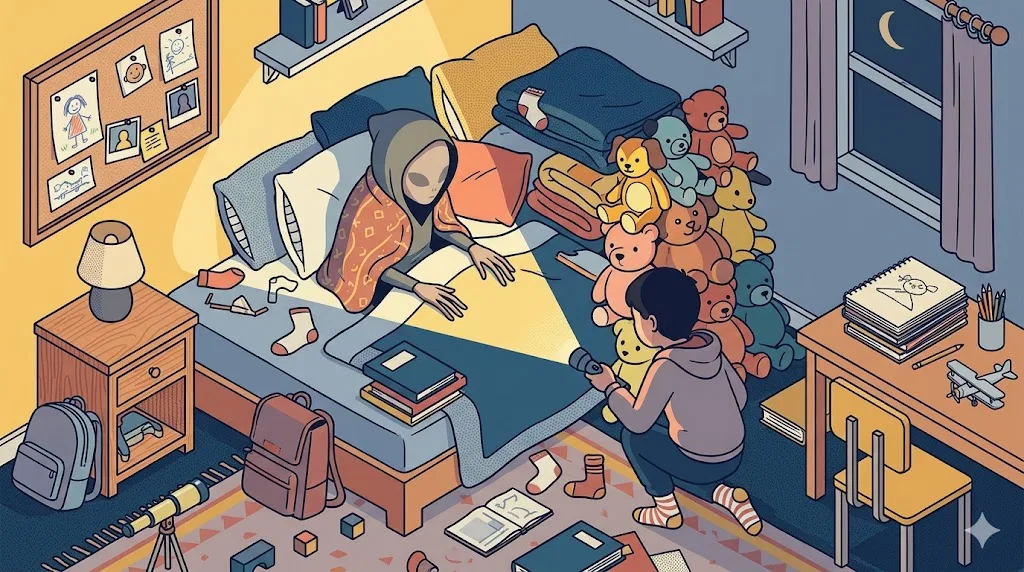
That mutual lostness is central. Elliott is lonely in a family marked by absence, while E.T. is separated from his own group in the opening forest sequence. The alien has extraordinary powers — healing, telepathy, telekinesis, a glowing heart — but those powers do not make him safe. They make him more mysterious and more precious. The plot repeatedly places him in situations where ordinary human care matters more than cosmic technology: he hides among stuffed toys, learns words from children’s television and household objects, gets drunk by accident, falls ill, and needs Elliott, Michael and Gertie to move him through an adult world he cannot navigate alone.
The film’s origin reinforces that reading. Spielberg told Time that he wanted Melissa Mathison to write a story about “a little boy and a family in the throes of divorce” who fill that emotional hole by befriending “a little lost alien”.[Time]time.comtollbit.time.com… Mathison’s contribution was not merely to make the film sentimental. Spielberg credited her with telling a very adult story from a child’s point of view, with dialogue that felt as if it came from children rather than from an adult writing down to them.[Time]time.comnational film registry 2018national film registry 2018
E.T.’s vulnerability also depends on design. Spielberg and cinematographer Allen Daviau withheld E.T.’s face for much of the first act, showing him in silhouette and backlight before allowing a full look. Spielberg later explained that lighting expanded the puppet’s emotional range: a shift in light could make E.T. look not only sad, but “curiously sad”.[The American Society of Cinematographers]theasc.comSource details in endnotes. That matters because the creature’s apparent weakness has to be readable before he can speak. His body is awkward, his movements tentative, his eyes watchful. The film teaches the audience to read him as a being with feelings before it asks anyone to understand him as an alien.

Fear of Adult Institutions
The danger in E.T. does not come from the sky. It comes from the systems that arrive after the sky-event is over: keys, vehicles, scanners, suits, quarantine tents and official containment. Britannica’s plot summary captures the turning point plainly: government agents who have been searching for E.T. capture him for scientific examination, build a sterile environment in Elliott’s house and run tests while both E.T. and Elliott weaken.[Encyclopedia Britannica]britannica.comSource details in endnotes.
Spielberg’s visual strategy makes that institutional fear feel child-sized. In his American Cinematographer interview, he said the film’s viewpoint had to remain that of a child: the camera often sat around four feet eight inches high for Elliott, lower for E.T., and adult strangers were largely denied faces until the end. Mary, Elliott’s mother, was the exception because Spielberg thought of her as “one of the kids in that household” — someone capable of keeping a secret.[The American Society of Cinematographers]theasc.comSource details in endnotes.
That formal choice does more than create nostalgia. It turns adult institutions into partial bodies and impersonal forces. The famous jangling keys are not just a character detail for Peter Coyote’s government agent; they announce an adult world of access, locks, authority and pursuit. Before the film allows that agent any nuance, it lets the children experience him as a sound and a silhouette. The threat is not that adults are evil by nature, but that adult systems tend to translate wonder into procedure.
The medical takeover of the house is the clearest example. Spielberg said he and Daviau deliberately moved from the magical warmth of E.T.’s closet to an “antiseptic white on white” look once scientists and doctors occupied the house and yard. Production design turned the family home into a field hospital, with clean-room suits, scientific hardware and layers of clear plastic; Spielberg said the result almost let the viewer “smell the antiseptic”.[The American Society of Cinematographers]theasc.comSource details in endnotes.
This is why E.T.’s vulnerability changes the moral geometry of the UFO story. In many UFO narratives, the unknown object threatens the public, and institutions exist to protect people from it. In E.T., the unknown being is the one who needs protection. Science and government are not portrayed as stupid; the film even softens Keys near the end, revealing his own longing for contact. But the institution still arrives too late, too loudly and too clinically. It can study the visitor’s body, yet it almost misses the emotional bond keeping him alive.
Empathy as the Point of Contact
The decisive contact in E.T. is not a radio signal, military briefing or formal exchange between species. It is empathy made physical. Elliott and E.T. become linked: when E.T. feels, Elliott feels; when E.T. is endangered, Elliott is weakened; when E.T. revives, Elliott’s grief turns into renewed action. Britannica describes their bond as both emotional and telepathic, even though they do not initially communicate through words.[Encyclopedia Britannica]britannica.comSource details in endnotes.
That bond gives Spielberg a different model of UFO contact from the one in Close Encounters. In Close Encounters, communication is spectacular: lights, tones, coded music and a landing-site revelation. In E.T., communication begins with imitation, touch and shared sensation. E.T. learns “home” from fragments of domestic life. Elliott learns responsibility by recognising that this strange being’s fear resembles his own. The film’s most famous phrase, “E.T. phone home,” is remembered as a science-fiction line, but in context it is a plea, not a boast. AFI lists it among the most memorable American movie quotations, which shows how completely the film’s idea of contact entered popular speech.[American Film Institute]afi.coms 100 years 100 movie quotesAmerican Film InstituteAFI's 100 Years…100 Movie QuotesE.T.: The Extra-Terrestrial (1982) E.T.: The Extra-Terrestrial (1982) Cast: Dee Wa…
The children’s role is crucial because they respond before they can explain. Elliott does not run a test to determine E.T.’s rights. Gertie does not need a theory of alien intelligence before teaching him words. Michael becomes brave not because he suddenly understands extraterrestrial biology, but because he grasps the practical stakes: E.T. must be moved, hidden and returned. The film imagines first contact as an ethical reflex. Recognition comes before knowledge.
That is also why the farewell works. E.T. does not remain on Earth as a pet, miracle-worker or proof of alien life. The children’s love is tested by whether they can let him leave. Protecting the vulnerable alien means refusing possession. Spielberg’s UFO imagination here is not disclosure fantasy — the thrill of finally proving that aliens exist — but a care fantasy: the hope that human beings might respond to the unknown with tenderness before fear hardens into control.

How Vulnerability Changes Spielberg’s UFO Myth
E.T. belongs to Spielberg’s UFO cycle, but it narrows the scale until cosmic encounter becomes domestic melodrama. The AFI catalogue identifies the film as a 1982 fantasy/science-fiction work directed and produced by Spielberg, written by Melissa Mathison, and released in June 1982.[AFI Catalog]catalog.afi.comCatalog AFI|CatalogAFI CatalogAFI|Catalog… Yet its science-fiction premise is almost minimalist: an alien is left behind and must get home. The richness comes from what that premise does to the human household around him.
The film emerged after Spielberg had already made Close Encounters, and Britannica notes that an unrealised hostile-alien project called Night Skies included a subplot about an alien bonding with a child while Spielberg was also reflecting on childhood and his parents’ divorce.[Encyclopedia Britannica]britannica.comSource details in endnotes. The route from hostile invasion to fragile friendship is the key movement. Spielberg does not abandon fear; he relocates it. The alien is not frightening because he may destroy the family. He is frightening because the family may not be able to save him.
That reversal gives E.T. its durable place in popular UFO imagination. The alien is “other”, but not unknowably other. He is odd enough to remain non-human, yet vulnerable enough to invite human responsibility. The film avoids the easiest sentimental solution by making him both ugly-cute and wise-childlike: a wrinkled, ancient-looking creature who still needs a blanket, a hiding place and a way home.
The American Film Institute’s historical placement of E.T. among major American films reflects how thoroughly this vulnerability reshaped expectations of screen aliens. AFI’s 10th anniversary edition of its “100 Years…100 Movies” list includes E.T. and identifies Spielberg, Mathison, Kathleen Kennedy, Allen Daviau and John Williams among its key creative contributors.[American Film Institute]afi.coms 100 years 100 movie quotesAmerican Film InstituteAFI's 100 Years…100 Movie QuotesE.T.: The Extra-Terrestrial (1982) E.T.: The Extra-Terrestrial (1982) Cast: Dee Wa… The Library of Congress likewise notes that E.T. entered the National Film Registry in 1994, a sign of its recognised cultural and aesthetic importance.[The Library of Congress]blogs.loc.govSource details in endnotes.
The Adult World Is Frightening, but Not Simple
A weaker version of E.T. would make adults pure villains and children pure saints. Spielberg’s film is more interesting than that. The adults are frightening because they are powerful, not because every adult intention is cruel. Keys is introduced through menace, but he later reveals that he, too, has dreamed of meeting an alien. Mary is overwhelmed and frightened, yet she is not outside the emotional world of the children. The scientists’ procedures are invasive, but the film does not deny that a dying extraterrestrial would provoke panic, caution and medical intervention.
That ambivalence is visible in the film’s later history. For the 2002 anniversary version, Spielberg digitally replaced agents’ guns with walkie-talkies in the escape sequence; years later he said he regretted altering the original film and argued that movies should not be revised to suit later standards.[Variety]variety.comsteven spielberg regrets editing guns et censorship 1235594163Steven Spielberg Regrets Editing Guns Out of 'E.T.'25 Apr 2023 — Steven Spielberg participated in a master class at the Time 100 S… The controversy is revealing because the guns are not incidental. They mark how sharply the original film stages the child-protection fantasy against state force. Removing them softens the institutional threat, but also blurs what the children are resisting.
The point is not that E.T. is anti-science. It is anti-reduction. It asks what is lost when an encounter with a living, feeling being is handled only as a security breach, a specimen or a public-health problem. The clean-room sequence is painful because the doctors and agents are doing what institutions do: isolating, measuring, controlling risk. But the audience has already spent the film learning that E.T.’s life cannot be understood apart from attachment, trust and homesickness.
That is where Spielberg’s UFO imagination becomes most distinctive. The unknown is not made safe by being explained. It is made morally urgent by being vulnerable.
Why the Vulnerable Alien Still Feels Powerful
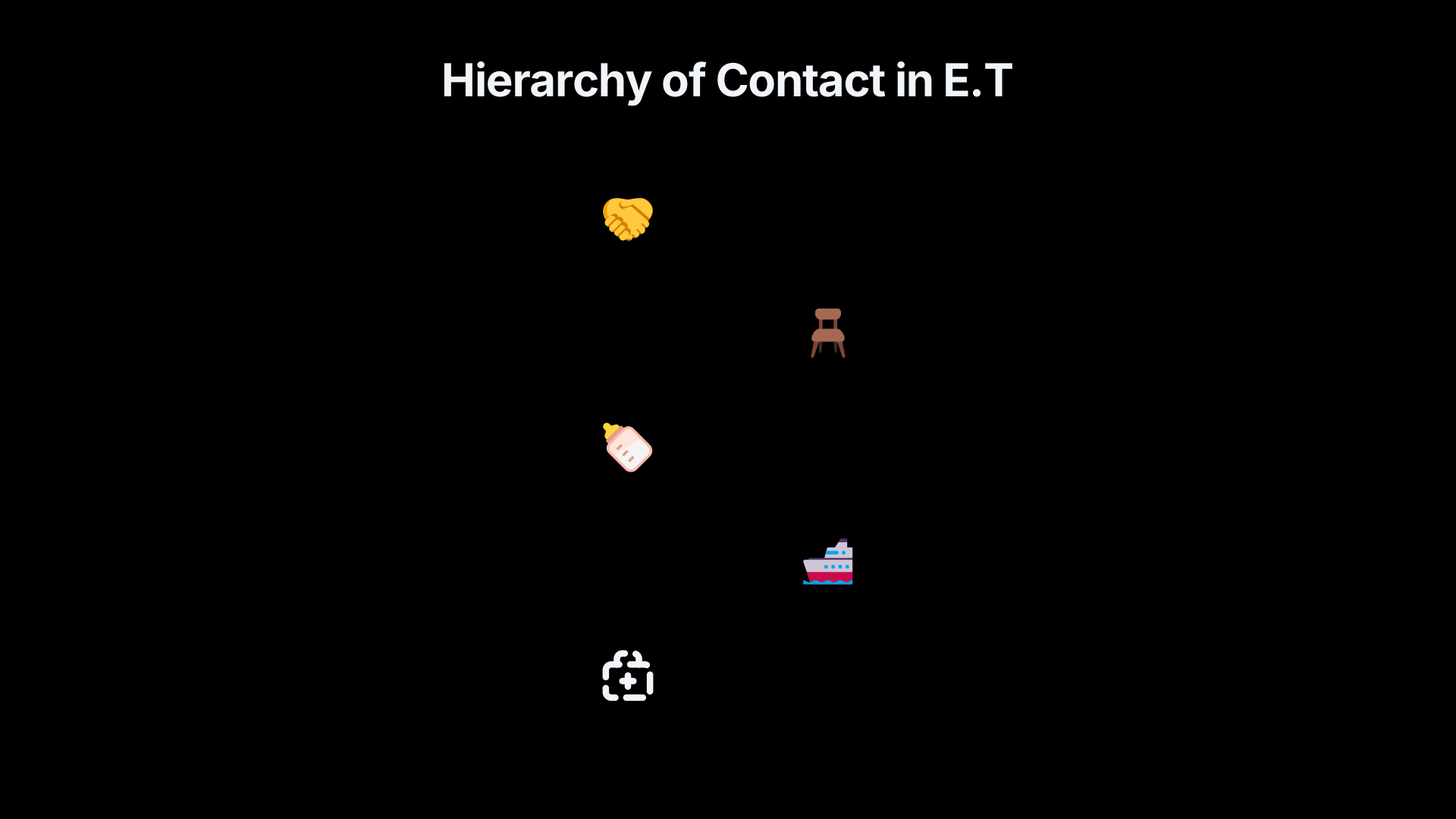
E.T.’s weakness does not make him passive. He heals a cut finger, revives a dead plant, lifts bicycles into the night sky and leaves Elliott with a promise of continuing presence. The vulnerability works because it sits beside wonder. If E.T. were only helpless, the film would become rescue melodrama. If he were only powerful, it would become conventional spectacle. Spielberg’s balance is to make him capable of miracles but unable to save himself without human compassion.
That balance also explains why the film remains so effective as a UFO story despite showing relatively little UFO machinery. The spaceship matters, but mostly as a sign of separation and return. The real “encounter” is the relationship between a human child and a stranded visitor. The landing is less important than the sheltering; the departure is less important than the ethical test that precedes it.
In Spielberg’s broader UFO imagination, E.T. supplies the most intimate answer to the question of alien contact. Close Encounters imagines communication as awe before the unknown. E.T. imagines it as care for the exposed. The film’s enduring insight is simple but hard to shake: if extraterrestrial life ever appeared not as an invading power but as a frightened guest, the first human question would not be how to classify it. It would be whether we could protect it before we tried to possess it.
Amazon book picks
Further Reading
Books and field guides related to When the Alien Needs Protecting. Use these as the next step if you want deeper reading beyond the article.
The Close Encounters Man
Explains the UFO ideas and personalities that informed Spielberg's vision of contact.
Close Encounters of the Third Kind
Provides context for Spielberg's evolving treatment of alien contact from awe to compassion.
E.T., the Extra-Terrestrial
First published 1982. Subjects: Fiction, Human-alien encounters, Juvenile fiction, Life on other planets, Fiction, media tie-in.

Steven Spielberg
First published 2008. Subjects: Motion picture producers and directors, Motion pictures, production and direction, Motion pictures, biogr...
eBay marketplace picks
Marketplace Samples
Example marketplace items related to this page. Use the search link to explore similar finds on eBay.


Endnotes
1.
Source: time.com
Link:https://time.com/4109365/melissa-mathison-steven-spielberg/
Source snippet
tollbit.time.com...
2.
Source: britannica.com
Link:https://www.britannica.com/topic/ET-The-Extra-Terrestrial
3.
Source: afi.com
Title: s 100 years 100 movie quotes
Link:https://www.afi.com/afis-100-years-100-movie-quotes/
Source snippet
American Film InstituteAFI's 100 Years…100 Movie QuotesE.T.: The Extra-Terrestrial (1982) E.T.: The Extra-Terrestrial (1982) Cast: Dee Wa...
4.
Source: catalog.afi.com
Title: Catalog AFI|Catalog
Link:https://catalog.afi.com/Catalog/moviedetails/67140
Source snippet
AFI CatalogAFI|Catalog...
5.
Source: afi.com
Title: s 100 years 100 movies 10th anniversary edition
Link:https://www.afi.com/afis-100-years-100-movies-10th-anniversary-edition/
Source snippet
E.T.: The Extra-Terrestrial (1982). Cast: Dee Wallace, Peter Coyote, Robert MacNaughton. Directors: Steven Spielberg.Read more...
6.
Source: variety.com
Title: steven spielberg regrets editing guns et censorship 1235594163
Link:https://variety.com/2023/film/news/steven-spielberg-regrets-editing-guns-et-censorship-1235594163/
Source snippet
Steven Spielberg Regrets Editing Guns Out of 'E.T.'25 Apr 2023 — Steven Spielberg participated in a master class at the Time 100 S...
7.
Source: afi.com
Title: afis 10 top 10
Link:https://www.afi.com/afis-10-top-10/
8.
Source: afi.com
Title: s 100 years 100 movies
Link:https://www.afi.com/afis-100-years-100-movies/
9.
Source: afi.com
Link:https://www.afi.com/afis-100-years-100-heroes-villians/
10.
Source: afi.com
Title: s 100 years 100 cheers
Link:https://www.afi.com/afis-100-years-100-cheers/
11.
Source: afi.com
Title: s 100 years 100 thrills
Link:https://www.afi.com/afis-100-years-100-thrills/
12.
Source: cinema.com
Link:https://cinema.com/articles/832/20th-anniversary-edition-of-et-the-extra-terrestrial-production-notes.phtml
13.
Source: news.sky.com
Title: steven spielberg says he regrets editing guns out of [e t]({{ ‘e-t/’ | relative_url }}) re release 12867123
Link:https://news.sky.com/story/steven-spielberg-says-he-regrets-editing-guns-out-of-e-t-re-release-12867123
14.
Source: time.com
Title: national film registry 2018
Link:https://time.com/5476779/national-film-registry-2018/
15.
Source: youtube.com
Title: Why E.T. Is Steven Spielberg’s Best Character | Mini-Essay
Link:https://www.youtube.com/watch?v=GIMqt13ePT0
Source snippet
THE EXTRA-TERRESTRIAL - Steven Spielberg on E.T...
16.
Source: youtube.com
Title: THE EXTRA-TERRESTRIAL
Link:https://www.youtube.com/watch?v=aiqLxSuXBzI
Source snippet
Why I would show E.T. The Extra Terrestrial to ALIENS (VIDEO ESSAY)...
17.
Source: blogs.loc.gov
Link:https://blogs.loc.gov/now-see-hear/2018/11/reading-the-film-registry-e-t-the-extra-terrestrial-1982/
18.
Source: theasc.com
Link:https://theasc.com/article/spielberg-et-the-extraterrestrial/
19.
Source: Wikipedia
Title: National Film Registry
Link:https://en.wikipedia.org/wiki/National_Film_Registry
Additional References
20.
Source: youtube.com
Link:https://www.youtube.com/watch?v=fW73jP8RolM
Source snippet
Steven Spielberg says he's believed in alien life since 'Close Encounters'...
21.
Source: Wikipedia
Title: E.T. the Extra Terrestrial
Link:https://en.wikipedia.org/wiki/E.T._the_Extra-Terrestrial
Source snippet
E.T. the Extra-TerrestrialIt tells the story of Elliott, a boy who befriends an extraterrestrial that he names E.T. who has been stran...
22.
Source: youtube.com
Title: Why I would show E.T. The Extra Terrestrial to ALIENS (VIDEO ESSAY)
Link:https://www.youtube.com/watch?v=EIcrxBvptQI
Source snippet
Steven Spielberg talks "[Disclosure Day]({{ 'disclosure-day/' | relative_url }})" and says aliens "have been here and they are here"...
23.
Source: loc.gov
Link:https://www.loc.gov/programs/national-film-preservation-board/film-registry/complete-national-film-registry-listing/
24.
Source: loc.gov
Link:https://www.loc.gov/static/programs/national-film-preservation-board/documents/ET.pdf
25.
Source: publicsquaremag.org
Link:https://publicsquaremag.org/bulletin/disclosure-day-turns-aliens-into-angels/
26.
Source: instagram.com
Link:https://www.instagram.com/reel/DUGGShujnpl/?hl=en
27.
Source: instagram.com
Link:https://www.instagram.com/p/DYC8LPglrP9/?hl=af&img_index=2
28.
Source: instagram.com
Link:https://www.instagram.com/reel/DS_J5KYgb84/
29.
Source: amazon.com
Link:https://www.amazon.com/Extra-Terrestrial-Illustrated-Filmmakers-Pictorial-Moviebook/dp/1557045135
Topic Tree