Within Spielberg
How Technical Details Make UFOs Believable
Technical systems such as radio chatter, air traffic control and radar help Spielberg's UFO scenes feel credible.
On this page
- Air traffic control as authority
- Radar and radio as reality cues
- The limit of technical plausibility
Page outline Jump by section
Introduction
Air traffic control and radar make UFO cinema feel believable because they place the impossible inside systems built to manage the ordinary. In Steven Spielberg’s Close Encounters of the Third Kind, the famous air traffic control sequence works not by showing a spectacular object, but by letting pilots, controllers, radar language and procedural uncertainty do the dramatic work. The scene’s credibility comes from a recognisable aviation problem: a crew sees traffic, the controller has only a limited return, other aircraft help corroborate the sighting, and nobody quite knows what kind of report to file.[Flight Safety Detectives]flightsafetydetectives.comFlight Safety Detectives CE3K_ATC_TranscriptFlight Safety DetectivesCE3K_ATC_Transcript - Google Docs…
That is why the technical texture matters. Spielberg’s UFO cinema does not ask viewers to accept a flying saucer in isolation. It surrounds the sighting with authority figures, radio discipline, imperfect instruments and social hesitation. Radar becomes a reality cue, but also a warning: a radar return can make a UFO feel harder to dismiss, yet real aviation and modern UAP research both show that sensor data is not automatically proof of an extraordinary object.[Federal Aviation Administration]faa.govFederal Aviation Administration Section 5Surveillance SystemsAir Traffic Control Radar Beacon System (ATCRBS). The ATCRBS, sometimes referred to as secondary surveillance radar…
Air Traffic Control Turns Wonder Into a Safety Problem
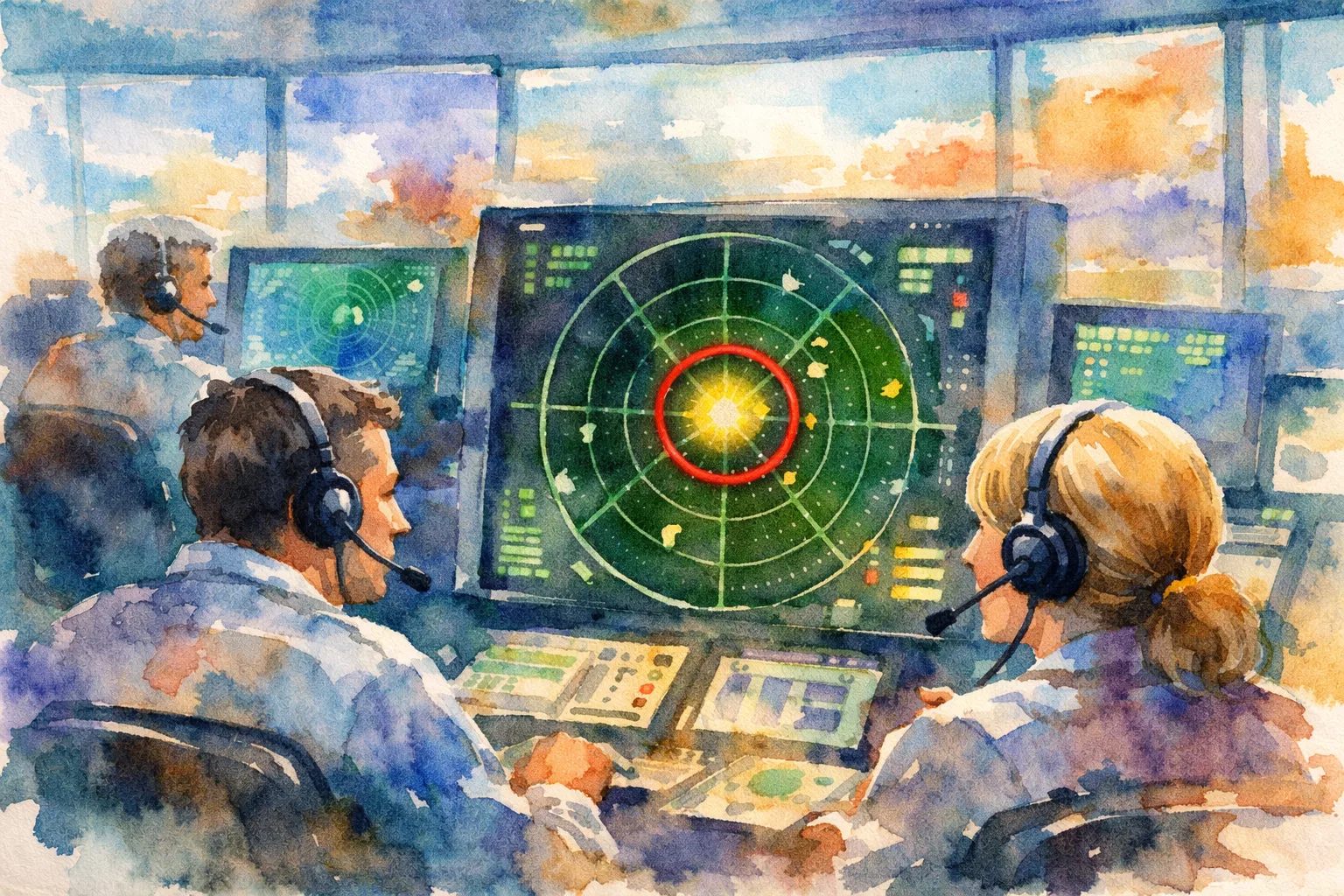
The air traffic control scene in Close Encounters is one of Spielberg’s cleanest demonstrations of institutional realism. The scene is not staged as a military briefing or a scientist’s lecture. It begins as routine work: a controller monitoring traffic, airline crews asking about nearby aircraft, and the language of position, range and altitude turning a mysterious light into an immediate airspace concern. A later transcript of the scene identifies the setting as Indianapolis Air Route Traffic Control Center, with Air East 31 reporting unknown traffic and the controller checking known traffic before acknowledging a primary target in roughly the same position.[Flight Safety Detectives]flightsafetydetectives.comFlight Safety Detectives CE3K_ATC_TranscriptFlight Safety DetectivesCE3K_ATC_Transcript - Google Docs…
That matters because the UFO is first treated as “traffic”, not as mythology. The controller’s questions follow an aviation logic: where is it, how close is it, what altitude is it at, and is it a hazard to other aircraft? The dramatic escalation comes from the mismatch between what the system can handle and what the witnesses describe. The crew reports something bright, above them and descending; the controller sees a primary target but lacks an altitude readout; another aircraft, TWA 517, provides a second visual perspective.[Flight Safety Detectives]flightsafetydetectives.comFlight Safety Detectives CE3K_ATC_TranscriptFlight Safety DetectivesCE3K_ATC_Transcript - Google Docs…
The result is a scene that makes authority feel credible without making authority omniscient. Controllers are experts, but they are not all-seeing. The pilots are trained observers, but they are still startled. The technology helps organise the event, yet it does not explain it. Spielberg’s realism lies in that middle ground: the strange object becomes more persuasive because competent people are trying, and failing, to reduce it to normal aviation categories.
Radar and Radio Work as Reality Cues
Radar gives UFO scenes a special kind of weight because it appears to move the event beyond personal testimony. In aviation, however, “radar” is not a single magic instrument. The FAA’s Aeronautical Information Manual explains that primary radar works by transmitting a signal and receiving a reflection from an object, while the Air Traffic Control Radar Beacon System, also called secondary surveillance radar, depends on aircraft transponders replying to interrogations from the ground system.[Federal Aviation Administration]faa.govFederal Aviation Administration Section 5Surveillance SystemsAir Traffic Control Radar Beacon System (ATCRBS). The ATCRBS, sometimes referred to as secondary surveillance radar…
This distinction is exactly what makes the Close Encounters scene sharper than a generic “blip on a screen” moment. The controller has a primary target, but no known high-altitude traffic and no altitude readout. In plain terms, the system has detected something, but not enough to identify it in the normal cooperative way. That is more credible than a film simply claiming that radar has proved an alien craft is present.[Flight Safety Detectives]flightsafetydetectives.comFlight Safety Detectives CE3K_ATC_TranscriptFlight Safety DetectivesCE3K_ATC_Transcript - Google Docs…
Radio chatter adds a second layer of realism. Aviation radio compresses emotion into procedure: clock positions, flight levels, traffic calls, heading changes and requests to “stand by”. In Spielberg’s scene, the fear is not expressed through panic speeches. It leaks through operational language. When Air East 31 says the traffic has turned towards the windshield and the crew is leaving flight level 350, the danger is legible because the language remains professional.[Flight Safety Detectives]flightsafetydetectives.comFlight Safety Detectives CE3K_ATC_TranscriptFlight Safety DetectivesCE3K_ATC_Transcript - Google Docs…
The same technique explains why the scene remains memorable even without a clear view of the UFO. A spectacular visual effect might have dated quickly; procedural tension has aged better. Viewers hear trained people comparing possibilities — traffic, military testing, space debris, an SR-71 — and those attempted explanations make the unknown more convincing because the film has done the sceptical sorting inside the scene rather than asking the audience to do it afterwards.[Flight Safety Detectives]flightsafetydetectives.comFlight Safety Detectives CE3K_ATC_TranscriptFlight Safety DetectivesCE3K_ATC_Transcript - Google Docs…
The Stigma Is Part of the Realism
The scene’s most revealing moment comes after the near miss. The controller asks whether the pilots want to report a UFO. Both crews decline. Air East 31 finally says it would not know what kind of report to file. That hesitation is not just a punchline; it captures a central problem in aviation UFO accounts, where pilots may be worried about ridicule, bureaucracy or the professional consequences of sounding irrational.[Flight Safety Detectives]flightsafetydetectives.comFlight Safety Detectives CE3K_ATC_TranscriptFlight Safety DetectivesCE3K_ATC_Transcript - Google Docs…
The issue has not disappeared. The FAA’s current air traffic control guidance now refers to “Unidentified Anomalous Phenomena” and instructs personnel to inform the operations supervisor or controller-in-charge of reported or observed activity. The FAA’s Aeronautical Information Manual has also directed people wanting to report UFO or unexplained phenomena activity to a reporting data collection centre, while advising local law enforcement contact if life or property may be endangered.[Federal Aviation Administration]faa.govFederal Aviation Administration Section 5Surveillance SystemsAir Traffic Control Radar Beacon System (ATCRBS). The ATCRBS, sometimes referred to as secondary surveillance radar…
NASA’s Aviation Safety Reporting System shows why a confidential reporting culture matters more broadly in aviation. ASRS describes itself as confidential, voluntary and non-punitive, and the FAA says ASRS receives and de-identifies incident reports from pilots, air traffic controllers, cabin crew, maintenance technicians, dispatchers and others involved in aviation operations.[ASRS]asrs.arc.nasa.govAviation Safety Reporting System - NASAConfidential. Voluntary. Non-Punitive. (airport, aircraft, tower graphic). ASRS captures confident…
This makes Spielberg’s old scene feel unusually modern. It recognises that a sighting is not only a sensory event; it is also a reporting event. A UFO film can show lights, radar and radio calls, but the most human question is often what happens next: who records the event, who believes it, and what professional cost attaches to saying “UFO” aloud?
Radar-Visual Evidence Feels Strong, But It Has Limits
UFO cinema often treats radar-visual confirmation as the gold standard: someone sees the object, and an instrument appears to confirm that something is there. Spielberg uses that structure carefully. In Close Encounters, the pilots see the object, the controller sees a primary target, and a second aircraft adds another witness. That layered evidence makes the scene feel more grounded than a lone witness staring at a light in the sky.[Flight Safety Detectives]flightsafetydetectives.comFlight Safety Detectives CE3K_ATC_TranscriptFlight Safety DetectivesCE3K_ATC_Transcript - Google Docs…
But the film also leaves an important ambiguity intact. Primary radar can detect reflected energy from objects, but it may not supply identity or altitude in the way secondary radar and transponder systems can. SKYbrary, an aviation safety knowledge base, defines primary surveillance radar as a system using reflected radio signals and notes that it provides range and bearing relative to the antenna. The FAA similarly distinguishes primary returns from transponder-based replies that can add identification and altitude information.[Skybrary]skybrary.aeroPrimary Surveillance Radar (PSR) | SKYbrary Aviation SafetyThe primary surveillance radar is equipment that emits radio wave puls…
That technical limitation is narratively useful. If the radar return were too complete, the mystery would shrink into a solvable tracking problem. If there were no radar at all, the scene would become pure anecdote. Spielberg’s balance is to give the audience enough instrumentation to trust that the event is not imaginary, but not enough to resolve what the object is.
Modern UAP analysis reinforces the same caution. NASA’s independent UAP study found that air traffic control and radar data may be useful, but warned that such data is often collected incidentally by instruments not designed for UAP research and may lack the contextual information needed for rigorous analysis. The 2021 U.S. intelligence preliminary assessment similarly identified limited data and inconsistent reporting as major obstacles to evaluating UAP cases.[NASA Science]science.nasa.govNASA ScienceIndependent Study Team ReportThese data include information obtained from air traffic control towers and radar systems. Howev…
Spielberg’s Technical Realism Is Selective, Not Documentary
The realism of Close Encounters should not be mistaken for documentary accuracy. Spielberg uses aviation procedure as a credibility engine, then bends it towards awe. The scene’s job is not to teach air traffic control; it is to prepare the viewer to accept that the UFO phenomenon is entering ordinary systems from multiple angles: pilots, radar rooms, government teams, electrical workers and anxious families.
That selectivity is visible in the way the film concentrates many useful UFO-cinema signals into one compact scene:
- Professional witnesses: pilots and controllers speak in restrained, practical terms.
- Instrument support: the object is not only seen; it is also associated with a primary radar target.
- Multiple viewpoints: two airline crews contribute to the event rather than one isolated observer.
- Plausible alternatives: controllers consider known explanations before the moment becomes unclassifiable.
- Reporting hesitation: the film acknowledges the social awkwardness of making a UFO report.[Flight Safety Detectives]flightsafetydetectives.comFlight Safety Detectives CE3K_ATC_TranscriptFlight Safety DetectivesCE3K_ATC_Transcript - Google Docs…
This is why the sequence fits Spielberg’s larger UFO method. Close Encounters is full of wonder, but it does not begin with wonder alone. It first builds a world of records, maps, radio calls, classification systems and official activity. The more ordinary the systems look, the more extraordinary the intrusion feels.
How Later UAP Evidence Changes the Way the Scene Plays
A viewer in 1977 might have read the air traffic control scene mainly as suspenseful fiction. A viewer today is likely to hear other resonances: pilot stigma, military and civilian reporting pathways, data quality debates, and the challenge of interpreting sensor returns. NASA’s UAP work explicitly calls for moving the subject towards better data and more scientific analysis, while AARO says it approaches UAP through a rigorous, data-driven framework.[NASA Science]science.nasa.govNASA ScienceIndependent Study Team ReportThese data include information obtained from air traffic control towers and radar systems. Howev…
That does not mean Spielberg “predicted” modern UAP policy. It means he understood the dramatic power of the same unresolved triangle that still shapes the subject: trained witnesses, technical systems and incomplete evidence. The scene feels authentic because it does not overclaim. The pilots and controllers do not prove an alien craft exists; they document an encounter that outruns their categories.
The strongest lesson for UFO cinema is therefore not “add radar and the audience will believe”. It is subtler: technical detail is persuasive when it also shows its own limits. Radio procedure, traffic calls and radar returns make the unknown feel grounded, but the unknown remains unknown. In Spielberg’s hands, that gap is not a weakness. It is the space where realism and wonder meet.
Amazon book picks
Further Reading
Books and field guides related to How Technical Details Make UFOs Believable. Use these as the next step if you want deeper reading beyond the article.
UFO: The Inside Story of the US Government's Search for Alien...
Covers the institutional and evidential world that makes radar and technical sightings persuasive.
The Close Encounters Man: How One Man Made the World Believe...
Places technical UFO investigation and expert credibility into cultural context.
The UFO Experience: A Scientific Inquiry
Classifies sighting types including radar-visual cases and explains why technical corroboration matters.
Close Encounters of the Third Kind: The Making of Steven Spie...
Covers the production context for Close Encounters, including how procedural detail supports believability.
eBay marketplace picks
Marketplace Samples
Example marketplace items related to this page. Use the search link to explore similar finds on eBay.

Endnotes
1.
Source: faa.gov
Title: Federal Aviation Administration Section 5
Link:https://www.faa.gov/air_traffic/publications/atpubs/aim_html/chap4_section_5.html
Source snippet
Surveillance SystemsAir Traffic Control Radar Beacon System (ATCRBS). The ATCRBS, sometimes referred to as secondary surveillance radar...
2.
Source: science.nasa.gov
Link:https://science.nasa.gov/wp-content/uploads/2023/09/uap-independent-study-team-final-report.pdf
Source snippet
NASA ScienceIndependent Study Team ReportThese data include information obtained from air traffic control towers and radar systems. Howev...
3.
Source: faa.gov
Link:https://www.faa.gov/air_traffic/publications/atpubs/atc_html/chap9_section_8.html
Source snippet
Federal Aviation AdministrationSection 8. Unidentified Anomalous Phenomena (UAP...Inform the operations supervisor/CIC of any reported o...
4.
Source: faa.gov
Title: Federal Aviation Administration Section 6
Link:https://www.faa.gov/air_traffic/publications/atpubs/aim/aim0706.html
Source snippet
Safety, Accident, and Hazard Reports8 Jan 2015 — 7-6-4. Unidentified Flying Object (UFO) Reports. a. Persons wanting to report UFO/unexpl...
5.
Source: asrs.arc.nasa.gov
Link:https://asrs.arc.nasa.gov/
Source snippet
Aviation Safety Reporting System - NASAConfidential. Voluntary. Non-Punitive. (airport, aircraft, tower graphic). ASRS captures confident...
6.
Source: faa.gov
Title: aviation voluntary reporting programs 1
Link:https://www.faa.gov/newsroom/aviation-voluntary-reporting-programs-1
Source snippet
Federal Aviation AdministrationAviation Voluntary Reporting Programs10 Mar 2021 — ASRS receives, de-identifies, and analyzes aviation saf...
7.
Source: skybrary.aero
Link:https://skybrary.aero/articles/primary-surveillance-radar-psr
Source snippet
Primary Surveillance Radar (PSR) | SKYbrary Aviation SafetyThe primary surveillance radar is equipment that emits radio wave puls...
8.
Source: science.nasa.gov
Link:https://science.nasa.gov/uap/
9.
Source: aaro.mil
Link:https://www.aaro.mil/
10.
Source: aaro.mil
Link:https://www.aaro.mil/UAP-Cases/Official-UAP-Imagery/
11.
Source: aaro.mil
Link:https://www.aaro.mil/Submit-A-Report/
12.
Source: aaro.mil
Link:https://www.aaro.mil/UAP-Cases/UAP-Case-Resolution-Reports/
13.
Source: faa.gov
Title: document ID
Link:https://www.faa.gov/regulations_policies/orders_notices/index.cfm/go/document.information/documentID/1044304
14.
Source: faa.gov
Link:https://www.faa.gov/air_traffic/publications/media/aim.pdf
15.
Source: faa.gov
Title: aim chg1 dtd 3 29 18
Link:https://www.faa.gov/air_traffic/publications/media/aim_chg1_dtd_3-29-18.pdf
16.
Source: faa.gov
Title: 2025 09 12 Notice N7110.800 Unidentied Anomalous Phenomena (UAP) Reports FINAL
Link:https://www.faa.gov/documentLibrary/media/Notice/2025-09-12Notice_N7110.800_Unidentied_Anomalous_Phenomena%28UAP%29_Reports_FINAL.pdf
17.
Source: faa.gov
Title: asr 11
Link:https://www.faa.gov/air_traffic/technology/asr-11
18.
Source: asrs.arc.nasa.gov
Link:https://asrs.arc.nasa.gov/publications/callback/cb_555.html
19.
Source: asrs.arc.nasa.gov
Title: cb 527
Link:https://asrs.arc.nasa.gov/publications/callback/cb_527.html
20.
Source: asrs.arc.nasa.gov
Title: ASRS Program Briefing
Link:https://asrs.arc.nasa.gov/docs/ASRS_ProgramBriefing.pdf
21.
Source: nasa.gov
Title: 40 years of safer aviation through reporting
Link:https://www.nasa.gov/aeronautics/40-years-of-safer-aviation-through-reporting/
22.
Source: ntrs.nasa.gov
Title: ICASS 2024 ASRS
Link:https://ntrs.nasa.gov/api/citations/20240014226/downloads/ICASS%202024%20ASRS.pdf
23.
Source: asrs.arc.nasa.gov
Title: 60 Case for Confidential Incident Reporting
Link:https://asrs.arc.nasa.gov/docs/rs/60_Case_for_Confidential_Incident_Reporting.pdf
24.
Source: skybrary.aero
Link:https://skybrary.aero/sites/default/files/bookshelf/4143.pdf
25.
Source: skybrary.aero
Link:https://skybrary.aero/articles/surveillance
26.
Source: skybrary.aero
Link:https://skybrary.aero/articles/secondary-surveillance-radar-ssr
27.
Source: youtube.com
Title: Close Encounters of the Third Kind
Link:https://www.youtube.com/watch?v=MLiRnvppAaM
Source snippet
3 Close Encounters Air Traffic Control Scene...
28.
Source: flightsafetydetectives.com
Title: Flight Safety Detectives CE3K_ATC_Transcript
Link:https://flightsafetydetectives.com/wp-content/uploads/2026/02/CE3K_ATC_Transcript.pdf
Source snippet
Flight Safety DetectivesCE3K_ATC_Transcript - Google Docs...
29.
Source: Wikipedia
Title: Close Encounters of the Third Kind
Link:https://en.wikipedia.org/wiki/Close_Encounters_of_the_Third_Kind
30.
Source: Wikipedia
Title: Secondary surveillance radar
Link:https://en.wikipedia.org/wiki/Secondary_surveillance_radar
31.
Source: Wikipedia
Title: Aviation Safety Reporting System
Link:https://en.wikipedia.org/wiki/Aviation_Safety_Reporting_System
32.
Source: flightsafetydetectives.com
Link:https://flightsafetydetectives.com/what-did-steven-spielberg-get-right-about-ufo-encounters-in-the-cockpit-episode-317/
33.
Source: flightsafetydetectives.com
Title: CITD Curtis ASRS1
Link:https://flightsafetydetectives.com/wp-content/uploads/2025/01/CITD_Curtis_ASRS1.pdf
34.
Source: blog.dronedesk.io
Title: aviation safety reporting system
Link:https://blog.dronedesk.io/aviation-safety-reporting-system/
35.
Source: jhwikicollection-20.fandom.com
Title: Close Encounters of the Third Kind
Link:https://jhwikicollection-20.fandom.com/wiki/Close_Encounters_of_the_Third_Kind
36.
Source: bfidatadigipres.github.io
Title: close encounters of the third kind
Link:https://bfidatadigipres.github.io/member%20picks/2022/02/23/close-encounters-of-the-third-kind/
Additional References
37.
Source: youtube.com
Link:https://www.youtube.com/watch?v=8fbkXE1xBTM
Source snippet
2 Close Encounters of the Third Kind - Air Traffic Control scene HD...
38.
Source: youtube.com
Link:https://www.youtube.com/watch?v=6gRdt7qkSW4
Source snippet
5 Air East 31 Deleted Scene - Close Encounters...
39.
Source: youtube.com
Title: Close Encounters Air Traffic Control Scene
Link:https://www.youtube.com/watch?v=KW10xCub3Kg
Source snippet
4 Close Encounters of the Third Kind Air Traffic Control Scene with airport deleted scene included...
40.
Source: researchgate.net
Link:https://www.researchgate.net/publication/400348279_Science_in_a_Stigmatized_Field_Challenges_and_Opportunities_in_the_Emerging_Research_Domain_of_UAP
41.
Source: aui.edu
Link:https://aui.edu/aaro-releases-report-on-unidentified-anomalous-phenomena-uap/
42.
Source: reddit.com
Link:https://www.reddit.com/r/UFOs/comments/1ccnj6t/aaro_does_not_have_a_100_confidence_in_its_report/
43.
Source: aiaa.org
Link:https://aiaa.org/wp-content/uploads/2025/08/AIAA-UAPIOC-Opinion-Paper-UAP-Occupational-Safety-Reporting_ForPublication_kb.pdf
44.
Source: intersoft-electronics.com
Link:https://intersoft-electronics.com/wp-content/uploads/2023/09/IE-IEA-01364-001-ATC-Challenges-and-Solutions-1.pdf
45.
Source: aircraftspruce.com
Link:https://www.aircraftspruce.com/catalog/pdf/ASRS_ProgramBriefing.pdf
46.
Source: studyaircrafts.com
Link:https://www.studyaircrafts.com/atc-transponder
Topic Tree