Within Hynek System
First Kind Sighting 964 Dcc
Steven Spielberg’s Close Encounters of the Third Kind is remembered for its climactic meeting between humans and extraterrestrials, but the film’s emotional engine begins much earlier. Before contact, before proof, and before explanation, there is simply a sighting. That starting point closely mirrors J.
Page outline Jump by section
Introduction
Steven Spielberg’s Close Encounters of the Third Kind is remembered for its climactic meeting between humans and extraterrestrials, but the film’s emotional engine begins much earlier. Before contact, before proof, and before explanation, there is simply a sighting. That starting point closely mirrors J. Allen Hynek’s idea of a Close Encounter of the First Kind: a nearby observation of an unidentified object without direct interaction. In Hynek’s system, this is the threshold where certainty begins to erode and curiosity takes over.[Center for UFO Studies]cufos.orgCenter for UFO Studies Classification SystemsAllen Hynek developed his classification system as he was working on his book The UFO Experience, to help him organize UFO reports into c…
 Spielberg recognised the dramatic power of that threshold. Rather than opening with undeniable evidence, he builds his story around ordinary people who see something extraordinary and struggle to describe it. The result is a film in which the first sighting matters as much as the final encounter. It creates doubt, fascination and obsession long before anyone knows what they are looking at.[Wikipedia]WikipediaClose encounterClose encounterSightings within about 150 meters (500 ft) are sub-classified as various types of close encounters. Hynek and others ar…
What Hynek meant by the first kind
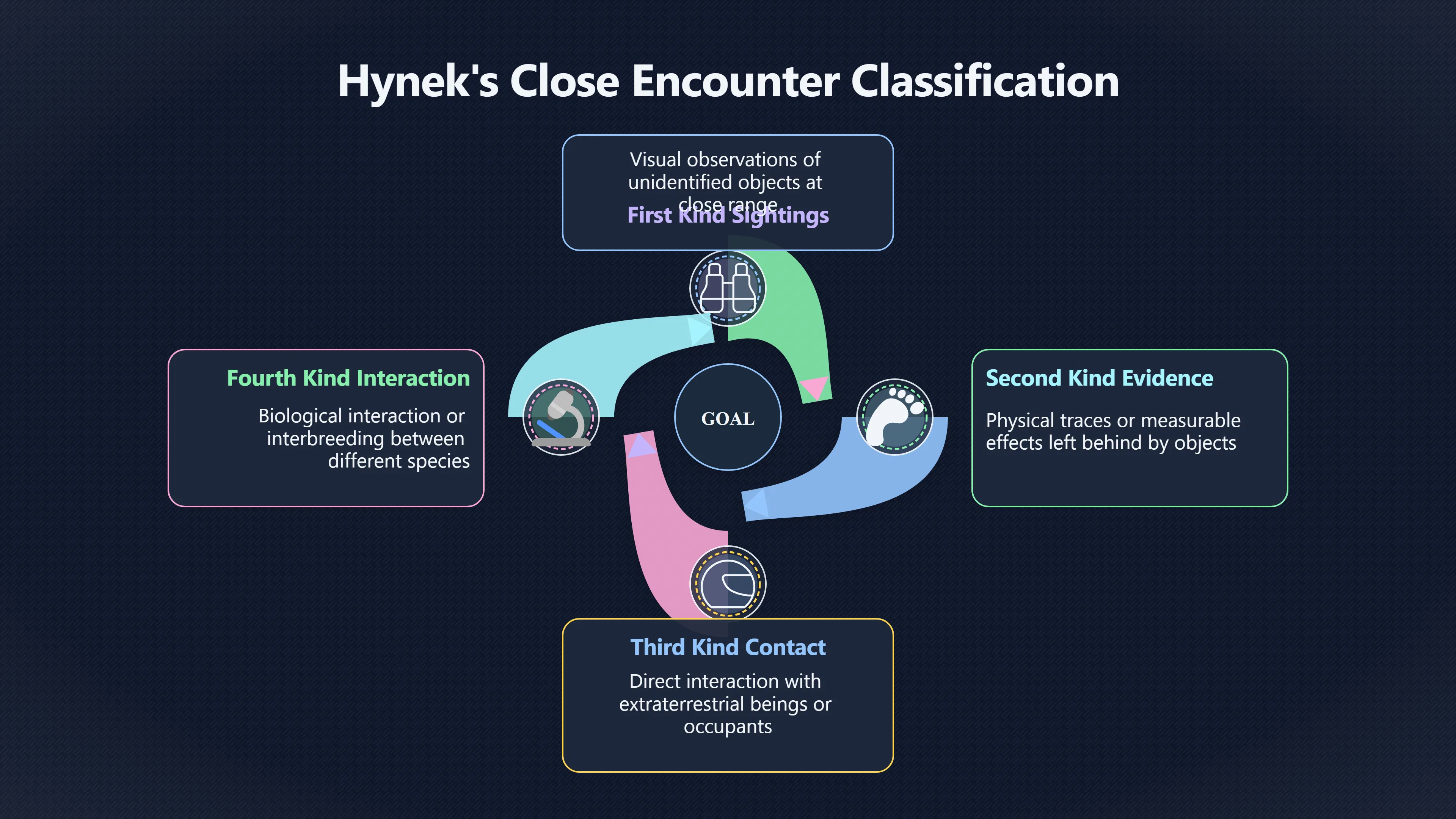
Hynek developed his close encounter classification system in the early 1970s as a way to organise UFO reports. A Close Encounter of the First Kind referred to a visual observation of an unidentified object at relatively close range—commonly defined as within about 500 feet—where enough detail could be seen that simple misidentification became less likely. Crucially, the witness sees something unusual, but there is no direct contact and no physical evidence left behind.[Center for UFO Studies]cufos.orgCenter for UFO Studies Classification SystemsAllen Hynek developed his classification system as he was working on his book The UFO Experience, to help him organize UFO reports into c… Wikipedia This category is fundamentally about perception. The witness has experienced something significant[Wikipedia]WikipediaClose encounterClose encounterSightings within about 150 meters (500 ft) are sub-classified as various types of close encounters. Hynek and others ar…, yet possesses little more than a memory and a description. Unlike later categories in Hynek’s scale, the first kind does not provide investigators with traces, occupants or measurable effects. It creates a puzzle rather than a solution.[Center for UFO Studies]cufos.orgCenter for UFO Studies Classification SystemsAllen Hynek developed his classification system as he was working on his book The UFO Experience, to help him organize UFO reports into c…
That limitation is precisely what makes the category useful for storytelling. A witness may be convinced something extraordinary happened while remaining unable to prove it to anyone else. The gap between certainty and evidence becomes the source of tension.
How Spielberg turns sightings into suspense
Spielberg structures much of Close Encounters of the Third Kind around this first-kind dynamic. Roy Neary is not initially presented as a scientist, military officer or UFO investigator. He is an ordinary worker whose life is disrupted by an unexpected sighting. What follows is not immediate revelation but confusion. He knows he saw something, yet cannot fully explain it.[Wikipedia]WikipediaClose Encounters of the Third KindClose Encounters of the Third Kind
This approach distinguishes the film from many science-fiction stories of its era. Instead of treating UFOs as obvious external threats or clearly understood visitors, Spielberg places viewers inside the witness experience. Information arrives in fragments:
- Brief visual glimpses.
- Contradictory interpretations.
- Emotional reactions from witnesses.
- Authorities who appear uncertain or secretive.
The audience therefore occupies the same position as the characters. We are asked to observe first and understand later.
Hynek’s classification system helps explain why this works. The First Kind is not about confirmation. It is about the moment when a familiar world becomes unreliable. A strange light in the sky is unsettling precisely because it resists easy categorisation. Spielberg repeatedly returns to that sensation of seeing without knowing.[Center for UFO Studies]cufos.orgCenter for UFO Studies Classification SystemsAllen Hynek developed his classification system as he was working on his book The UFO Experience, to help him organize UFO reports into c…

Why visual evidence is never enough
One of the most striking aspects of the film is that seeing the UFO does not resolve the mystery. In many narratives, visual proof ends debate. Spielberg uses the opposite logic.
Roy’s encounter provides him with certainty but not understanding. The sighting transforms him because he feels he has witnessed something real, yet he lacks a framework capable of explaining it. His experience becomes difficult to communicate to family members and neighbours who did not see what he saw.[Wikipedia]WikipediaJ. Allen HynekJ. Allen HynekJosef Allen Hynek (May 1, 1910 – April 27, 1986) was an American astronomer, professor, and ufologist. He is perhaps bes…
This reflects a long-standing challenge in UFO reports. Hynek’s first-kind category assumes that observation alone can be compelling for the witness while remaining inconclusive for everyone else. Even a detailed sighting leaves unanswered questions about identity, origin and meaning.[Center for UFO Studies]cufos.orgCenter for UFO Studies Classification SystemsAllen Hynek developed his classification system as he was working on his book The UFO Experience, to help him organize UFO reports into c…
Spielberg converts that ambiguity into character drama. The important question is not whether Roy saw something. The audience sees enough to accept that he did. The tension comes from what the sighting does to him:
- It isolates him from ordinary routines.
- It changes his priorities.
- It creates an obsession with finding answers.
- It pushes him beyond the limits of conventional explanation.
The first sighting therefore functions as a narrative trigger rather than a narrative payoff.
The threshold that makes the rest of the film possible
The title Close Encounters of the Third Kind points toward eventual contact with extraterrestrial beings, but the film’s emotional credibility depends on the earlier stage represented by the First Kind. Without that initial encounter, the later escalation would feel arbitrary.
Spielberg’s achievement was recognising that wonder begins before proof. Hynek’s first category captures the instant when a witness crosses from ordinary experience into uncertainty. The object is seen clearly enough to matter, yet not clearly enough to settle the question.[Center for UFO Studies]cufos.orgCenter for UFO Studies Classification SystemsAllen Hynek developed his classification system as he was working on his book The UFO Experience, to help him organize UFO reports into c… Wikipedia By building his film around that threshold[Wikipedia]WikipediaClose encounterClose encounterSightings within about 150 meters (500 ft) are sub-classified as various types of close encounters. Hynek and others ar…, Spielberg transforms a technical UFO classification into a powerful storytelling mechanism. The audience is drawn into the same position occupied by countless witnesses in UFO reports: staring at something extraordinary, convinced they saw it, but still searching for the words to explain what it was.[2syfy.com]syfy.comproject blue book close encounters flash forwardProject Blue Book Close Encounters of the Third Kind flash…24 Feb 2020 — The director also invited Hynek to serve as a technical consu…
Amazon book picks
Further Reading
Books and field guides related to Hynek's first kind as Spielberg's sighting threshold. Use these as the next step if you want deeper reading beyond the article.
Close Encounters of the Third Kind
Shows how sighting reports inspired Spielberg's storytelling.
The UFO Experience
Best source for understanding first-kind sightings and close encounter categories.

Passport to Magonia: from folklore to flying saucers
Examines patterns in witness reports and unexplained sightings.
eBay marketplace picks
Marketplace Samples
Example marketplace items related to this page. Use the search link to explore similar finds on eBay.

Endnotes
1.
Source: Wikipedia
Title: Close encounter
Link:https://en.wikipedia.org/wiki/Close_encounter
Source snippet
Close encounterSightings within about 150 meters (500 ft) are sub-classified as various types of close encounters. Hynek and others ar...
2.
Source: Wikipedia
Title: Close Encounters of the Third Kind
Link:https://en.wikipedia.org/wiki/Close_Encounters_of_the_Third_Kind
3.
Source: Wikipedia
Title: J. Allen Hynek
Link:https://en.wikipedia.org/wiki/J._Allen_Hynek
Source snippet
J. Allen HynekJosef Allen Hynek (May 1, 1910 – April 27, 1986) was an American astronomer, professor, and ufologist. He is perhaps bes...
Published: May 1, 1910
4.
Source: syfy.com
Title: project blue book close encounters flash forward
Link:https://www.syfy.com/syfy-wire/project-blue-book-close-encounters-flash-forward
Source snippet
Project Blue Book Close Encounters of the Third Kind flash...24 Feb 2020 — The director also invited Hynek to serve as a technical consu...
5.
Source: Wikipedia
Title: Close (2022 film)
Link:https://en.wikipedia.org/wiki/Close_%282022_film%29
Source snippet
Close (2022 film)It follows two teenage boys whose close friendship is thrown into disarray when their schoolmates notice their intima...
6.
Source: Wikipedia
Title: Project Blue Book
Link:https://en.wikipedia.org/wiki/Project_Blue_Book
Source snippet
Project Blue BookProject Blue Book was the code name for the systematic study of unidentified flying objects (UFOs) by the United Stat...
7.
Source: Wikipedia
Link:https://en.wikipedia.org/wiki/J
Source snippet
JJ (minuscule: j) is the tenth letter of the Latin alphabet, used in the modern English alphabet, the alphabets of other Western Europ...
8.
Source: cufos.org
Title: Center for UFO Studies Classification Systems
Link:https://cufos.org/types-of-ufos/classification-systems/
Source snippet
Allen Hynek developed his classification system as he was working on his book The UFO Experience, to help him organize UFO reports into c...
9.
Source: kardashev.fandom.com
Link:https://kardashev.fandom.com/wiki/UFO
Source snippet
Kardashev Scale Wiki - FandomJosef Allen Hynek was an American astronomer and ufologist who devised this scale for close encounters which...
10.
Source: science.howstuffworks.com
Title: ufo classification
Link:https://science.howstuffworks.com/space/aliens-ufos/ufo-classification.htm
Source snippet
ClassificationA close encounter of the first kind is a visual sighting of a UFO. The second kind involves the UFO leaving some kind of a...
11.
Source: engines.egr.uh.edu
Link:https://engines.egr.uh.edu/episode/2873
Source snippet
of the Third Kind | The Engines of Our IngenuityApr 1, 2013 — Hynek developed a systematic classification of various encounters with unid...
Additional References
12.
Source: universalcompendium.com
Link:https://www.universalcompendium.com/tables/phil/ufos.htm
Source snippet
Classification of UFO SightingsClassification of UFO Sightings; Close Encounters of the Seventh Kind, CE7, Interbreeding between human a...
13.
Source: awakenche.org
Link:https://awakenche.org/knowledge-base/close-encounters-of-the-second-kind/
14.
Source: cufos.org
Link:https://cufos.org/PDFs/books/The_Hynek_UFO_Report.pdf
Source snippet
H¥NEKDr. J. Allen Hynek is Professor of. Astronomy at Northwestern University in the United States. He is also head of the. Centre for UF...
15.
Source: enigmalabs.io
Link:https://enigmalabs.io/library/6483dd0f-9d12-41fa-842b-c064d636c3bb
Source snippet
Hynek's Close Encounters ScaleAllen Hynek devised a sixfold classification for UFO sightings, ranked by proximity to the event. Populariz...
16.
Source: cufos.org
Link:https://cufos.org/hynek-biography/j-allen-hynek-biography/
17.
Source: slj.com
Link:https://www.slj.com/review/the-real-story-close-encounters-of-the-third-kind
Source snippet
The Real Story: Close Encounters of the Third KindThe majority of the piece focuses on the work of Dr. J. Allen Hynek, noted UFO research...
18.
Source: themindreels.com
Title: close encounters of the third kind 1977 steven spielberg
Link:https://themindreels.com/2013/02/22/close-encounters-of-the-third-kind-1977-steven-spielberg/
Source snippet
Close Encounters of the Third Kind (1977) – Steven Spielberg22 Feb 2013 — The film follows an everyman, Roy Neary (Richard Dreyfuss) as h...
19.
Source: chud.com
Title: tugging on the beard close encounters of the third kind
Link:https://chud.com/174/tugging-on-the-beard-close-encounters-of-the-third-kind/
Source snippet
CLOSE ENCOUNTERS OF THE THIRD KIND18 Feb 2008 — Spielberg talks about how he was a different man when he made the film, and that he'd nev...
20.
Source: smokingpipes.com
Title: allen hynek pipe smoking astronomer and ufo researcher
Link:https://www.smokingpipes.com/smokingpipesblog/single.cfm/post/allen-hynek-pipe-smoking-astronomer-and-ufo-researcher
Source snippet
J. Allen Hynek: Pipe Smoking Astronomer and UFO...15 Jan 2021 — Close Encounters of the First Kind refers to UFO sightings i...
21.
Source: reactormag.com
Title: the birth of spielbergian close encounters of the third kind at 40
Link:https://reactormag.com/the-birth-of-spielbergian-close-encounters-of-the-third-kind-at-40/
Source snippet
We begin with a nuclear family: Roy Neary, his wife Ronnie, and their three kids in a cluttered, noisy house.Read more...
Topic Tree