Within Spielberg
When Spielberg Made Contact Terrifying
War of the Worlds shows Spielberg's darker answer to the same question: what if contact means terror, not wonder?
On this page
- Invasion instead of invitation
- Helplessness and mass displacement
- The fear side of Spielberg's alien vision
Page outline Jump by section
Introduction
War of the Worlds is Spielberg’s darkest answer to the question that made Close Encounters of the Third Kind so moving: what happens when contact is not a summons, but an assault? Released in 2005, his adaptation of H. G. Wells’s invasion story replaces the luminous invitation of earlier Spielberg alien cinema with panic, ash, sirens, missing-person walls, military helplessness and families fleeing through a collapsing America. The film still belongs inside Spielberg’s UFO imagination, but it turns the emotional polarity upside down: the sky no longer promises communication, and the alien presence offers no explanation, bargain or shared language. AFI identifies the film as a Spielberg-directed, Tom Cruise-led adaptation released on 29 June 2005, while contemporary and later critics have repeatedly read it as one of the clearest post-9/11 alien-invasion films of its era.[AFI Catalog]catalog.afi.comAFI CatalogWar of the Worlds (2005) - AFI CatalogPG-13 | 117 mins | Science fiction | 29 June 2005; Cast: Tom Cruise, Dakota Fanning, Mi…
Invasion Instead of Invitation
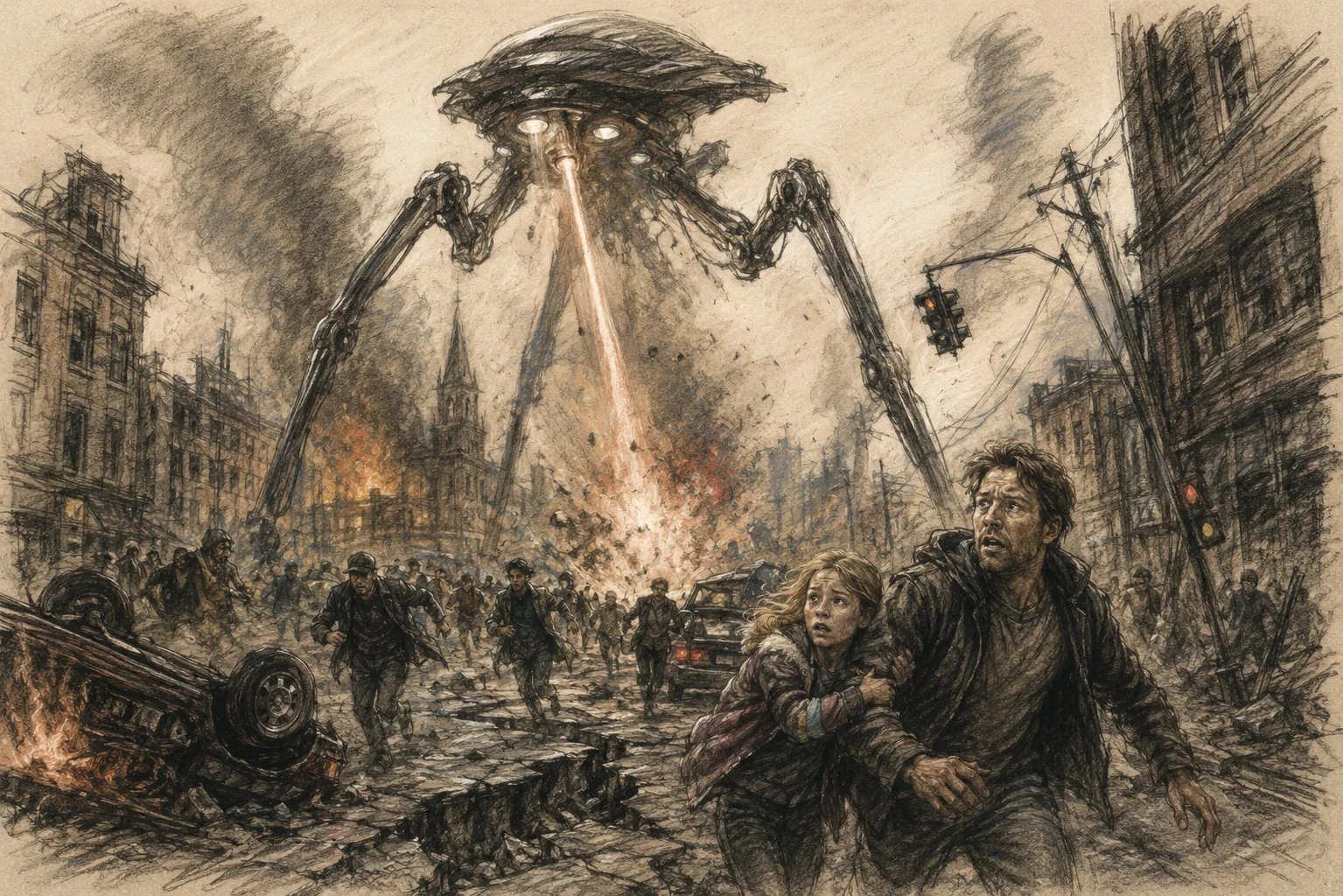
Spielberg’s earlier alien films made contact feel spiritually charged. Close Encounters moved towards music, light and exchange; E.T. made the extraterrestrial vulnerable, childlike and intimate. War of the Worlds keeps the sense of awe but drains it of comfort. The tripod’s first emergence is staged like a revelation, yet what is revealed is not intelligence reaching out but intelligence choosing extermination. The result is not a reversal of Spielberg’s UFO interests so much as their fear-side: contact remains overwhelming, but its meaning is unreadable and lethal.
That contrast was not accidental. Production accounts and interviews around the film repeatedly framed War of the Worlds as the hostile counterweight to Spielberg’s benevolent alien work. The film’s own premise is stripped to a blunt survival line: Ray Ferrier, a divorced dockworker, must protect his children after alien machines begin devastating cities and towns. Rotten Tomatoes’ synopsis captures the domestic scale of the plot, noting that the invasion begins during an already tense weekend with Ray’s children, while AFI’s catalogue records the central creative team: Spielberg directing, Josh Friedman and David Koepp writing, and Janusz Kamiński photographing the film.[Rotten Tomatoes]rottentomatoes.comRotten TomatoesWar of the WorldsHowever, when electromagnetic pulses of lightning strike the area, the strange event turns out to be the…
The most important creative decision is that the aliens do not arrive as visitors in the usual screen language of spacecraft. In Spielberg’s version, the tripods have been hidden underground, waiting beneath ordinary streets. This makes invasion feel less like a spectacle from outer space than a buried threat erupting inside daily life. A 2005 press-conference account describes the change from Wells’s falling cylinders to machines lying dormant beneath the Earth, while later production summaries attribute the buried-tripod idea to Spielberg’s resistance to the familiar image of aliens arriving in spaceships.[Black Film]blackfilm.comBlack FilmPress Conference Interview with Director Steven Spielberg…Jun 24, 2005 — One of the things changed from the novel was having…
That choice gives the film its particular terror. The enemy is alien, but the rupture is local: pavements crack, church walls split, neighbourhoods turn into killing grounds. The first contact is not a meeting at a landing site; it is the destruction of a street corner.

Contact Without Communication
One of the film’s bleakest moves is its refusal to give the invaders a communicative dimension. Spielberg’s earlier UFO cinema is full of signals: lights, tones, gestures, faces, musical phrases. War of the Worlds has signals too, but they are warnings rather than messages. Lightning strikes disable technology. The tripod horn is not language in the humanising sense; it is a sound of domination. The heat ray is the invaders’ clearest “statement”.
This matters because Spielberg does not simply make the aliens evil in a comic-book way. He makes them unknowable. They do not explain themselves, negotiate, threaten by broadcast or appear before world leaders. The New Yorker’s 2005 review stressed how radically the film removes the usual institutional apparatus of invasion cinema: no brilliant scientists, no military-intelligence experts, no White House or United Nations response guiding the audience through the crisis. Instead, the viewer stays close to Ray’s panic as the destruction becomes “immediate and total”.[The New Yorker]newyorker.comThe New Yorker Stayin' AliveWells's novel, devoid of scientific experts or high-level political intervention, instead focusing on raw human survival. Tom Cruise star…
The absence of explanation also changes the viewer’s relationship to scale. A more conventional invasion film often expands outward towards maps, command rooms and strategy. Spielberg contracts inward. The audience knows almost nothing more than the fleeing family knows. This makes the aliens feel less like opponents in a war narrative and more like a hostile condition: weather, plague, occupation and mass violence fused into one unstoppable presence.
Roger Ebert saw a weakness in that refusal, arguing that the invasion seemed destructive “for no apparent reason” and that the aliens’ long planning produced a strangely flawed strategy. That criticism points to a real tension in the film: as speculative world-building, the invaders are thinly explained; as a nightmare of helpless contact, their opacity is the point.[Roger Ebert]rogerebert.comRoger Ebert Creaking Havoc movie review & filmRoger EbertCreaking Havoc movie review & film summary“War of the Worlds” is a big, clunky movie containing some sensational sights but la…
Helplessness and Mass Displacement
The most distinctive part of Spielberg’s War of the Worlds is not that the aliens are powerful. It is that human beings become refugees almost immediately. The film does not centre heroic counterattack. It follows people running, hiding, crowding roads, fighting over transport and trying to keep children alive when the old systems no longer work.
That makes the film very different from the triumphant alien-invasion blockbuster tradition. In Independence Day, destruction eventually feeds a story of military recovery and patriotic victory. In War of the Worlds, the state and army are mostly background forces, brave but overmatched. The film’s practical lesson is not “fight back”; it is “move, hide, endure”. Contemporary commentary recognised this as a defining feature, with one widely cited description reducing the film’s anti-war posture to the blunt instruction: if aliens invade, do not fight back — run.[Wikipedia]WikipediaWar of the Worlds (2005 filmWar of the Worlds (2005 film
Spielberg builds that helplessness through concrete images rather than speeches. Ray comes home covered in grey ash after the first tripod attack. A burning train passes through a crossing as if the machinery of everyday life is still obeying its schedule while civilisation collapses. Crowds swarm the only working car. A ferry crossing turns into a crush of panic and violence. Bodies float downriver. The horror comes from watching ordinary civic space become evacuation space.
This is where the film’s post-9/11 reading becomes unavoidable, though it should not be reduced to a one-to-one allegory. The Guardian’s review called it a powerful update of Wells for the post-9/11 era, while later retrospectives have singled out its imagery of dust, missing people, sudden urban attack and terrified civilians as central to its impact.[The Guardian]theguardian.comThe GuardianWar of the Worlds | Film5 Jan 2006 — A powerful, intense movie that skilfully updates the HG Wells classic for the post 9/11…
The line “Is it the terrorists?” spoken by Rachel, Ray’s daughter, is especially revealing. It places the alien attack inside the mental furniture of an American child in 2005: the first available explanation for catastrophe is terrorism. That does not make the tripods terrorists in a literal sense. It makes hostile contact a screen on which contemporary fear can register.

A Family Story Under Alien Pressure
For all its scale, War of the Worlds is built around a narrow family problem. Ray is not a scientist, soldier or chosen intermediary. He is an unreliable father who becomes useful only when the world shrinks to survival. That is a crucial Spielberg move. The invasion does not test humanity through speeches about civilisation; it tests one parent’s capacity to protect children he does not fully understand.
This domestic focus makes the film a darker mirror of Close Encounters. In Close Encounters, Roy Neary’s encounter pulls him away from family life and towards the alien unknown. In War of the Worlds, Ray’s encounter forces him into family responsibility. The aliens are not an escape route from domestic failure; they are the catastrophe that exposes it. A 2005 interview account directly raised this reversal, asking Spielberg about the contrast between the man who leaves with the aliens and the father who must stay with his family.[CHUD]chud.cominterview tom cruise and steven spielberg war of the worldsinterview tom cruise and steven spielberg war of the worlds
Tom Cruise’s casting sharpens the effect. Cruise’s star image often suggests competence, velocity and control. Spielberg uses that expectation against the viewer. Ray survives not because he understands the invasion but because he reacts quickly, grabs what he can and keeps moving. He is not heroic in the clean blockbuster sense; he is frightened, angry, improvisational and morally compromised.
The basement sequence with Harlan Ogilvy, played by Tim Robbins, pushes this survival story into ethical darkness. Harlan imagines resistance, tunnelling and revenge. Ray increasingly sees him as a danger to Rachel. The film’s most disturbing human conflict is not between humanity and aliens but between two frightened men trapped under the pressure of catastrophe. Hostile contact corrodes the social world from within: strangers become threats, shelter becomes confinement, and protection can demand acts that feel morally unclean.
The Tripods as Spielberg’s Anti-Saucers
Spielberg’s tripods are among the film’s most important ideas. They are not sleek flying saucers or graceful motherships. They are towering, jointed, biological-mechanical war machines that make the human body feel tiny and obsolete. Wired’s 2005 production report noted that Spielberg had long wanted to revisit this kind of invasion story and that modern visual-effects technology finally allowed him to realise walking tripods rather than the hovering machines used in the 1953 film.[WIRED]wired.comClose Encounters of the Worst KindClose Encounters of the Worst Kind
Their design also matters because they are frighteningly impersonal. A saucer can hover like a mystery. A tripod strides like an occupation force. The movement is visible, weighty and predatory. Production accounts describe the challenge of making the machines feel like 150-foot creatures, with visual-effects work focused on their scale, motion and physical presence.[Wikipedia]WikipediaOpen source on wikipedia.org.
The tripod is therefore the hostile version of Spielberg’s luminous UFO. In Close Encounters, the alien craft becomes an object of fascination: a shape that invites looking, listening and decoding. In War of the Worlds, the alien machine punishes looking. To see it is to be seen by it. Contact becomes surveillance, targeting and erasure.
The film’s sound design reinforces that anti-saucer quality. The tripod horn is not a musical phrase awaiting response. It is closer to an air-raid siren, an animal call and a death announcement combined. Spielberg’s alien cinema still uses sound as contact, but here sound does not bridge species. It widens the gap.
Why the Film Feels Like Horror
War of the Worlds is often described as science fiction, but its strongest scenes work like horror. The threat is unstoppable, its rules are poorly understood, and the safest spaces keep failing. The first tripod attack is a monster emergence. The ferry scene is disaster horror. The basement is siege horror. The red weed turns familiar environments into infected spaces.
This horror emphasis explains why the film can feel so different from Spielberg’s warmer alien stories while still belonging to the same imagination. The question remains “What if we are not alone?” The answer changes from “we might be transformed by contact” to “we might not survive being noticed”.
The New Yorker’s review called it a “stark, horror-movie take” on Wells, noting the lack of comforting authorities and the speed with which the machines begin vaporising everything in sight. That reading is useful because it identifies the film’s real engine: not military suspense, not political strategy, but exposure. Human beings are out in the open, visible to a force they cannot meaningfully address.[The New Yorker]newyorker.comThe New Yorker Stayin' AliveWells's novel, devoid of scientific experts or high-level political intervention, instead focusing on raw human survival. Tom Cruise star…
The film’s PG-13 blockbuster surface can hide how grim some of its images are. People are reduced to drifting clothing and ash. A crowd becomes a mob around Ray’s vehicle. The river carries corpses. Human bodies are harvested. The aliens do not merely kill; they turn the human world into raw material.
The Fear-Side of Spielberg’s Alien Vision
The lasting value of War of the Worlds in Spielberg’s UFO-related body of work is that it prevents his alien imagination from being reduced to wonder. Spielberg is not only the filmmaker of the benevolent other. He is also the filmmaker who understands that the same unknown sky can produce dread, helplessness and moral panic.
That is why the film works best when read alongside, not apart from, Close Encounters and E.T. The earlier films ask whether humanity can recognise intelligence beyond itself without fear destroying the possibility of contact. War of the Worlds asks what remains when fear is justified. There is no shared grammar, no moment of mutual recognition, no childlike healing of the alien-human divide. Contact is real, but it is catastrophic.
The film also preserves a Wellsian irony: human weapons cannot solve the invasion. The aliens are ultimately defeated by Earth’s microbes, not by military victory. This ending can feel abrupt, and some critics have found it dramatically unsatisfying. Yet it fits the film’s logic of human smallness. Humanity does not win because it masters the unknown. It survives because the invaders have misread the planet they tried to possess.
That final reversal is important for Spielberg’s broader UFO vision. In Close Encounters, humility allows contact. In War of the Worlds, humility is forced on humanity by terror. The result is a film that does not abandon Spielberg’s fascination with extraterrestrial life; it darkens it. The universe may contain intelligence, but intelligence is not automatically wisdom, kindness or kinship. Sometimes contact is not disclosure, friendship or transcendence. Sometimes it is the moment the ground opens and the machines rise.
Amazon book picks
Further Reading
Books and field guides related to When Spielberg Made Contact Terrifying. Use these as the next step if you want deeper reading beyond the article.
The War of the Worlds
The source text for Spielberg's hostile-contact film and the core alien-invasion template.

Steven Spielberg
Explains Spielberg's broader emotional and cinematic approach to fear, family and spectacle.
The Science Fiction Hall of Fame -- Volume One
Gives readers wider context for alien encounter and invasion traditions.
UFO
"The full story of our national obsession with UFOs--and the covert, decades-long search by scientists, the United States military, and t...
eBay marketplace picks
Marketplace Samples
Example marketplace items related to this page. Use the search link to explore similar finds on eBay.




Endnotes
1.
Source: catalog.afi.com
Link:https://catalog.afi.com/Catalog/moviedetails/67276
Source snippet
AFI CatalogWar of the Worlds (2005) - AFI CatalogPG-13 | 117 mins | Science fiction | 29 June 2005; Cast: Tom Cruise, Dakota Fanning, Mi...
Published: June 2005
2.
Source: Wikipedia
Title: War of the Worlds (2005 film)
Link:https://en.wikipedia.org/wiki/War_of_the_Worlds_%282005_film%29
3.
Source: chud.com
Title: interview tom cruise and steven spielberg war of the worlds
Link:https://chud.com/3532/interview-tom-cruise-and-steven-spielberg-war-of-the-worlds/
4.
Source: wired.com
Title: Close Encounters of the Worst Kind
Link:https://www.wired.com/2005/06/war-2
5.
Source: catalog.afi.com
Link:https://catalog.afi.com/Catalog/moviedetails/51100
6.
Source: watch.afi.com
Title: war of the worlds
Link:https://watch.afi.com/movie/war-of-the-worlds
7.
Source: Wikipedia
Link:https://en.wikipedia.org/wiki/War
8.
Source: youtube.com
Link:https://www.youtube.com/watch?v=Cn4CQdnUD0Q
Source snippet
'War of the Worlds' | Unscripted | Steven Spielberg, Tom Cruise...
9.
Source: youtube.com
Title: ‘War of the Worlds’ | Unscripted | Steven Spielberg, Tom Cruise
Link:https://www.youtube.com/watch?v=LLxvFakk3tg
Source snippet
The Insane Invasion Strategy in WAR OF THE WORLDS explained...
10.
Source: theguardian.com
Link:https://www.theguardian.com/film/movie/105119/war.of.the.worlds/review
Source snippet
The GuardianWar of the Worlds | Film5 Jan 2006 — A powerful, intense movie that skilfully updates the HG Wells classic for the post 9/11...
11.
Source: rottentomatoes.com
Link:https://www.rottentomatoes.com/m/war_of_the_worlds
Source snippet
Rotten TomatoesWar of the WorldsHowever, when electromagnetic pulses of lightning strike the area, the strange event turns out to be the...
12.
Source: blackfilm.com
Link:https://www.blackfilm.com/20050624/features/warofworldpress2.shtml
Source snippet
Black FilmPress Conference Interview with Director Steven Spielberg...Jun 24, 2005 — One of the things changed from the novel was having...
13.
Source: newyorker.com
Title: The New Yorker Stayin’ Alive
Link:https://www.newyorker.com/magazine/2005/07/11/stayin-alive
Source snippet
Wells's novel, devoid of scientific experts or high-level political intervention, instead focusing on raw human survival. Tom Cruise star...
14.
Source: rogerebert.com
Title: Roger Ebert Creaking Havoc movie review & film
Link:https://www.rogerebert.com/reviews/war-of-the-worlds-2005
Source snippet
Roger EbertCreaking Havoc movie review & film summary“War of the Worlds” is a big, clunky movie containing some sensational sights but la...
15.
Source: boxofficemojo.com
Link:https://www.boxofficemojo.com/year/world/2005/?sort=domesticGrossToDate
16.
Source: the-numbers.com
Title: War of the Worlds
Link:https://www.the-numbers.com/movie/War-of-the-Worlds
17.
Source: reverseshot.org
Title: war of the worlds
Link:https://reverseshot.org/archive/entry/725/war-of-the-worlds
18.
Source: theguardian.com
Link:https://www.theguardian.com/film/2005/jul/04/news
19.
Source: moviemom.com
Title: war of the worlds
Link:https://moviemom.com/war-of-the-worlds/
20.
Source: youtube.com
Title: War of the Worlds
Link:https://www.youtube.com/watch?v=51sGBG_-JBE
21.
Source: rogerebert.com
Title: war of the worlds
Link:https://www.rogerebert.com/reviews/war-of-the-worlds
22.
Source: blackfilm.com
Link:https://www.blackfilm.com/20050624/features/warofworldpress1.shtml
23.
Source: letterboxd.com
Title: war of the worlds
Link:https://letterboxd.com/film/war-of-the-worlds/
Additional References
24.
Source: independent.co.uk
Title: post-9/11 reality.Read more
Link:https://www.independent.co.uk/arts-entertainment/films/features/war-of-the-worlds-spielberg-tom-cruise-b2782006.html
Source snippet
The IndependentHow War of the Worlds became one of Steven Spielberg's...4 Jul 2025 — Two decades on, it's easy to gloss over the echoes...
25.
Source: youtube.com
Title: The Insane Invasion Strategy in WAR OF THE WORLDS explained
Link:https://www.youtube.com/watch?v=7E41m2ip3ZQ
Source snippet
War of the Worlds (2005): The Attack Begins | First Tripod On Earth Scene...
26.
Source: reddit.com
Link:https://www.reddit.com/r/movies/comments/ak1itd/war_of_the_worlds_and_steven_spielbergs_mastery/
27.
Source: researchgate.net
Link:https://www.researchgate.net/publication/318354252_Alien_Invasions_and_Identity_Crisis_Steven_Spielberg%27s_The_War_of_the_Worlds_2005
28.
Source: d-nb.info
Link:https://d-nb.info/1105478149/34
29.
Source: instagram.com
Link:https://www.instagram.com/reel/DW1h2Uasc6r/?hl=en
30.
Source: facebook.com
Link:https://www.facebook.com/groups/12117541695/posts/10161952237016696/
31.
Source: boxofficeprophets.com
Link:https://www.boxofficeprophets.com/tickermaster/movienews.cfm?TMID=1107
32.
Source: tapatalk.com
Link:https://www.tapatalk.com/groups/monsterkidclassichorrorforum/new-war-of-the-worlds-by-spielberg-cruise-t4882-s90.html
33.
Source: curzon.com
Link:https://www.curzon.com/journal/spielberg-s-aliens-always-respond-to-the-moment/
Topic Tree